

The Nikkei 225 Index crashed by over 4.25% on Wednesday, erasing some of the gains made this year as the war in Iran escalated. It also crashed as Asian stock indices retreated. It dropped from the year-to-date high of ¥59,205 to the current ¥53,940
Japanese stocks plunge as risk-off sentiment continues
The Nikkei 225 Index, which tracks the biggest Japanese companies, dropped sharply as concerns about the global economy.
These concerns continued as the war in Iran gained steam, with hundreds of people being killed in the region. Iran has continued to shut the Strait of Hormuz, a move that has pushed crude oil prices higher.
Data shows that Brent and the West Texas Intermediate (WTI) soared to $83 and $78, respectively. Natural gas prices have continued rising after Qatar shut down some of its fields and terminals. This soaring will lead to higher inflation in Japan and the United States.
Japan is highly exposed to these geopolitical tensions because it lacks its natural resources. It imports most of its energy from Asian countries, including Qatar and Saudi Arabia.
The Nikkei 225 Index also retreated as a report from Japan showed that the economy was doing well, raising the possibility of another interest rate hike later this year. This report showed that the services PMI rose from 53.7 in January to 53.8 in February, while the composite figure rose from 53.1 to 53.90.
Most analysts believe that the Bank of Japan will hike interest rates as soon as this month. This explains why Japanese bond yields have continued rising this year, with the ten-year moving to 2.1%.
The Nikkei 225 Index has also retreated as investors start booking profits after the recent surge.
Most Japanese stocks continued falling on Wednesday. Sumitomo Metal Mining dropped by 10%, while Dowa Holdings fell by 9%. The other top laggards were companies like JCG Holdings, Japan Steel Works, Nippon Electric Glass, Tosoh Corporation, and ENEOS Holdings.
Other top laggards were companies like Marubeni, Mitsubishi Chemical, Kawasaki Heavy, and Sumitomo Heavy Industries. All these stocks dropped by over 8%.
On the other hand, the top gainers in the Nikkei 225 Index were companies like Oriental Land, ZOZO, Nomura, and Trend Micro.
Nikkei 225 Index technical analysis
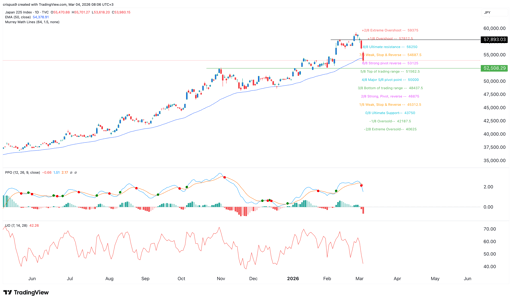
The daily chart reveals that the Nikkei Index has dropped sharply in the past few days, falling from the all-time high of ¥59,200 to the current ¥54,000.
The two lines of the Percentage Price Oscillator (PPO) have formed a bearish crossover, a sign that bears remain in control. Also, the Ultimate Oscillator has continued falling and is hovering at its lowest level since December last year.
The index has dropped below the 50-day Exponential Moving Average (EMA) and is now hovering at the strong pivot reverse point of the Murrey Math Lines tool.
Therefore, the most likely scenario is where the stock continues falling, potentially to the Major S&R pivot point at ¥50,000. It will then bounce back later this month as concerns about the war ends.



Comments
Log in or sign up to join the conversation.