


Nike Stock (NKE) is scheduled to leave the S&P 100 before the U.S. market opens on September 21, 2026, as part of the index’s quarterly rebalance. The company will remain a constituent of the broader S&P 500, according to S&P Dow Jones Indices. The change is an index reclassification rather than a delisting.
Nike’s removal from the S&P 100 does not remove the company from the broader large-cap benchmark. Instead, it reflects the company’s position in a rebalance that will also bring Dell Technologies (DELL), Palo Alto Networks (PANW), Arista Networks (ANET) and SanDisk (SNDK) into the index.
Crypto Expert: What is The Best Meme Coin To Buy and Forget Until The Next Bull Run?
Nike Stock: A Reclassification, Not a Verdict on the Business
Nike’s departure from the S&P 100 follows a substantial decline in its market value. Shares closed at $38.40 on September 4, valuing the sportswear group at about $57 billion. That valuation was roughly 80% below a November 2021 high of around $281 billion, representing a decline of more than $220 billion in market value.
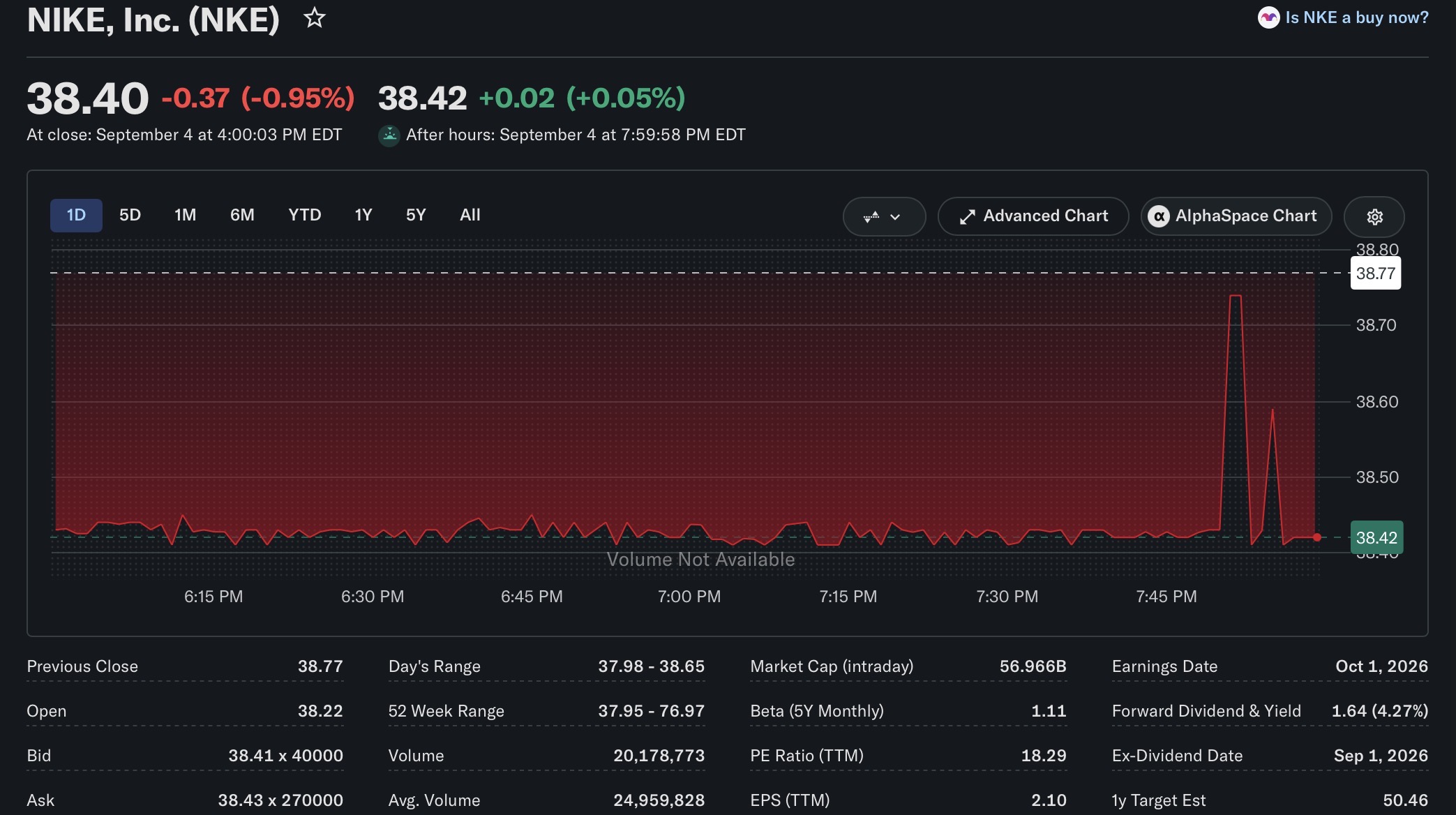
Nike Stock Price Yahoo Finance
Nike had been an S&P 100 constituent for almost 18 years before the scheduled rebalance. Honeywell Aerospace (HON), Simon Property Group (SPG), and Colgate-Palmolive (CL) are also set to leave the index, while Nike will continue to be included in the S&P 500. The announcement, therefore, provides a market-value snapshot at a particular point in the company’s recovery effort, rather than a determination of whether its shares can continue trading or whether it remains part of the S&P 500.
Why the Mechanical Impact Should Stay Contained
The immediate practical issue for Nike stock is the scheduled index change itself. S&P Dow Jones Indices said Nike will be removed from the S&P 100 before the market opens on September 21, alongside the other changes in the quarterly rebalance. Investors following the company can separate that calendar event from Nike’s continuing membership in the S&P 500.
The available information does not change Nike’s reported operating results or its stated business priorities. Fiscal 2026 revenue was $46.4 billion, essentially flat from the previous year and down 2% on a currency-neutral basis. Nike Direct revenue fell 6%, Nike Brand Digital revenue declined 12%, and Converse revenue dropped 31%, while wholesale revenue rose 6% on a reported basis.
The Real Signal Is About Rank, Not Rules
The decline came as Nike faced pressure across its business. Greater China revenue fell 11% (13% currency-neutral) to $5.85 billion, with footwear down 15%, Nike Direct down 12%, and digital sales down 29% on a currency-neutral basis.
Nike cited declining store traffic, heavy promotions, and excess inventory as key drags, and is working to clear inventory with retail partners while repositioning Nike Brand Digital as full-price, reinvesting in wholesale, and pushing product innovation.
The company also faces a more fragmented market, with On and Hoka gaining in performance running and China’s Anta and Li-Ning strengthening locally. CEO Elliott Hill, who returned in October 2024, is focused on product, wholesale relationships, and demand. Nike expects Greater China and Converse pressures to persist through fiscal 2027.

Photo by Stanislav Kondratiev on Pexels
For investors, the S&P 100 change is therefore best viewed alongside those operational measures and financial results. Nike’s continued S&P 500 membership remains unchanged, while its future market value will depend on how its recovery efforts develop.



Comments
Log in or sign up to join the conversation.