

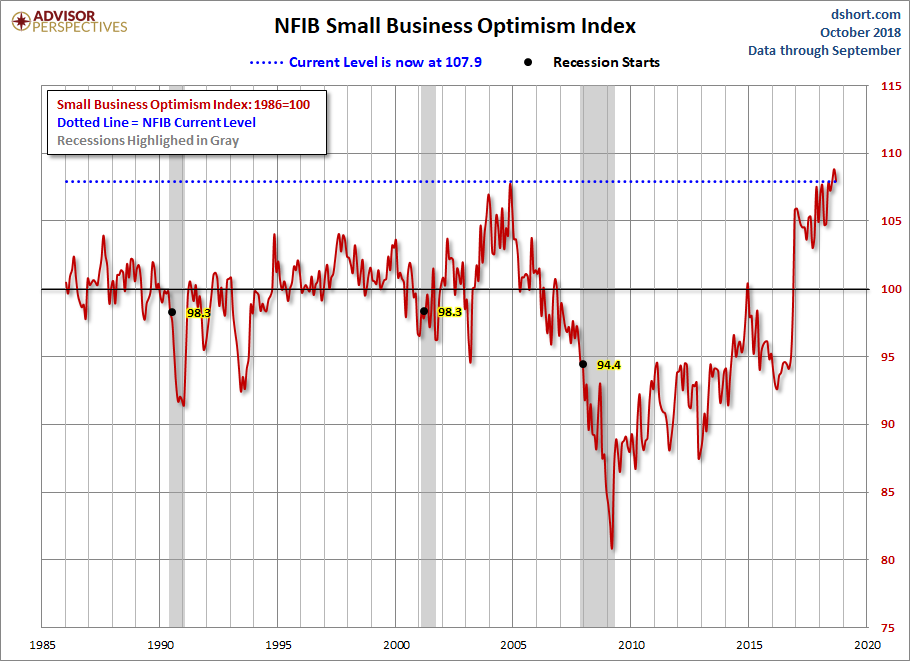
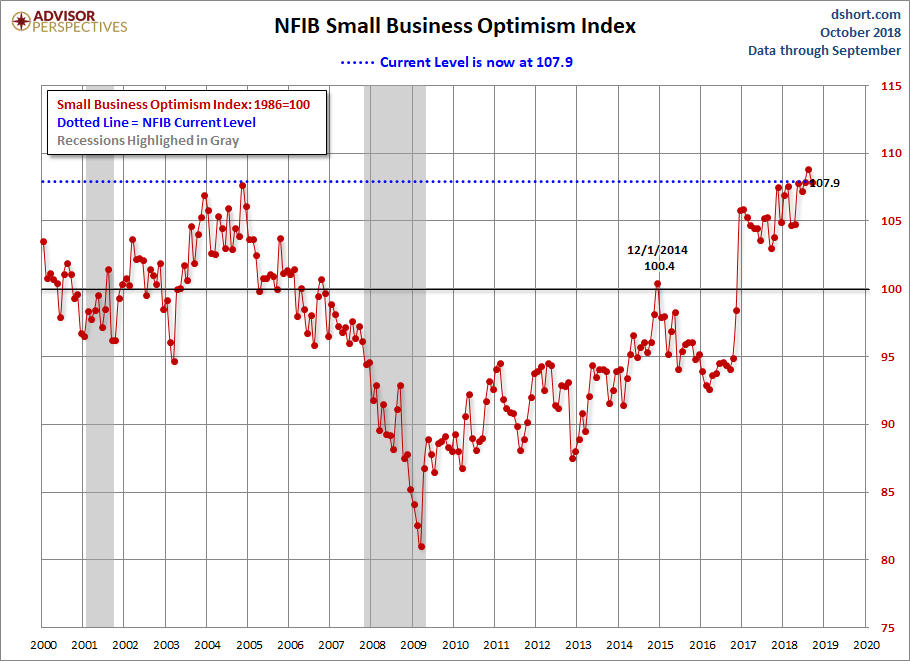
The latest issue of the NFIB Small Business Economic Trends came out this morning. The headline number for September came in at 107.9, down 0.9 from the previous month. The index is at the 99th percentile in this series. Today's number came in below the Investing.com forecast of 108.9.
Here is an excerpt from the opening summary of the news release.
A record net 37 percent of owners reported raising overall compensation in hopes of hiring and retaining employees in the tight labor market, according to NFIB’s monthly jobs report, released today. This surpasses the previous record of a net 35 percent in May 2018. The competition for qualified workers is pushing up compensation as there are more job openings than job seekers.
“There is extraordinary competition for workers in this historically tight labor market. Small business owners are investing more in their employees to attract and keep qualified workers,” said NFIB President and CEO Juanita D. Duggan. “Thanks to the recent tax cuts and regulatory reforms, owners are able and comfortable investing more in their employees and businesses which further strengthens the economy.”
The first chart below highlights the 1986 baseline level of 100 and includes some labels to help us visualize that dramatic change in small-business sentiment that accompanied the Great Financial Crisis. Compare, for example, the relative resilience of the index during the 2000-2003 collapse of the Tech Bubble with the far weaker readings following the Great Recession that ended in June 2009.
Here is a closer look at the indicator since the turn of the century. We are just below the all-time high.
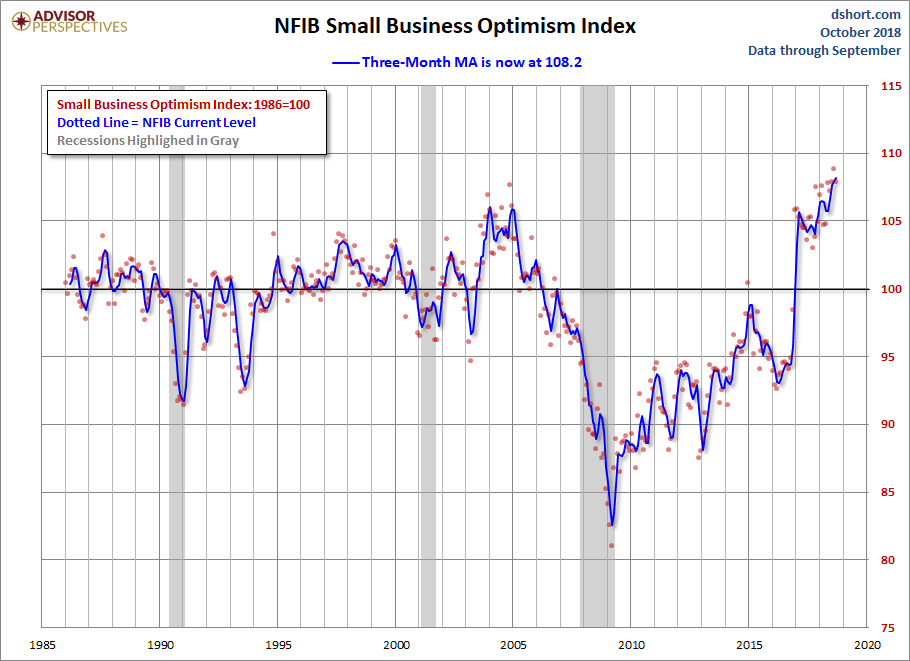
The average monthly change in this indicator is 3.0 points. To smooth out the noise of volatility, here is a 3-month moving average of the Optimism Index along with the monthly values, shown as dots.
Here are some excerpts from the report.
Labor Markets
Job creation picked up again in September, rising to a net addition of 0.15 workers per firm (including those making no change in employment).
Inflation
How effective has the Fed's monetary policy been in lifting inflation to it two percent target rate?
The net percent of owners raising average selling prices dropped 2 points to a net 15 percent seasonally adjusted. Thirty-one percent of the construction firms reported raising prices (4 percent reduced) while 42 percent of the firms in agriculture report lower average prices (16 percent raised).
Credit Markets
Has the Fed's zero interest rate policy and quantitative easing had a positive impact on Small Businesses?
Three percent of owners reported that all their borrowing needs were not satisfied, unchanged and just 1 point above the record low. Twenty-seven percent reported all credit needs met (down 6 points) and 53 percent said they were not interested in a loan, up 2 points.
NFIB Commentary
This month's "Commentary" section includes the following observations and opinions:
The economy is growing faster than our ability to support that growth without inflation or significant productivity gains. Many analysts observe that with the labor force growing about 0.7 percent a year and output per worker (productivity) growing about 1.5 percent per year (at best), it is hard to support demand growth in excess of about 2 percent (the sum of the two which measures our growth in the capacity to produce output). So, with growth running at 3 percent and higher, this presents issues in the future. A good example of this is the impact of the shortage of labor on our ability to grow and produce more stuff. Of course, there are changes that can neutralize some of these problems including higher labor force participation rate induced by higher compensation, labor saving technology, new scientific breakthroughs, and the like. Hopefully policymakers won’t screw around with success.
Business Optimism and Consumer Confidence
The next chart is an overlay of the Business Optimism Index and the Conference Board Consumer Confidence Index. The consumer measure is the more volatile of the two, so it is plotted on a separate axis to give a better comparison of the two series from the common baseline of 100.
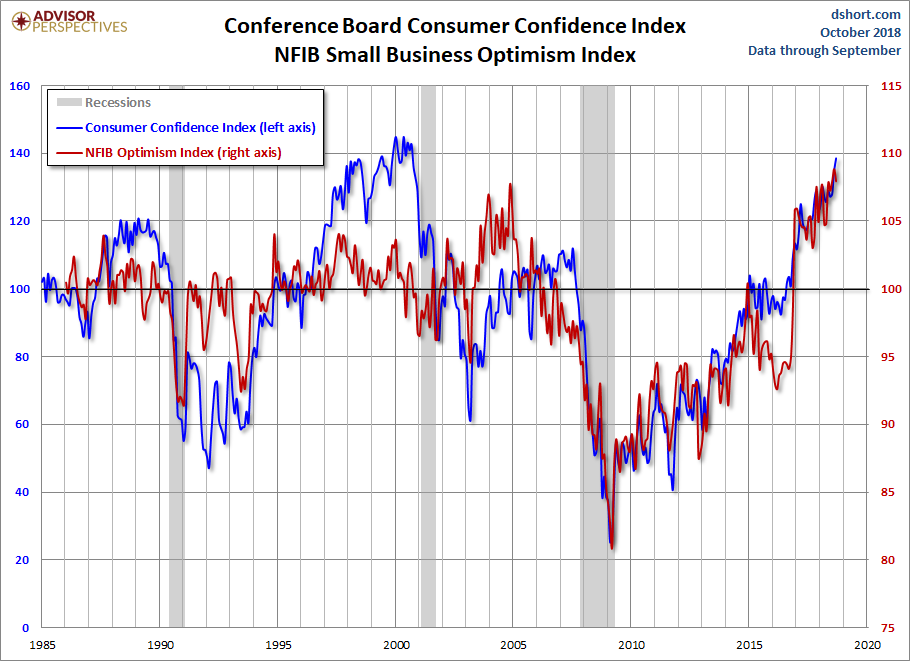
These two measures of mood have been highly correlated since the early days of the Great Recession. The two diverged after their previous interim peaks, but have recently resumed their correlation. A decline in Small Business Sentiment was a long leading indicator for the last two recessions.

Comments
Log in or sign up to join the conversation.