

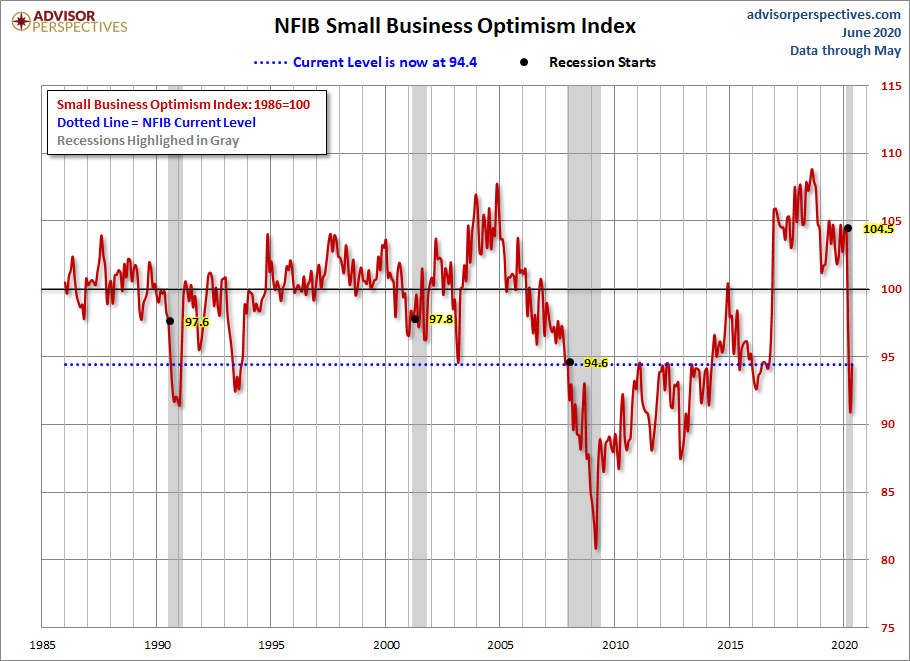
The latest issue of the NFIB Small Business Economic Trends came out this morning. The headline number for May came in at 94.4, up 3.5 from the previous month. The index is at the 22nd percentile in this series.
Here is an excerpt from the opening summary of the news release.
The Small Business Optimism Index increased 3.5 points in May to 94.4, a strong improvement from April’s 90.9 reading. Eight of the 10 Index components improved in May and two declined. The NFIB Uncertainty Index increased seven points to 82. Reports of expected business conditions in the next six months increased 5 points to a net 34%, following a 24-point increase in April. Owners are optimistic about future business conditions and expect the recession to be short-lived.
“As states begin to reopen, small businesses continue to navigate the economic landscape rocked by COVID-19 and new government policies,” said NFIB’s Chief Economist Bill Dunkelberg. “It’s still uncertain when consumers will feel comfortable returning to small businesses and begin spending again, but owners are taking the necessary precautions to reopen safely.”
The first chart below highlights the 1986 baseline level of 100 and includes some labels to help us visualize that dramatic change in small-business sentiment that accompanied the Great Financial Crisis and now the COVID-19 pandemic. Compare, for example, the relative resilience of the index during the 2000-2003 collapse of the Tech Bubble with the far weaker readings following the Great Recession that ended in June 2009 and today's figures.
Here is a closer look at the indicator since the turn of the century.
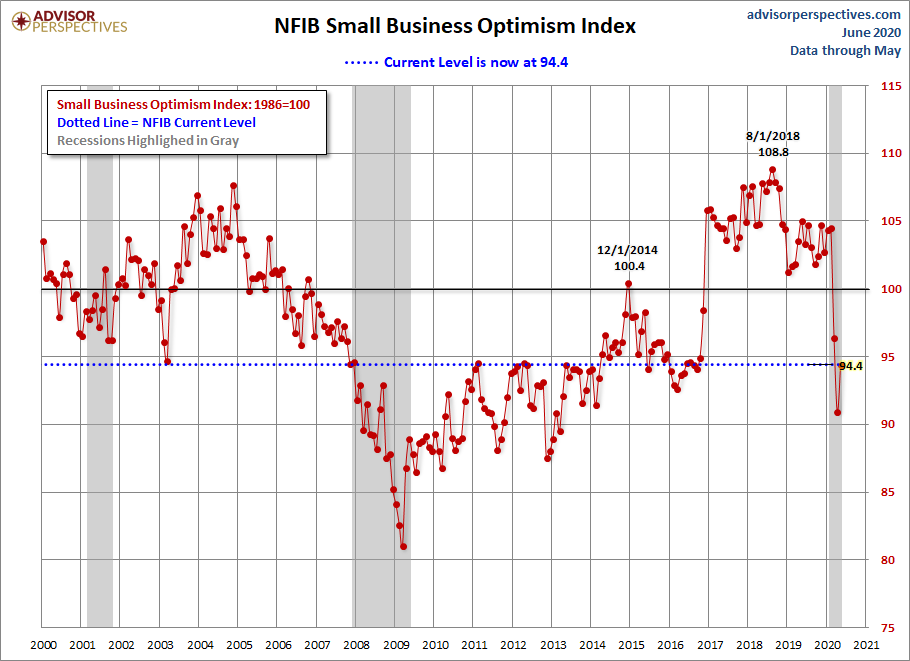
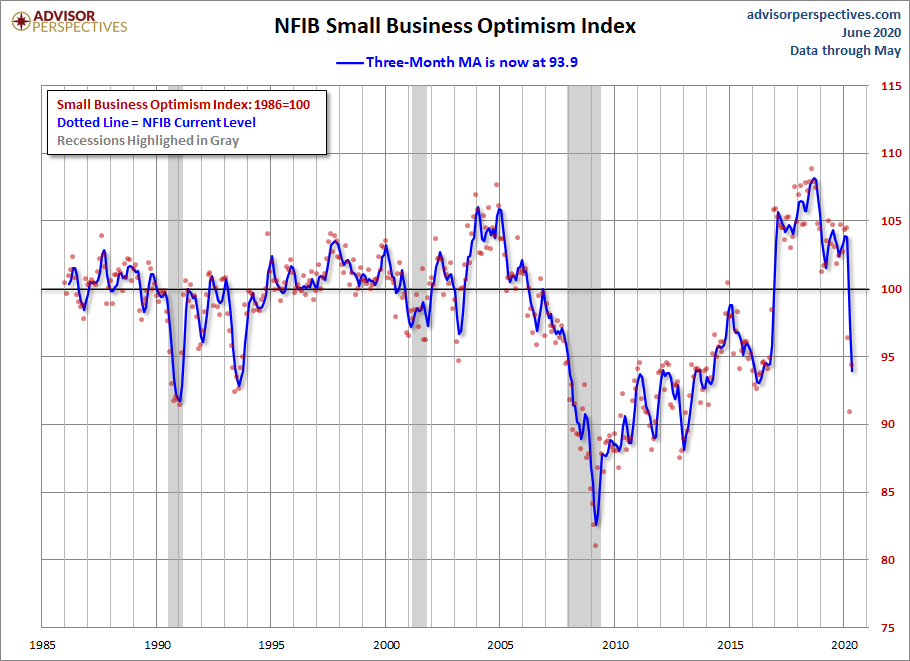
The average monthly change in this indicator is 1.3 points. To smooth out the noise of volatility, here is a 3-month moving average of the Optimism Index along with the monthly values, shown as dots.
NFIB Commentary
This month's "Commentary" section includes the following observations and opinions:
The economic landscape is in turmoil, rocked by government policies to fight Covid-19, dramatic changes in Federal Reserve policies, the behavior of financial markets, government policies to stimulate the economy, and widespread protests expressing overwhelming public concerns.
Policies to curb the spread of Covid-19 also curbed the growth in retail sales which in April alone fell 16 percent. Policies to support spending produced a major surge in personal income which collided with the anti-Covid-19 policies. Unable to easily spend the money, consumers “saved” it (including debt reduction), producing a savings rate of 33 percent, a historic record.
This “pot” of money will find its way into the economy, but the pace at which it does will depend on how quickly the economy is reopened, which depends on the decisions of at least 50 levels of government and reports about the incidence of new Covid-19 cases. Consumers will have to feel safe about emerging from lockdown in order to spend the money which, in turn, will shape the pace of the recovery in employment.
More stimulus? Likely if the recovery in employment lags. There is plenty of pent-up demand. If conditions are favorable, that will provide lots of stimulus to the private sector. The Fed will maintain its current posture, leaving interest rates historically low and liquidity strong. The stock market is “optimistic.”There are a huge number of policies and regulations that will determine how the economy does, lots of uncertainty, but likely “upward” and small businesses are eager to get back to work.
Business Optimism and Consumer Confidence
The next chart is an overlay of the Business Optimism Index and the Conference Board Consumer Confidence Index. The consumer measure is the more volatile of the two, so it is plotted on a separate axis to give a better comparison of the two series from the common baseline of 100.
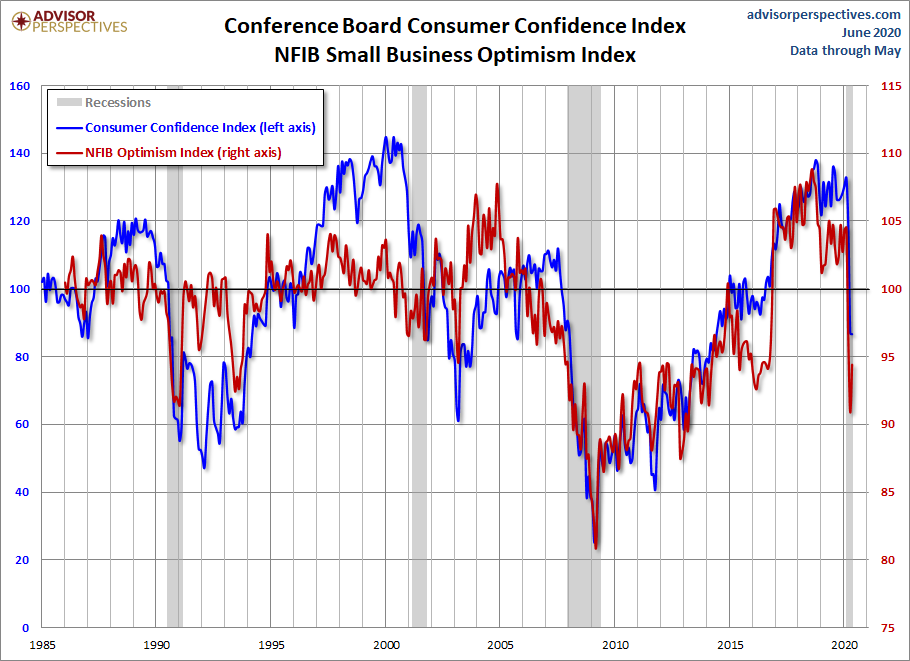
These two measures of mood have been highly correlated since the early days of the Great Recession. The two diverged after their previous interim peaks, but have recently resumed their correlation. A decline in Small Business Sentiment was a long leading indicator for the last two recessions.

Comments
Log in or sign up to join the conversation.