

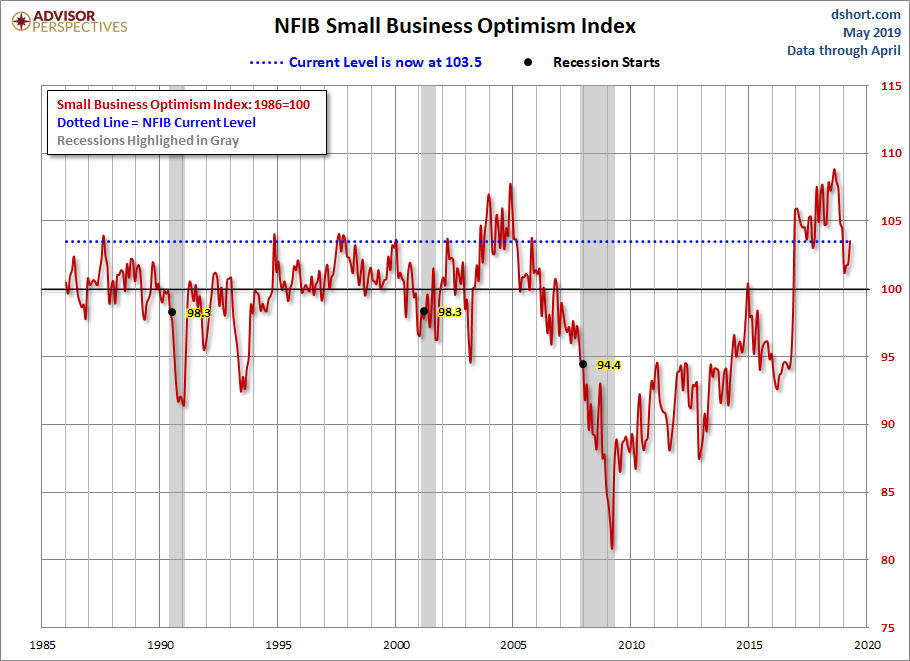
The latest issue of the NFIB Small Business Economic Trends came out this morning. The headline number for April came in at 103.5, up 1.7 from the previous month. The index is at the 88th percentile in this series. Today's number came in above the Investing.com forecast of 102.3.
Here is an excerpt from the opening summary of the news release.
Optimism among small business owners continued its steady climb in April, with the NFIB Small Business Optimism Index increasing 1.7 points to 103.5. Sales improved in April, the inventory soft spot seen in last month’s report rebounded, and profit trends posted a very solid advance. Job creation plans gained, hiring remained strong, and expectations for sales, business conditions, and credit conditions all improved.
“America’s small and independent businesses are rebounding from the first quarter ‘shut down, slow down’ and don’t appear to be looking back. April’s Index is further evidence that when certainty and stability increase, so do optimism and action,” said NFIB President and CEO Juanita D. Duggan. “The continued economic boom is thanks, in a major way, to strong growth in the small business half of the economy.”
The first chart below highlights the 1986 baseline level of 100 and includes some labels to help us visualize that dramatic change in small-business sentiment that accompanied the Great Financial Crisis. Compare, for example, the relative resilience of the index during the 2000-2003 collapse of the Tech Bubble with the far weaker readings following the Great Recession that ended in June 2009.
Here is a closer look at the indicator since the turn of the century.
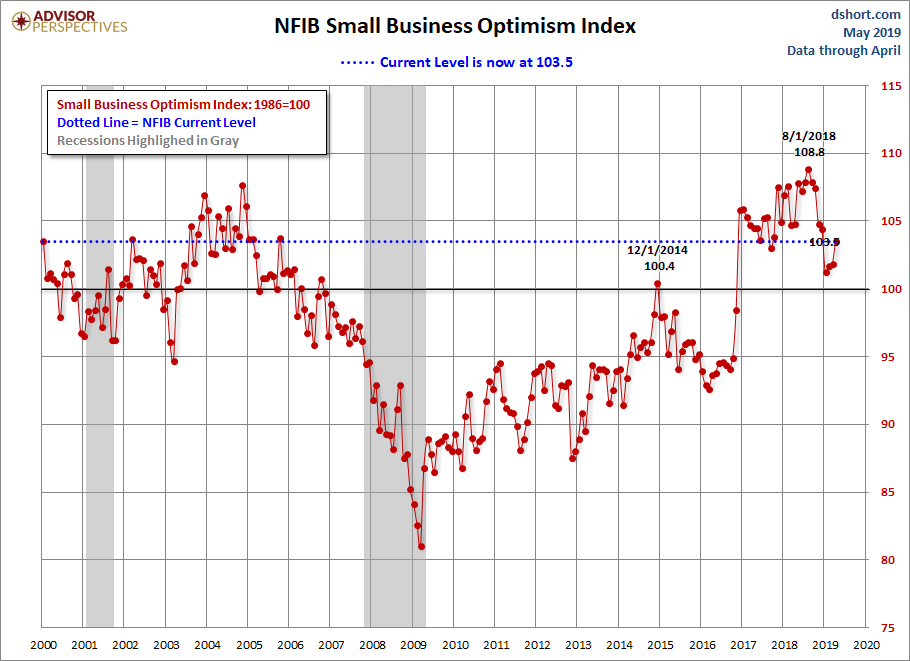
The average monthly change in this indicator is 1.3 points. To smooth out the noise of volatility, here is a 3-month moving average of the Optimism Index along with the monthly values, shown as dots.

Here are some excerpts from the report.
Labor Markets
More new jobs were created in April, although at a slower pace than in the last quarter, with a net addition of 0.32 workers per firm. Twelve percent (unchanged) reported increasing employment an average of 3.0 workers per firm and 5 percent (up 4 points) reported reducing employment an average of 2.9 workers per firm (seasonally adjusted).
Inflation
How effective has the Fed's monetary policy been in lifting inflation to its two percent target rate?
The net percent of owners raising average selling prices rose 1 point to a net 13 percent, seasonally adjusted. Unadjusted, 11 percent (up 1 point) reported lower average selling prices and 24 percent (down 3 points) reported higher average prices.
Credit Markets
Has the Fed's zero interest rate policy and quantitative easing had a positive impact on Small Businesses?
Four percent of owners reported that all their borrowing needs were not satisfied, up 1 point and historically very low.
NFIB Commentary
This month's "Commentary" section includes the following observations and opinions:
The strength in hiring plans and the record-high levels of job openings is a positive indicator for economic growth. We are at full employment and labor supply is a headwind to growth. Hiring a worker is an investment, involving training time and substantial training costs, which raise worker productivity but uses valuable firm resources, cash, and time. The wide-spread willingness of owners to increase employment indicates that they see an economy that will be solid enough to deliver a return on their investment in labor as well as new capital.
Financial markets, however, are displaying a lot of volatility, responding to “rumors” about the Federal Reserve and more tariffs. This volatility creates a lot of noise in analyzing U.S. economy but is disconnected from the strong small business sector.
Business Optimism and Consumer Confidence
The next chart is an overlay of the Business Optimism Index and the Conference Board Consumer Confidence Index. The consumer measure is the more volatile of the two, so it is plotted on a separate axis to give a better comparison of the two series from the common baseline of 100.

These two measures of mood have been highly correlated since the early days of the Great Recession. The two diverged after their previous interim peaks, but have recently resumed their correlation. A decline in Small Business Sentiment was a long leading indicator for the last two recessions.

Comments
Log in or sign up to join the conversation.