

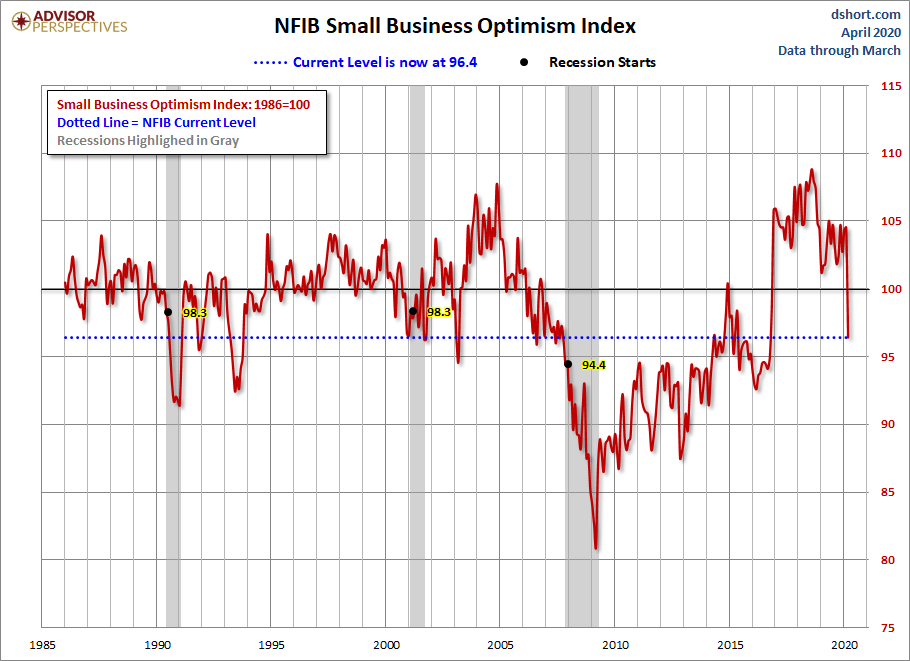
The latest issue of the NFIB Small Business Economic Trends came out this morning. The headline number for March came in at 96.4, down 8.1 from the previous month. The index is at the 30th percentile in this series.
Here is an excerpt from the opening summary of the news release.
The NFIB Small Business Optimism Index fell 8.1 points in March to 96.4, the largest monthly decline in the survey’s history. Nine of the 10 Index components declined, which is evidence that economic disruptions are escalating on Main Street as small businesses struggle to keep their doors open. The small business sector is anticipating and bracing for continued economic disruptions going forward.
“Small businesses are living through the coronavirus pandemic right now and it’s hard to say what the severity of the disruption will be, but we do know they’re feeling the urgency,” said NFIB Chief Economist William Dunkelberg. “It is vital that these businesses have access to federal funds that are made available through the CARES Act to keep the doors open on Main Street.”
The financial markets saw substantial change in March, with the stock market indices losing 22% of their value and jobless claims rising to a record 10 million in the last two weeks of the month. The NFIB survey collected the majority of responses in the first half of the month, so the sharp decline in employment is not reflected in the March survey data.
The first chart below highlights the 1986 baseline level of 100 and includes some labels to help us visualize that dramatic change in small-business sentiment that accompanied the Great Financial Crisis. Compare, for example, the relative resilience of the index during the 2000-2003 collapse of the Tech Bubble with the far weaker readings following the Great Recession that ended in June 2009.
Here is a closer look at the indicator since the turn of the century.
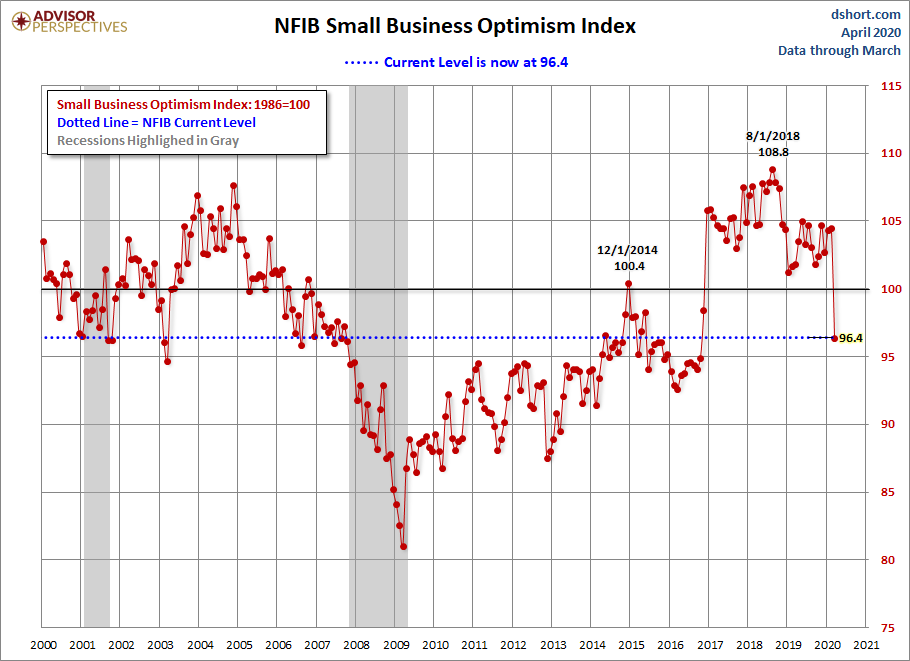
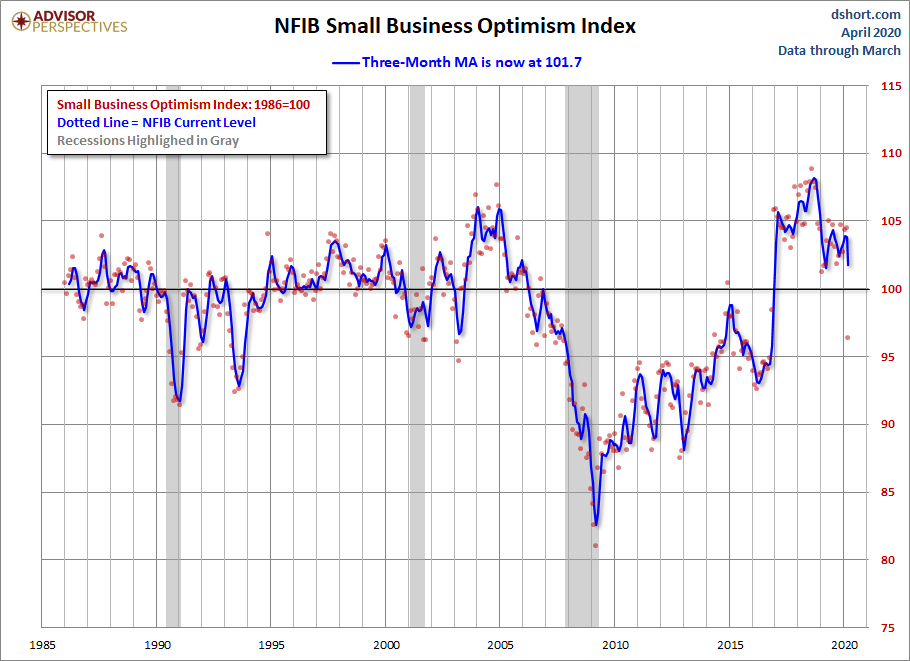
The average monthly change in this indicator is 1.3 points. To smooth out the noise of volatility, here is a 3-month moving average of the Optimism Index along with the monthly values, shown as dots.
Here are some excerpts from the report.
Labor Markets
As the COVID-19 outbreak started to escalate, the small business labor market generally held steady in March with strong hiring, elevated levels of open positions, and historically high employee compensation. However, hiring plans had a significant drop from February –a signal of a strong downturn in future months.
Inflation
How effective has the Fed's monetary policy been in lifting inflation to its two percent target rate?
The net percent of owners raising average selling prices fell 5 points to a net 6 percent, seasonally adjusted. Unadjusted, 13 percent (up 3 points) reported lower average selling prices and 21 percent (unchanged) reported higher average prices.
Credit Markets
Has the Fed's zero interest rate policy and quantitative easing had a positive impact on Small Businesses?
Three percent of owners reported that all their borrowing needs were not satisfied, up 1 point. Twenty-nine percent reported all credit needs met (down 3 points) and 55 percent said they were not interested in a loan (unchanged). A net 4 percent reported their last loan was harder to get than in previous attempts, up 3 points.
NFIB Commentary
This month's "Commentary" section includes the following observations and opinions:
The COVID-19 outbreak and regulatory responses to curtail its spread shook the small business sector in March. Small business owners’ outlook is bleak as they wrestle to adjust quickly to rapidly changing economic conditions. Many owners have had to close their doors and others are scaling back operations dramatically.
NFIB released the results of three COVID-19 related surveys evaluating the outbreaks impact on small businesses throughout the month of March. The vast majority ofsmall businesses are now impacted by the COVID-19 outbreak, and owners are taking the threat to their business seriously. Many owners have already sought out financial help and more are planning to do so in the near future. The outbreak has left few, if any, owners unscathed. The economic impact is immense, and now, the questions are how long will it last and how quickly can the small business sector recover once on the other side.
Business Optimism and Consumer Confidence
The next chart is an overlay of the Business Optimism Index and the Conference Board Consumer Confidence Index. The consumer measure is the more volatile of the two, so it is plotted on a separate axis to give a better comparison of the two series from the common baseline of 100.
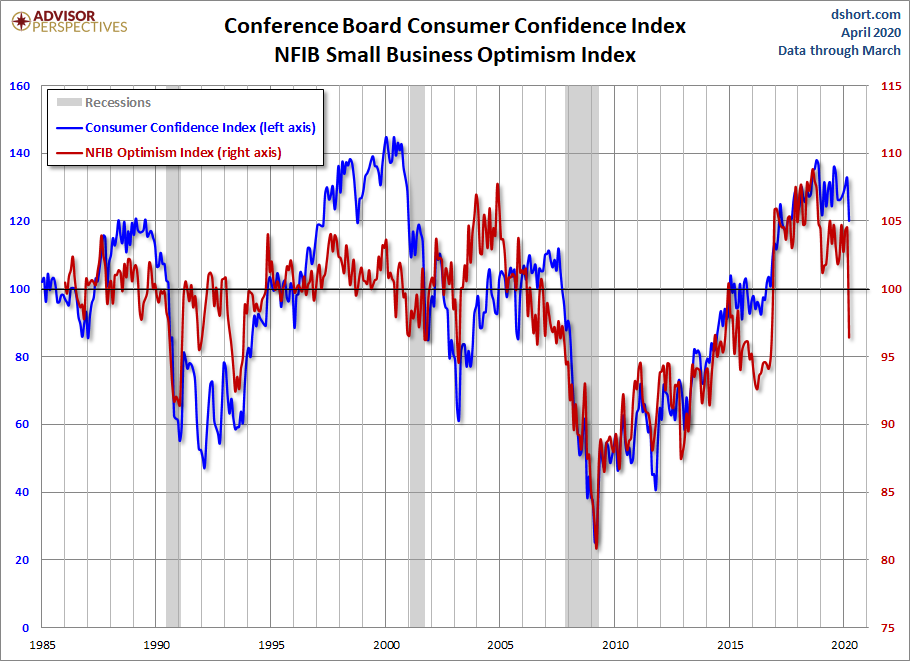
These two measures of mood have been highly correlated since the early days of the Great Recession. The two diverged after their previous interim peaks, but have recently resumed their correlation. A decline in Small Business Sentiment was a long leading indicator for the last two recessions.

Comments
Log in or sign up to join the conversation.