

The latest issue of the NFIB Small Business Economic Trends is out today. The update for November came in at 94.8, down 1.3 from the previous month's 96.1. The index has dropped to the 25th percentile in this series.
Today's number came in below the Investing.com forecast of an increase to 96.6.
Here is an excerpt from the opening summary of the news release.
"During this holiday season, small business owners are finding little to be hopeful or optimistic about including the economy in the New Year. This month’s Index continues to signal a lackluster economy and shows that the small business sector has no expansion energy whatsoever." — Bill Dunkelberg, NFIB Chief Economist
The first chart below highlights the 1986 baseline level of 100 and includes some labels to help us visualize that dramatic change in small-business sentiment that accompanied the Great Financial Crisis. Compare, for example the relative resilience of the index during the 2000-2003 collapse of the Tech Bubble with the far weaker readings following the Great Recession that ended in June 2009.

The average monthly change in this indicator is 1.3 points. To smooth out the noise of volatility, here is a 3-month moving average of the Optimism Index along with the monthly values, shown as dots.

Here are some excerpts from the report.
Labor Markets
Fifty-five percent reported hiring or trying to hire (unchanged), but 47 percent reported few or no qualified applicants for the positions they were trying to fill. Sixteen percent reported using temporary workers, up 2 points. Twenty-seven percent of all owners reported job openings they could not fill in the current period, unchanged over the past 2 months. This is a solid reading historically and suggests no significant change in the unemployment rate.
Inflation
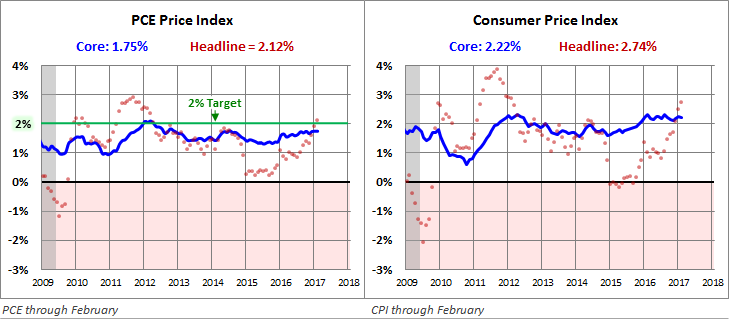
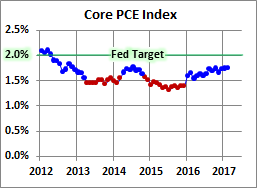
How effective has the Fed's monetary policy been in lifting inflation to it two percent target rate?
Seasonally adjusted, the net percent of owners raising selling prices was 3 percent, up 1 point from October. This is bad news for the Federal Reserve which is trying to stoke the flames of inflation, while for consumers, the news is good. Twenty-three percent plan on raising average prices in the next few months (up 6 points). percent plan reductions (unchanged), far fewer than actually reported reductions in past prices. Seasonally adjusted, a net 17 percent plan price hikes (up 3 points). If history repeats, this will be offset by unplanned reductions in selling prices.
Credit Markets
Has the Fed's zero interest rate policy and quantitative easing had a positive impact on Small Businesses?
Three percent of owners reported that all their borrowing needs were not satisfied, 1 point above the record low reached in September. Thirty-two percent reported all credit needs met (up 2 points), and 52 percent explicitly said they did not want a loan. Only 2 percent reported that financing was their top business problem.
NFIB Commentary
This month's "Commentary" section includes the following observations:
In this “Season of Hope”, small business owners are finding little to be hopeful or optimistic about including the economy in the New Year. Society is showing stress fractures all around, on college campuses, mass shootings, terrorist attacks, major cities and their police forces, scandals and incompetence rampant in D.C., a Justice Department politicized, a political IRS and EPA running roughshod over individual rights and personal freedom, a Fed that can’t make up its mind about 0 interest rates “for too long”, a Congress that can’t seem to stay in the “power ring” with the President for a round, a President who thinks that our most important problem and threat is climate change (formally known as global warming) and is willing to punish the current economy for inconsequential benefits in the future just to set an example for the world (right!). It feels like we are starting to “lose it”, to dissemble.
Business Optimism and Consumer Confidence
The next chart is an overlay of the Business Optimism Index and the Conference Board Consumer Confidence Index. The consumer measure is the more volatile of the two, so it is plotted on a separate axis to give a better comparison of the volatility from the common baseline of 100.

These two measures of mood have been highly correlated since the early days of the Great Recession.
Comments
Log in or sign up to join the conversation.