

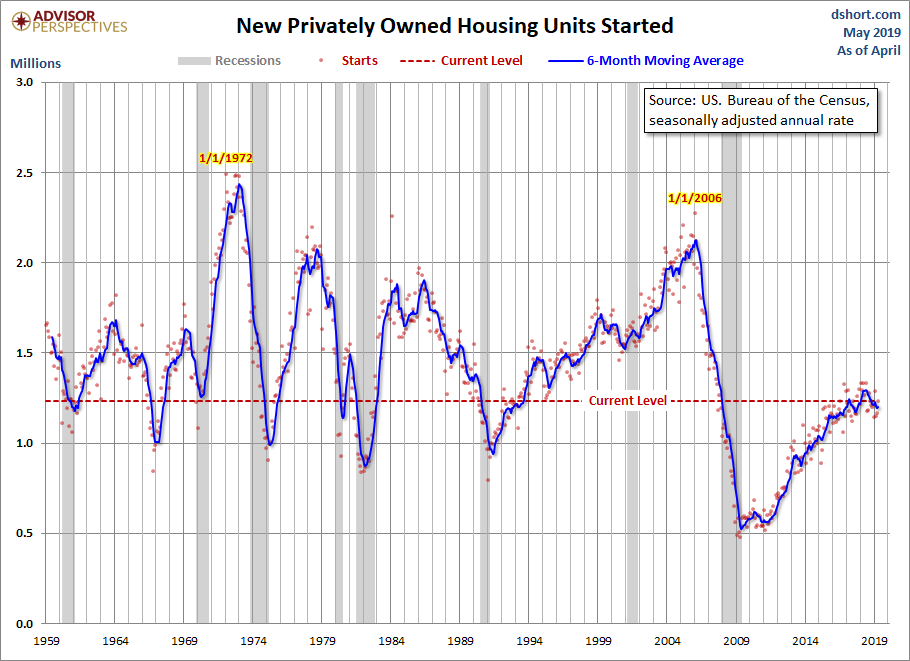
The U.S. Census Bureau and the Department of Housing and Urban Development have now published their findings for April new residential housing starts. The latest reading of 1.235M was slightly below the Investing.com forecast of 1.205M and an increase from the previous month's revised 1.168M.
Here is the opening of this morning's monthly report, including a note on revisions:
Housing Starts
With this release, seasonally adjusted estimates of housing units authorized but not started, started, under construction, and completed have been revised back to January 2014. All revised estimates are available on our website.
Privately‐owned housing starts in April were at a seasonally adjusted annual rate of 1,235,000. This is 5.7 percent (±13.0 percent)* above the revised March estimate of 1,168,000, but is 2.5 percent (±10.4 percent)* below the April 2018 rate of 1,267,000. Single‐family housing starts in April were at a rate of 854,000; this is 6.2 percent (±13.7 percent)* above the revised March figure of 804,000. The April rate for units in buildings with five units or more was 359,000. [link to report]
Here is the historical series for total privately-owned housing starts, which dates from 1959. Because of the extreme volatility of the monthly data points, a 6-month moving average has been included.
The Population-Adjusted Reality
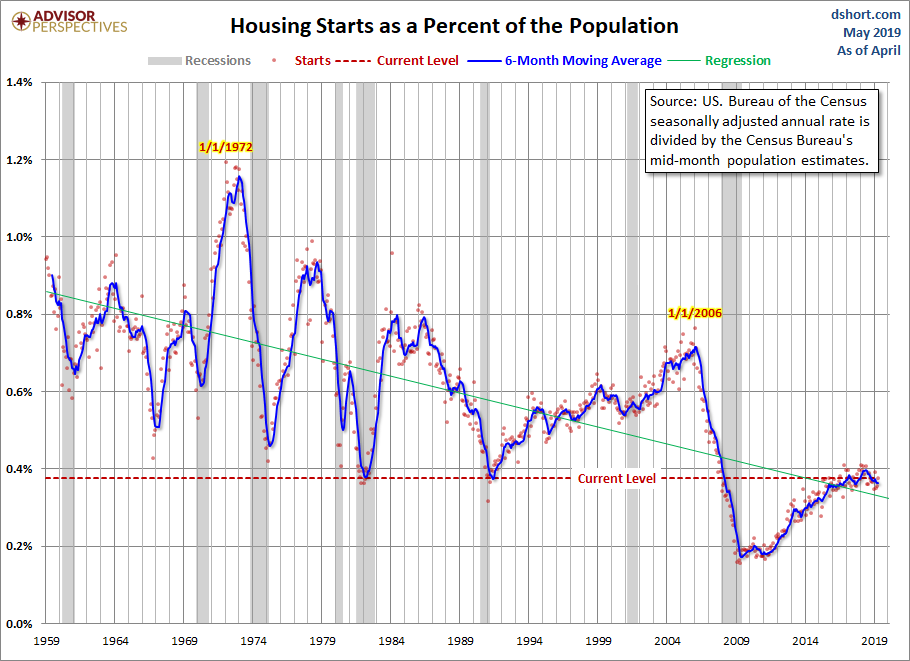
Here is the data with a simple population adjustment. The Census Bureau's mid-month population estimates show substantial growth in the US population since 1959. Here is a chart of housing starts as a percent of the population. We've added a linear regression through the monthly data to highlight the trend.
A Footnote on Volatility
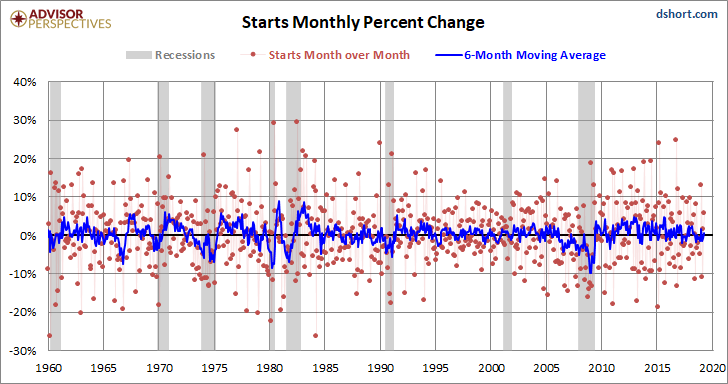
The extreme volatility of this monthly indicator is the rationale for paying more attention to its 6-month moving average than to its noisy monthly change. Over the complete data series, the absolute MoM average percent change is 6.3%. The MoM range minimum is -26.4% and the maximum is 29.3%.
For visual confirmation of the volatility, here is a snapshot of the monthly percent change since 1990.

Comments
Log in or sign up to join the conversation.