

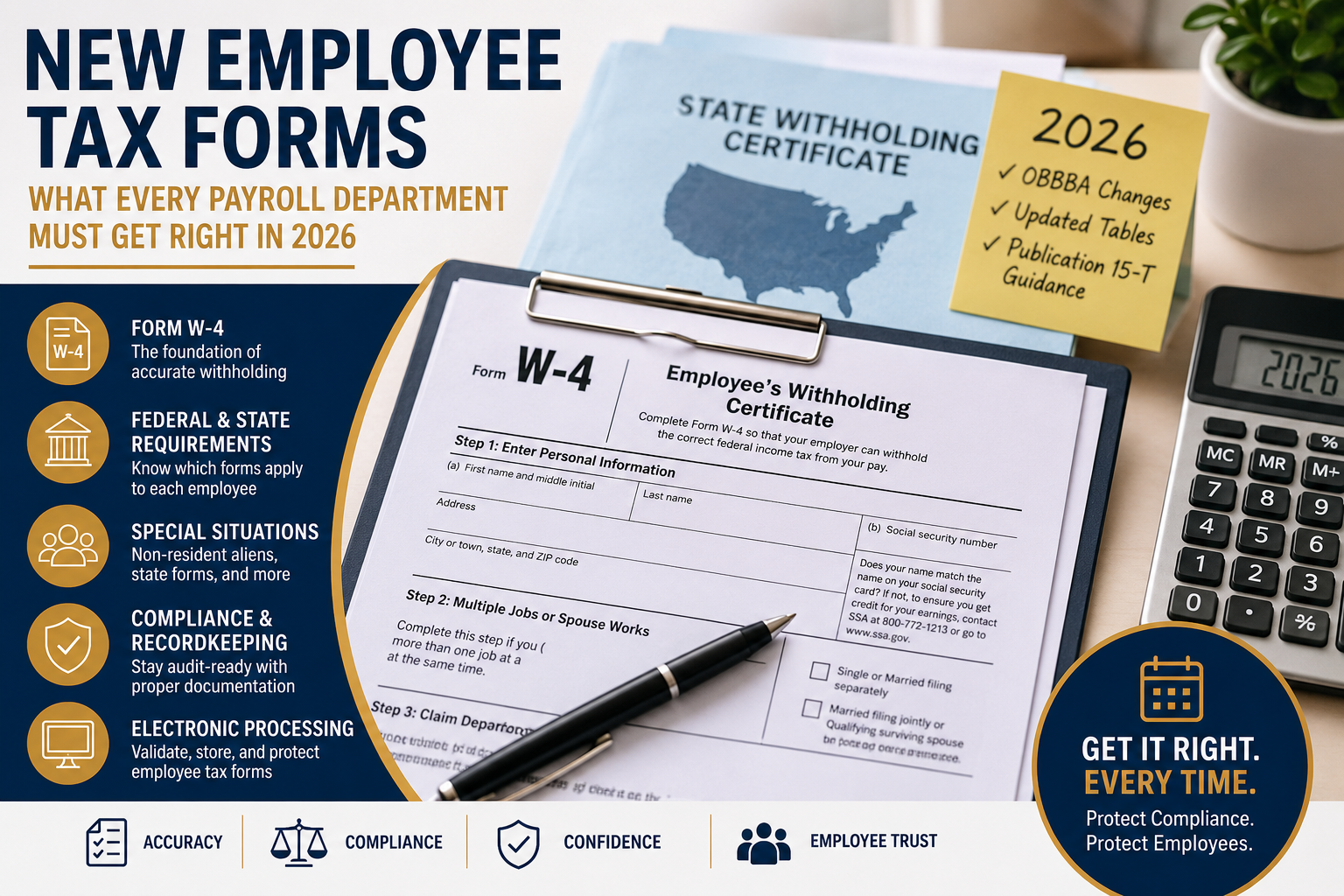
Onboarding a new hire always comes with a stack of paperwork, but few documents carry as much weight as the tax forms that determine how much money comes out of that employee's very first paycheck. Among the new employee tax forms every payroll and HR professional handles, the Form W-4 sits at the center. Get it wrong, and the consequences ripple far beyond a single pay period — from under-withholding penalties to frustrated employees and costly corrections down the road.
Why New Employee Tax Forms Matter So Much
The Form W-4 isn't just paperwork — it's the legal foundation for taxing an employee's wages. It's a required IRS document, and payroll teams process questions about it almost daily. Is the form valid? Did the employee complete Step 4? Did they check the box on Line 2c? Each of these small details changes how withholding is calculated, and a single overlooked checkbox can mean an employee is significantly over- or under-withheld for months.
Beyond the federal form, many states now require their own version of the withholding certificate and no longer accept the federal W-4 as a substitute. That means payroll professionals handling new employee tax forms must track two sets of rules simultaneously — federal and state — and know exactly which one applies to which employee.
What's New for 2026
The 2026 version of the Form W-4 brings fresh wording changes tied to the One Big Beautiful Bill Act (OBBBA), along with updated withholding tables. Payroll professionals need to understand not just the new form itself, but how to apply the guidance in IRS Publication 15-T, which lays out the employer instructions for calculating withholding correctly.
This creates a layered challenge for anyone processing new employee tax forms in 2026:
Learning the redesigned W-4 and its updated tables
Applying Publication 15-T's employer instructions accurately
Calculating withholding using both current and prior-year W-4 versions, since not every employee submits a new form each year
Adjusting for OBBBA-related changes that affect how income is taxed at the withholding stage
Because employees are not required to submit a new W-4 every year, payroll departments often juggle multiple form versions simultaneously — meaning staff must be fluent in calculating withholding under both the new and legacy structures.
Special Situations That Complicate New Employee Tax Forms
Standard W-4 processing is only part of the picture. Payroll teams also have to navigate:
Non-resident alien employees, who follow special withholding instructions that differ from the standard W-4 process and require careful attention to avoid compliance missteps.
State equivalent forms, since a growing number of states have broken away from the federal form entirely and demand their own state-specific withholding certificate.
Record retention requirements, which dictate how long completed forms — federal and state — must be kept on file and accessible in case of an audit.
Electronic processing, as more employers shift away from paper intake toward digital W-4 submission, which introduces its own validation and storage considerations.
Each of these scenarios adds a layer of complexity to what might seem, on the surface, like a routine onboarding task.
Best Practices for Processing New Employee Tax Forms Efficiently
Getting new employee tax forms right isn't just about compliance — it's about protecting the employee experience. A miscalculated withholding can mean a surprise tax bill or a smaller-than-expected paycheck, both of which erode trust in the payroll department and can hurt morale.
To reduce errors and speed up processing, payroll teams should:
Build a checklist for validating W-4 completeness before it's processed, including Step 4 entries and Line 2c elections.
Stay current on Publication 15-T updates each tax year, since withholding tables and instructions can shift.
Maintain a clear reference for which states require their own withholding certificate versus accepting the federal form.
Standardize how prior-year W-4s are handled so calculations stay accurate for employees who haven't submitted an updated form.
Invest in electronic W-4 systems that build in validation rules to catch incomplete submissions before they reach payroll.
The Bottom Line
New employee tax forms, especially the Form W-4, are deceptively simple on the surface but carry real compliance risk underneath. With the 2026 changes tied to the OBBBA and updated Publication 15-T guidance, payroll professionals need more than a passing familiarity with the form — they need a working command of the tables, the instructions, and the exceptions that come with every new hire. Staying current isn't optional; it's the difference between accurate paychecks and costly corrections later.
FAQs
1. What are the most common new employee tax forms payroll needs to collect?
The federal Form W-4 is the core document, but many states also require their own withholding certificate. Employers may need additional forms for non-resident alien employees or state-specific reporting.
2. Do employees have to submit a new W-4 every year?
No. A W-4 stays in effect until the employee submits a new one, which means payroll often processes withholding under multiple form versions at the same time.
3. What changed with the Form W-4 for 2026?
The 2026 form reflects updates tied to the One Big Beautiful Bill Act (OBBBA) and revised IRS Publication 15-T withholding tables that employers must apply correctly.
4. Can employers use the federal W-4 in place of a state withholding form?
Not always. A number of states require their own withholding certificate and don't accept the federal W-4 as a substitute, so payroll teams need to confirm state rules for each employee.
Comments
Log in or sign up to join the conversation.