

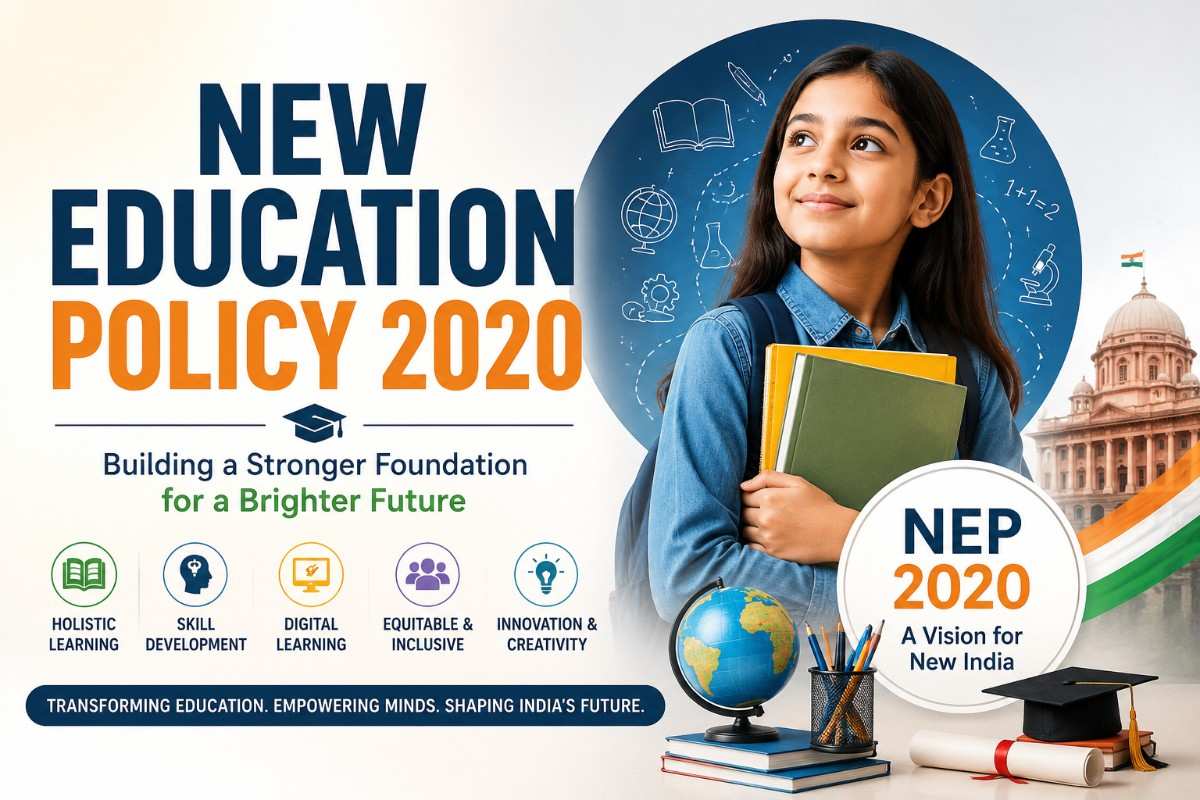
The New Education Policy (NEP) 2020 is one of the most significant reforms in India's education system. Approved by the Government of India on 29 July 2020, it replaces the National Policy on Education of 1986 and aims to make education more flexible, skill-oriented, inclusive, and aligned with the needs of the 21st century. The policy focuses on improving learning outcomes, reducing rote memorization, and preparing students for global opportunities while preserving India's cultural values.
Why Was NEP 2020 Introduced?
The previous education system had remained largely unchanged for decades despite rapid technological and economic changes. Students often faced excessive academic pressure, limited subject choices, and a curriculum focused more on memorization than practical understanding. NEP 2020 was introduced to address these challenges by promoting creativity, innovation, critical thinking, and holistic development.
The policy also aims to improve access to quality education for all students, regardless of their social or economic background, and increase India's Gross Enrolment Ratio (GER) in higher education.
Major Features of NEP 2020
1. New School Structure (5+3+3+4)
One of the biggest changes is replacing the traditional 10+2 system with the 5+3+3+4 structure, based on children's developmental stages.
Foundational Stage (5 years): Preschool and Classes 1–2
Preparatory Stage (3 years): Classes 3–5
Middle Stage (3 years): Classes 6–8
Secondary Stage (4 years): Classes 9–12
This structure ensures age-appropriate learning and gives greater emphasis to early childhood education.
2. Focus on Foundational Literacy and Numeracy
NEP 2020 recognizes that reading, writing, and basic mathematics are essential building blocks for lifelong learning. The government launched initiatives to ensure every child achieves foundational literacy and numeracy in the early years of schooling.
3. Flexible Subject Choices
Students are no longer restricted to choosing only Science, Commerce, or Arts. They can combine subjects based on their interests. For example, a student can study Physics along with Music or Mathematics with Fine Arts, encouraging multidisciplinary learning.
4. Skill-Based and Vocational Education
Vocational education begins from Class 6, including internships and practical exposure. This helps students develop employable skills from an early age and prepares them for future careers.
5. Mother Tongue as Medium of Instruction
The policy recommends that, wherever possible, the medium of instruction should be the mother tongue or regional language at least until Grade 5. Research suggests that children learn concepts more effectively in their first language during their early years.
6. Reduced Exam Pressure
Instead of focusing solely on high-stakes examinations, NEP 2020 encourages continuous assessment, conceptual understanding, and competency-based learning. Board examinations are being redesigned to test application of knowledge rather than memorization.
Higher Education Reforms
The policy introduces several important reforms for colleges and universities.
Students benefit from multiple entry and exit options in undergraduate programs. A student leaving after one year can receive a certificate, after two years a diploma, and after completing the program, a degree. The Academic Bank of Credits allows students to store and transfer academic credits between institutions.
The policy also encourages multidisciplinary universities, promotes research through the National Research Foundation, and aims to increase the Gross Enrolment Ratio in higher education to 50% by 2035.
Digital Learning and Technology
NEP 2020 emphasizes the integration of technology into education. Online learning platforms, digital classrooms, virtual laboratories, and educational technology tools are expected to improve accessibility and learning quality. These initiatives also help bridge educational gaps, especially in remote areas.
Benefits of NEP 2020
The New Education Policy offers several advantages:
Encourages creativity and critical thinking.
Reduces dependence on rote learning.
Provides flexibility in subject selection.
Promotes practical skills and vocational training.
Strengthens early childhood education.
Makes higher education more flexible.
Encourages digital learning and innovation.
Improves employability through skill development.
Supports inclusive and equitable education for all students.
Challenges in Implementation
Although NEP 2020 presents a comprehensive vision, its implementation requires significant investment, teacher training, improved infrastructure, updated curricula, and coordination between central and state governments. Recent assessments also indicate that implementation has been uneven across institutions, with some reforms progressing faster than others.
Conclusion
The New Education Policy 2020 marks a major step toward modernizing India's education system. By emphasizing holistic learning, flexibility, skill development, technology, and multidisciplinary education, it seeks to prepare students for the rapidly evolving global economy. While successful implementation will take time and sustained effort, the policy has the potential to transform the educational landscape and create confident, innovative, and future-ready learners.
Students, parents, and educators can stay informed about educational updates, exam preparation tips, and learning resources by visiting studylab24.com, where valuable academic content is regularly shared.
Comments
Log in or sign up to join the conversation.