

Netflix (Nasdaq:NFLX) has been one of the main beneficiaries of the stay at home theme. But with increasing competition and some controversy around one of its movies, the company has risk to expectations.
The first two quarters the platform experienced an acceleration in user growth, but with the economy reopening, hope of a COVID-19 vaccine and increasing competition, results might fail to meet expectations.
Netflix Is Still The King of Streaming
Despite several challengers, Netflix has managed to maintain its status as the streaming leader.
The following chart was compiled with data of 2 million Reelgood users (April 1 to June 30 of 2020). Eleven of the 20 most watched TV shows were on Netflix, with eight of those being Netflix originals.
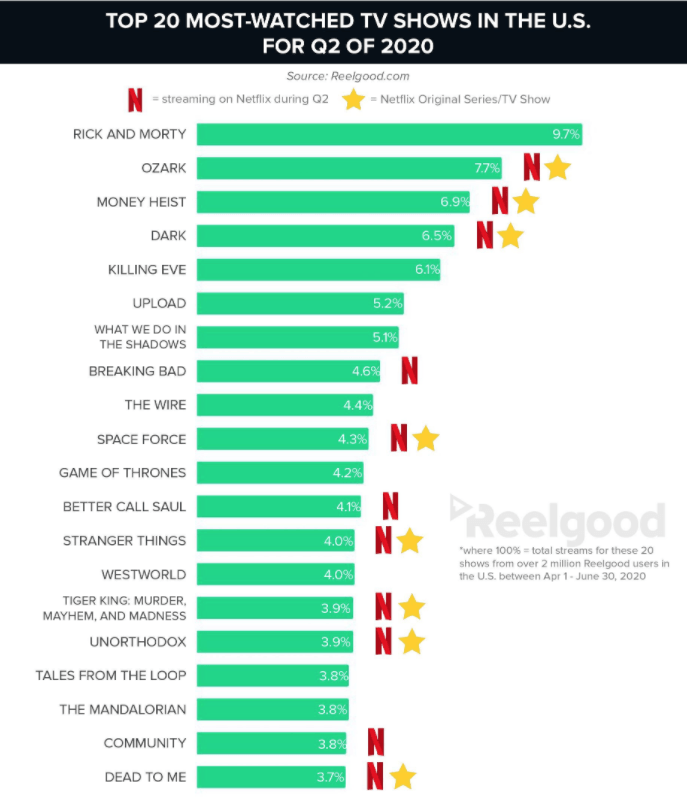
It’s clear that Netflix has the most attractive content, but it does not come cheap. In 2019, the company spent $15.3B on content, and in 2020 they were expected to spend $17.3B. For context, in 2019 the company had revenues of $20.15B.
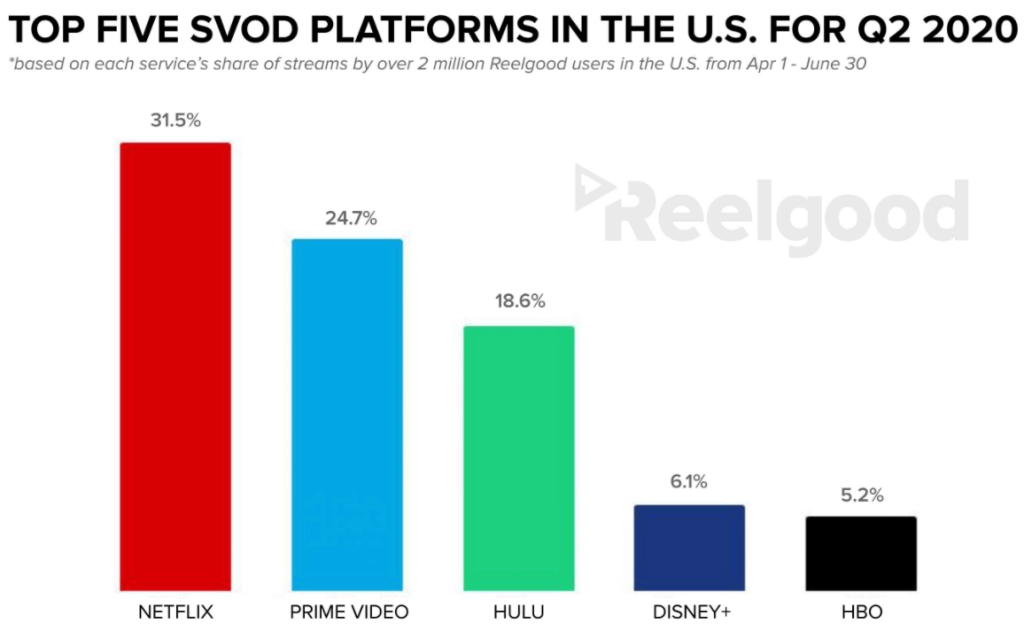
Those same users rated favorite streaming services. Netflix held the top spot (31.5%), followed by Prime Video (24.7%) and Hulu (18.6%). Nonetheless, competition is getting tougher, and Netflix might have a challenge keeping and growing their base.
Increasing Competition
Netflix has been the king of film and series streaming for over a decade, but competition in the space is suddenly heating up. Tech giants like Apple (Nasdaq:AAPL) and Amazon (Nasdaq:AMZN), and large media companies like NBC Universal (Nasdaq:CMCSA), Disney (NYSE:DIS) and Warner Media (NYSE:T), have entered the space with force.
The following services pose a significant threat to Netflix’s growth.
-
Apple TV+, which launched in November 2019, is Apple’s challenger to Netflix. The service costs just $4.99 a month, and you get one year free when you purchase an Apple device.
This service provides good value, but the company’s new offering, the Apple One, increases the perks significantly. For $14.95 a month ($19.95 for the family plan), consumers get Apple Music, Apple TV+, Apple Arcade, iCloud, Apple News+, and, coming in late 2020, Apple Fitness+.
The company also has $193.82 billion in cash on hand, a portion of which they can use to buy the rights for more content or produce it.
-
Hulu, a long-time Netflix competitor, has their cheaper ad-supported $5.99 plan and their ad free $11.99 plan.
Recently they also upped the ante with its Disney+ partnership. Consumers can get The Disney Bundle for $12.99/mo (ad-supported) or $18.99 (no ads), which includes Hulu, Disney+ and ESPN+. One key strength of this bundle is the inclusion of sports with ESPN+, something Netflix lacks.
-
Disney+: users can also get Disney+ on its own for $7/mo. This includes content from brands like Disney, Pixar, Marvel, Star Wars and National Geographic. One key advantage Disney has is their huge content library of which they own all of the rights.
-
Warner Media offers HBO Max, for $14.99 a month. This includes fan favorite shows like Friends, Game of Thrones and Westworld.
-
NBC Universal offers Peacock Premium for $4.99 (with ads) or $9.99 (no ads). Peacock recently had a dispute with Roku over ads, which was keeping the service off the Roku ecosystem, but they quickly resolved it. Having it on Roku will surely help exposure and drive subs.
-
Amazon Prime Video has some of the best content. You can buy it for $5.99 directly or get it though a $12.99 Amazon Prime subscription. Along with Apple, the Amazon prime bundle is one of the most compelling ones since it has much more than just video content.
All of these companies offer great services, with different shows and perks. While Netflix is still considered by many the best, the competition is getting stronger. There's also the possibility that others like Walmart (NYSE:WMT) (through Walmart+) will provide video streaming services.
In the following chart, we can see the latest subscription numbers from each service. It’s clear that Netflix is still the leader, but others are gaining share fast. Disney+, Apple TV+, HBO Max and Peacock were all launched in the last 12 months, and they are in the early stages of a ramp up of subscribers.
In less than a year, Disney+ reached more than 60 million subscribers, while Peacock, in just a couple of months, reached more than 10 million. This chips away at Netflix once-free reign on subscriber growth.
|
Netflix |
Hulu |
Disney+ |
Apple TV+ |
HBO Max |
Peacock |
Amazon Prime Video |
|
|
Subscribers (millions) |
192.5 |
35.5 |
60.5 |
10 |
4.1 |
10 |
150 |
|
Source Date |
July 2020 |
August 2020 |
August 2020 |
Feb 2020 |
July 2020 |
July 2020 |
Jan 2020 |
|
Source |
Since these services are in earlier growth stages, they will likely outpace Netflix’s growth. And with such a wide offering, it wouldn't be surprising to see them take away potential Netflix subscribers.
Netflix is aware of the problem. They have launched a free version of their service, which includes a smaller selection of movies and series, hoping to attract new customers and show them the benefits of its platform.
While these services are not exclusive, and several consumers will likely pay for more than one, they still represent a challenge for Netflix. According to a survey, 75% of US consumers don’t want to pay more than $30 a month for video streaming services. Moreover, 59 percent of consumers said they don’t want to pay more than $20 a month.
It’s clear that with so many services, consumers won’t be able to afford all of them, so companies will be competing for users. Another thing worth monitoring is the churn rate of Netflix subscribers. Since Netflix has been on for so long, some consumers might feel they already have exhausted the service and switch to others with fresh content.
One way to solve the pricing problem of streaming is through more ads. In the survey, more than half of the consumers surveyed said they would be willing to watch ads every other episode if it meant lowering the monthly cost. Services like Hulu and Peacock already do this. Netflix might look in the future to provide ad-supported services to reach more consumers through other forms of monetization.
Netflix User Growth
Despite the competition yet aided by the pandemic, Netflix’s user growth for the last quarter was strong. In the first half of the year, they managed to grow their user base from 167 million to 193 million.
|
Q4 2018 |
Q1 2019 |
Q2 2019 |
Q3 2019 |
Q4 2019 |
Q1 2020 |
Q2 2020 |
Q3 2020 |
|
|
Netflix Subscribers |
139.26 |
148.86 |
151.56 |
158.33 |
167.09 |
182.86 |
192.95 |
- |
|
QoQ Change |
6.78% |
6.89% |
1.81% |
4.47% |
5.53% |
9.44% |
5.52% |
- |
|
YoY Change |
25.87% |
25.20% |
21.88% |
21.40% |
19.98% |
22.84% |
27.31% |
- |
|
2Yr Change |
56.31% |
57.76% |
52.95% |
52.21% |
51.02% |
53.79% |
55.17% |
- |
|
Nov 2019 - Disney+ and Apple TV+ Launch |
May 2020 - HBO Max Launch |
July 2020 - Peacock Launch |
Their two-year growth rate for the last quarter was at around 55%, the highest it’s been since the start of 2019. Netflix benefited from the lockdowns and new stay at home trends, but this won’t last forever.
In fact, in the last earnings press release, we can see that the company experienced net cancellations in June. Netflix’s forecast has them reverting this trend, and finishing the next quarter strong.
However, I like to look at the trends, and the latest reported trend is net cancellations, which does not give me confidence in the next report.
It’s important to note that net cancellations were impacted by the company canceling the subscription of a small group of paying customers that were not using the service.
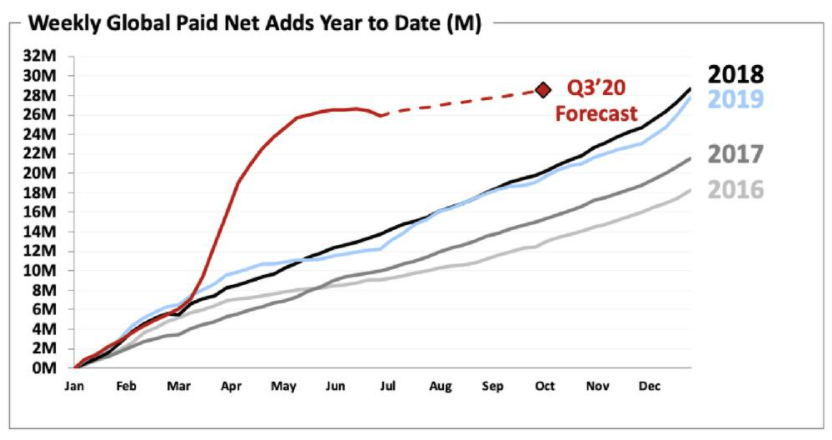
The next two quarters will be crucial for Netflix. We’ll see if they can maintain the new customers the pandemic brought and still grow, or if the June trend continued.
The combination of people coming off lockdown and competition along with cancellations seems like bias is set to disappoint.
Cuties Backlash
Following the addition of the film "Cuties" to its service, there was some controversy due to "sexualized portrayals of young children." The hashtag #CancelNetflix reached number one for trending topics on Twitter, and a petition on Change.org, which called on Netflix customers to cancel their subscription, had more than 600,000 petitions
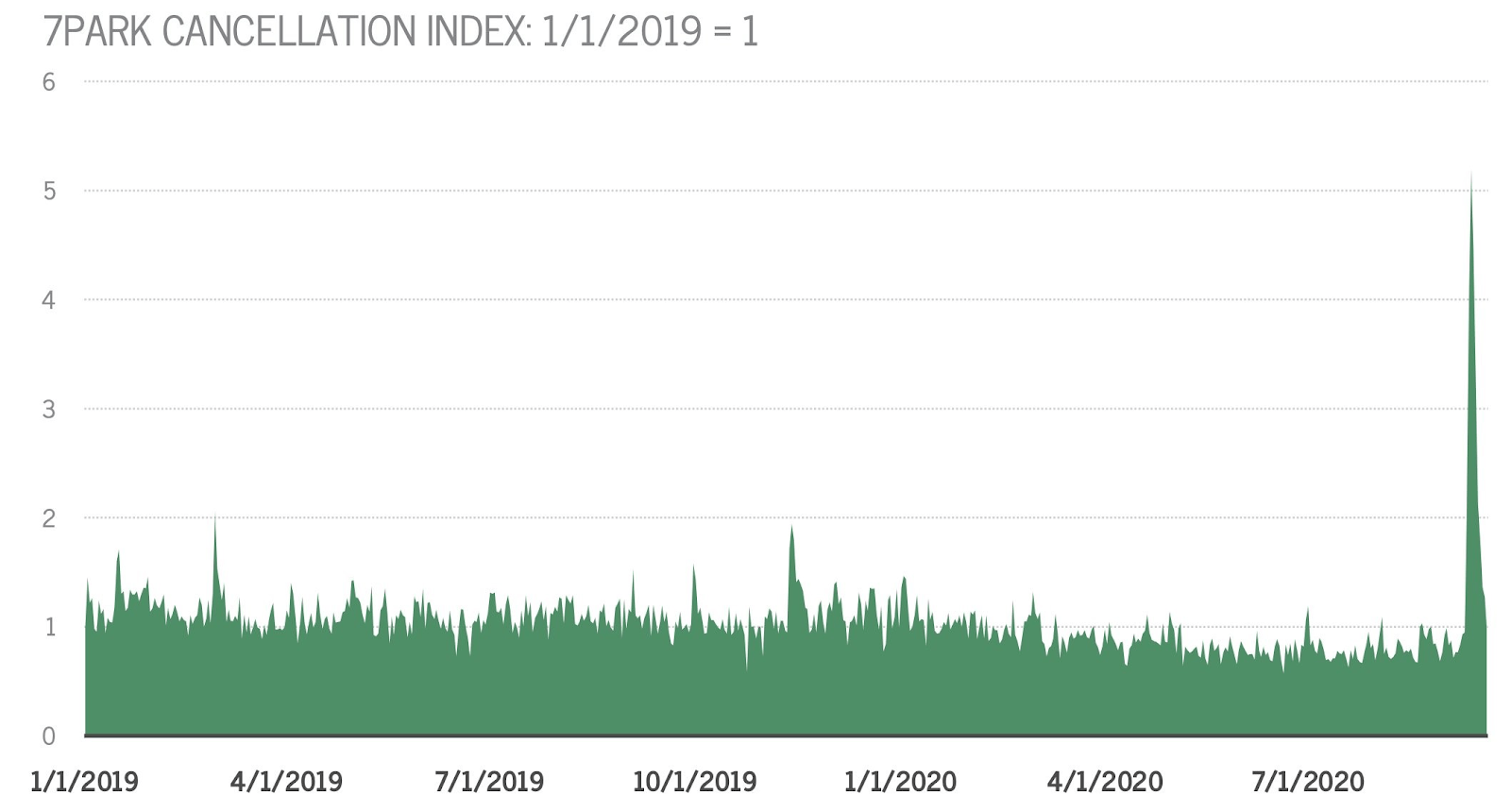
According to an analysis by 7Park Data, following the release of “Cuties,” Netflix account cancellations hit a peak of about five times the churn rate of January 2019. However, after just a week, the surge in cancellations subsided. But it can be another headwind to reported numbers.
This was a short-lived problem, but highlights how important it is to curate content and keep subscribers happy.
(Click on image to enlarge)
Conclusion
Total user growth has been the main driver for Netflix’s stock price in the past several years. The company posted strong numbers in the first half of the year, aided by lockdowns. However, the June numbers saw a slowdown. The company is facing more competition. With economies reopening, no new federal aid, and unemployment still high, Netflix’s subscriber growth might have some headwinds.


Comments
Log in or sign up to join the conversation.