

The latest persistence figures contain a contradiction that should concern college leaders. Of nearly 2.62 million students who entered college in fall 2024, 85.8% continued into spring 2025, yet only a little more than 77% returned the following fall, according to the 2026 Persistence and Retention Report. A sizeable group remained connected for one semester and did not continue into the second fall.
The figures don’t identify one cause. Students leave because of cost, academic difficulty, work, caregiving, health, or transfer plans. Colleges often hold warning signals before a departure, including missed classes, unpaid balances, incomplete forms, advising concerns, and falling course activity. The recurring failure is that those signals reach different offices at different times, with no shared rule for who must act.
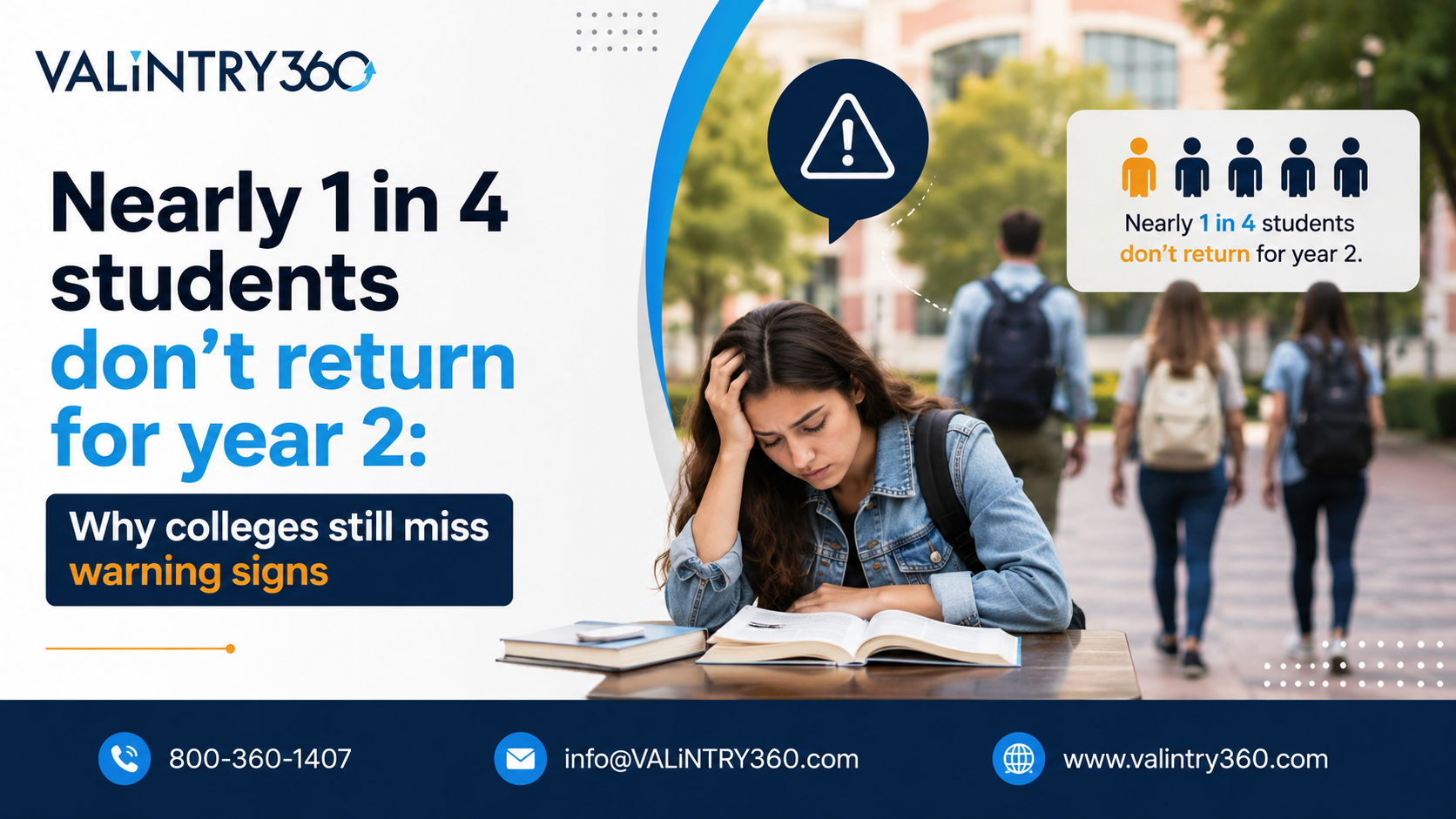
Warning signs often appear before the institution sees the pattern
A departure usually looks sudden only from the final record in the student information system. The registrar sees a missing registration, while an advisor may have recorded unanswered messages weeks earlier. Financial aid may be waiting for a document, and the learning platform may already show falling participation. Each office holds a useful piece, but the institution lacks a reliable view of the sequence.
This matters because persistence is only the first checkpoint. Federal data show that 64% of first-time, full-time bachelor’s degree students who entered 4-year institutions in fall 2014 finished at the same institution within 6 years. The NCES graduation-rate measure also reported an 82% first-year retention rate for the 2019 entering cohort at 4-year institutions, showing that many losses occur after the first return decision. These figures measure different cohorts and can’t prove that information gaps caused departure, but they show why a late response carries lasting consequences.
Department ownership creates blind spots at the handoff
The deeper cause often sits in the institution’s operating design. Admissions systems move applicants toward enrollment, while student records systems protect official academic data. Advising tools track appointments and cases, and fundraising systems focus on alumni relationships. These boundaries make administrative sense, yet students experience them as one institution.
Handoffs become risky when teams use different identifiers, status definitions, and update schedules. A student can appear active in one system, overdue in another, and unknown in a third. A college reviewing Higher Education solutions should examine how records move between recruitment, enrollment, support, and alumni functions instead of treating each department as a separate technology project.
Local incentives can preserve the wider problem
Campus units are often judged on their own queue, budget, compliance duties, and service targets. That structure rewards local completion, such as processing an application or closing an advising case, even when the next office receives incomplete context. Shared outcomes such as persistence require several units to accept responsibility for events they don’t fully control.
Poor information can also become normal. Staff create spreadsheets, email lists, and manual workarounds because formal system changes take too long. Those workarounds keep daily operations moving, but they hide definitions, ownership, and exceptions. The result depends on individual memory and becomes harder to audit when staff leave.
More technology won’t settle unclear decisions
Higher education leaders already recognize the pressure. In EDUCAUSE’s 2024 Higher Education Trend Watch, calls for decisions based on institutional data ranked 3rd among the listed technology trends, while data security and privacy ranked 1st. The report described institutions investing in centralized reporting while revising governance and policy around siloed data.
A shared platform can expose conflicts, but it can’t decide which record is authoritative or who owns a response. Institutions need agreed definitions for applicant, enrolled student, stop-out risk, active case, and completed intervention. They also need escalation rules, access controls, retention policies, and a record of why an alert was created. Without those decisions, a new platform can reproduce the old confusion in a cleaner interface.
Improvement starts with a shared operating model
The practical starting point is a map of decisions. The software inventory comes later. Leaders should identify which student events require action, which office receives the first signal, how quickly another team must respond, and what evidence closes the case. That work reveals where Salesforce Higher Education could support common records, alerts, case management, and communication while preserving existing academic systems.
Data design should follow the operating decisions. Salesforce’s official Education Cloud data model documentation shows that learner information can be brought in from learning management, student information, engagement, advancement, and enterprise resource planning systems. The presence of those objects doesn’t guarantee useful decisions. Institutions still have to reconcile identities, define access, test data quality, and decide which events deserve human review.
Implementation should follow a limited case from signal to action. A college might begin with students who have stopped attending, have an unresolved balance, and haven’t responded to an advisor. The team can test whether Salesforce for Education gives assigned staff enough context to act without exposing unrelated records.
What colleges should investigate before choosing a platform
A review of Salesforce system integration services should start with recent cases in which students left, stopped attending, or returned after a break. Trace what each office knew, when it knew it, and whether anyone had authority to combine the evidence. This review will expose missing data, slow updates, conflicting definitions, and alerts that generated activity without a useful response.
Leaders should also test alternative explanations. A student may leave despite timely support because the main barrier is financial, personal, or academic. Technology can improve detection and coordination, but it can’t remove every barrier. The honest measure is whether the institution identifies a problem earlier, assigns it clearly, and records what happened next.
The next warning should reach someone who can act
Student departure will never have one explanation, and no platform can remove every cause. Colleges can still reduce preventable misses by treating fragmented information as an operating problem with technical consequences. The next investigation should ask a plain question: when the warning appeared, did the right person receive enough verified information to act?
Frequently asked questions
Why do student data silos persist in higher education?
They persist because campus systems were often purchased for separate departmental duties and compliance needs. Each unit develops its own definitions, permissions, and workarounds over time. Replacing the software alone leaves those operating differences in place.
Can one CRM replace the student information system?
A CRM usually supports engagement, case work, communication, and relationship records, while the student information system remains the official source for enrollment and academic transactions. Some products are adding academic-operation functions, but the correct division depends on the institution’s architecture. Leaders should define system authority before moving records.
Which warning signals deserve early attention?
Useful signals are tied to a clear action and an accountable owner. Examples include missed academic activity, unresolved financial holds, repeated failed contact attempts, and incomplete enrollment steps. Institutions should test each signal for accuracy and unfair bias before using it to guide intervention.
How should colleges measure whether integration works?
The first measure should be operational. Colleges can track the time from signal to assignment, the percentage of cases with complete context, duplicate outreach, unresolved errors, and recorded outcomes. Retention can be monitored later, but attribution requires care because many outside factors affect it.
What is the main privacy risk in combining student records?
Broader access can expose information to staff who don’t need it for their role. Institutions should apply role-based permissions, document the purpose of each field, review consent requirements, and keep access logs. Privacy review belongs in the design stage rather than after launch.
Where should an institution begin?
Begin with one recurring student problem that crosses at least 2 offices. Document the current handoffs, delays, definitions, and decision rights before configuring a platform. The first project should prove that staff can receive better context and take a recorded action.
For more info Contact us 800-360-1407 or send mail at [email protected] to get a quote
Comments
Log in or sign up to join the conversation.