


As the IMF and World Bank prepare for their 2026 Annual Meetings in Bangkok, Thailand, the global economy is struggling with a set of systemic crises.
As the International Monetary Fund (IMF) and World Bank prepare for their 2026 Annual Meetings in Bangkok, Thailand, IMF Managing Director Kristalina Georgieva faces an overwhelming accumulation of concurrent global shocks.
For small and medium-sized powers—especially highly exposed, export-driven, or energy-importing nations—the upcoming discussions are overshadowed by systemic vulnerabilities.
There are half a dozen headaches that will keep Georgieva and the meeting participants awake at night.
Surging debt burdens and elevated borrowing costs
Renewed debt threats are heavily penalizing developing and middle-income economies as advanced markets keep interest rates higher for longer, thanks to unwarranted conflicts, and rearmament rather than appropriate fiscal support.
First, the cost of price stability is rising. The monetary tightening by major central banks to fight lingering inflation has triggered a severe spike in debt-servicing costs globally.
Second, there’s the challenge of fiscal consolidation inertia. Global public debt is on track to surpass 100% of GDP by 2029. Georgieva has repeatedly flagged that while there is universal awareness of the need for fiscal discipline, governments are failing to take sufficient concrete action.
However, the problem is that this tendency for governments to prolong austerity measures or spending cuts even after an economic crisis has passed is highly counterproductive because it is fostering a self-reinforcing cycle of economic stagnation. Austerity won’t resolve effectively secular or geopolitical challenges, but it can worsen each.
As long as fiscal discipline is equated with sheer austerity, challenges will compound. Small and medium powers are already running out of fiscal buffers to shield their populations.
While advanced economies possess deep local bond markets to absorb massive fiscal stimulus packages, emerging and developing economies face high external refinancing costs that squeeze space for vital development spending.
Geopolitical energy shocks and fractured supply chains
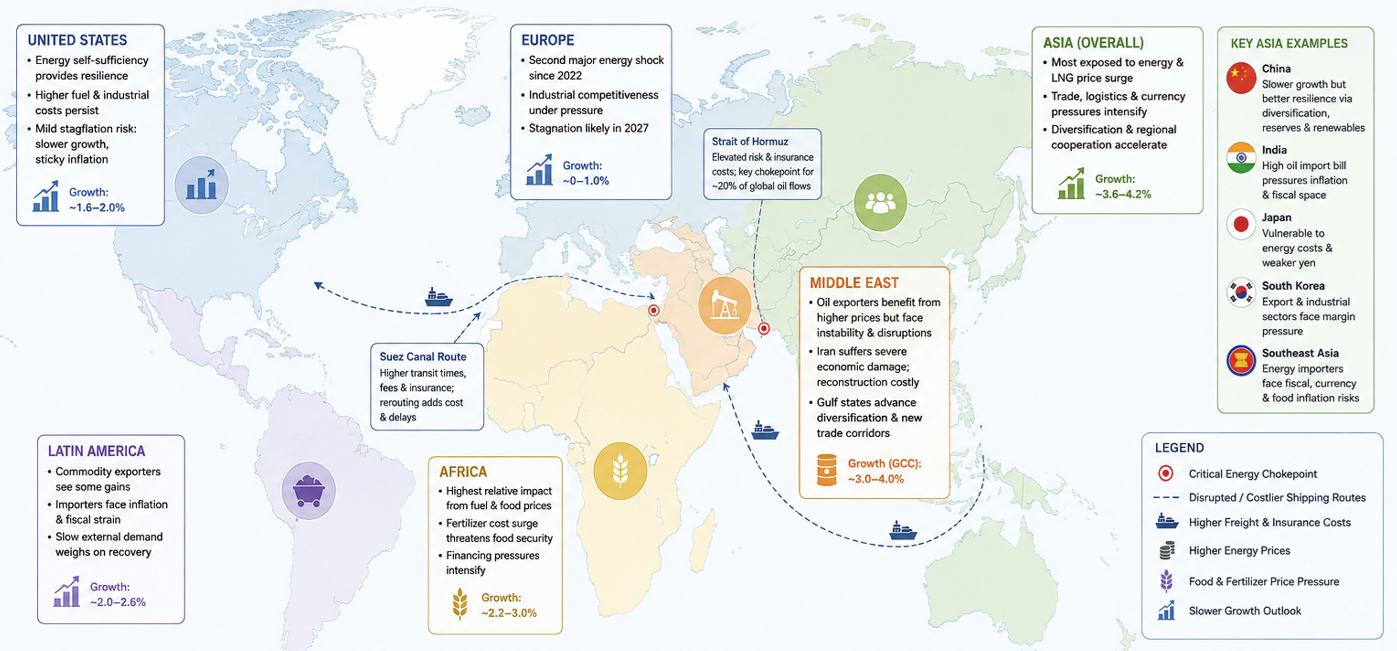
Escalating geopolitical conflicts continue to roil international markets, driving down projected global growth to 3.1% for 2026.
First, energy importers are ailing. Escalations in the Middle East have repeatedly shocked oil and liquefied natural gas (LNG) markets, spiking Brent crude prices and squeezing energy-importing, low-income nations.
Second, Asia’s supply chain vulnerability has taken a severe hit. Ongoing maritime and regional trade blockades have created severe physical breakdowns in supply chains. For mid-sized Asian manufacturing hubs, shortages of essential industrial inputs and rising fuel costs directly threaten economic stability.
While advanced economies lean on diverse trade networks and strategic oil reserves to buffer shocks, energy-importing emerging and developing economies face sudden current account deficits and severe domestic price spikes.
Tight restrictions on emergency finance
As economic pressures mount, the demand for IMF and World Bank financing has surged dramatically.
First, near-term demand for IMF emergency financing is expected to reach up to $50 billion. However, the pool for concessional (low-interest) terms targeted at vulnerable nations is tightly constrained.
Second, the G20 Framework for Debt Treatments suffers from severe delays, structural gridlocks and coordination failures. Smaller nations are watching high-stakes restructuring programs closely to see if frameworks can actually deliver rapid relief, or if standard development funding will continually be diverted into short-term emergency firefighting.
While advanced economies function as the global financial architecture's core balance-sheet absorbers, emerging and developing economies remain dependent on sluggish international frameworks to access nimble, affordable credit.
AI capital flight and deepening cyber risks
Technological transformations are introducing structural imbalances that smaller economies are ill-equipped to handle.
First, the global frenzy to invest in Artificial Intelligence (AI) threatens to pull vital private capital away from traditional emerging markets, compounding local labor market disruptions. Georgieva has expressed concerns over leverage and circular financing risks within AI investments.
While advanced economies capture the lion's share of venture capital and productivity gains from concentrated technology markets, emerging and developing economies face severe capital outflow risks and sudden labor disruptions.
Second, the "Bangkok Blueprint" is evolving, but only as damage is spreading. To counter the exponential growth of cyber risks to the international monetary system, the IMF and World Bank are using the Bangkok meetings to launch the Bangkok Blueprint—a joint policy framework designed to build cyber-resilience against digital financial fraud.
For Georgieva and ASEAN policymakers gathering in Bangkok, this evolution moves cybercrime from a law enforcement issue to a systemic financial risk, directly undermining banking confidence and regional economic stability.
Fragmented multilateralism and deglobalization
A persistent undercurrent for the Bangkok meetings is the fracturing of global trade. Declining trade volumes, protectionist policies, and tariff retaliations are chipping away at the export engines that small and medium-sized powers rely on to grow out of debt.
When advanced economies try to pivot toward protectionist subsidies and industrial onshoring, trade-dependent emerging and developing economies lose their primary pathways for upward economic mobility.
This macro-economic isolation is compounded locally for vulnerable nations, particularly in Southeast Asia and its island archipelagos like the Philippines, where severe climate shocks, including intense El Niño cycles and catastrophic typhoons, routinely decimate agricultural supply chains.
IMF’s chief Georgieva continues to urge member states to abandon trade barriers, warning that a fragmentation of the global economy will ultimately leave the most vulnerable nations isolated.
As she stays awake nights, perhaps she sees nightmares of Don Quixote fighting the windmills.


Comments
Log in or sign up to join the conversation.