

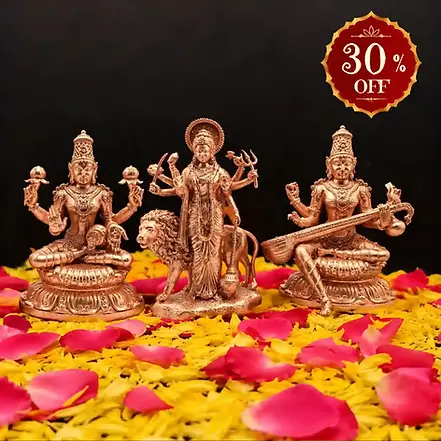
Navaratri, the nine holy nights dedicated to the worship of the Divine Mother, is one of the most widely celebrated festivals across India, and the collection of Navaratri goddess idols at IdolBronze is created especially for homes preparing to mark this occasion. The word "Navaratri" comes from Sanskrit, combining "nava," meaning nine, and "ratri," meaning night, and the festival unfolds across nine nights and ten days of prayer, fasting, music, and celebration.
Each of the nine nights is devoted to a distinct form of the goddess, building toward a tenth day that celebrates the victory of good over evil. From the elaborate Golu doll displays of Tamil Nadu to the Garba circles of Gujarat, Navaratri takes on many regional forms, but at its heart lies the same devotion to Durga, Lakshmi, and Saraswati. Idol Bronze offers handcrafted bronze idols of these goddesses for households observing this festival with traditional home worship.
What Is Navaratri?
Navaratri falls in the Hindu lunar month of Ashwin, typically arriving in September or October, and is known in this form as Sharad Navaratri, the most widely observed of the festival's several seasonal occurrences through the year. While Hindu tradition recognises four Navaratris altogether, tied to the change of seasons, it is this autumn observance that draws the largest and most visible celebrations, culminating in Vijayadashami, also known as Dussehra, on the tenth day.
A Festival of Fasting and Devotion
Across the nine nights, many devotees observe fasting, abstain from certain foods, and dedicate time each day to prayer, recitation of goddess hymns, and visits to temples or home shrines. The nights themselves are traditionally set aside for music, dance, and communal gathering, making Navaratri as much a festival of celebration as of austerity.
The Three Goddesses and Nine Forms Worshipped During Navaratri
Navaratri worship is structured around three principal goddesses, each honoured across three consecutive nights, before nine individual forms of the goddess, collectively called the Navadurga, are invoked one by one across the same nine nights.
Durga, Lakshmi, and Saraswati
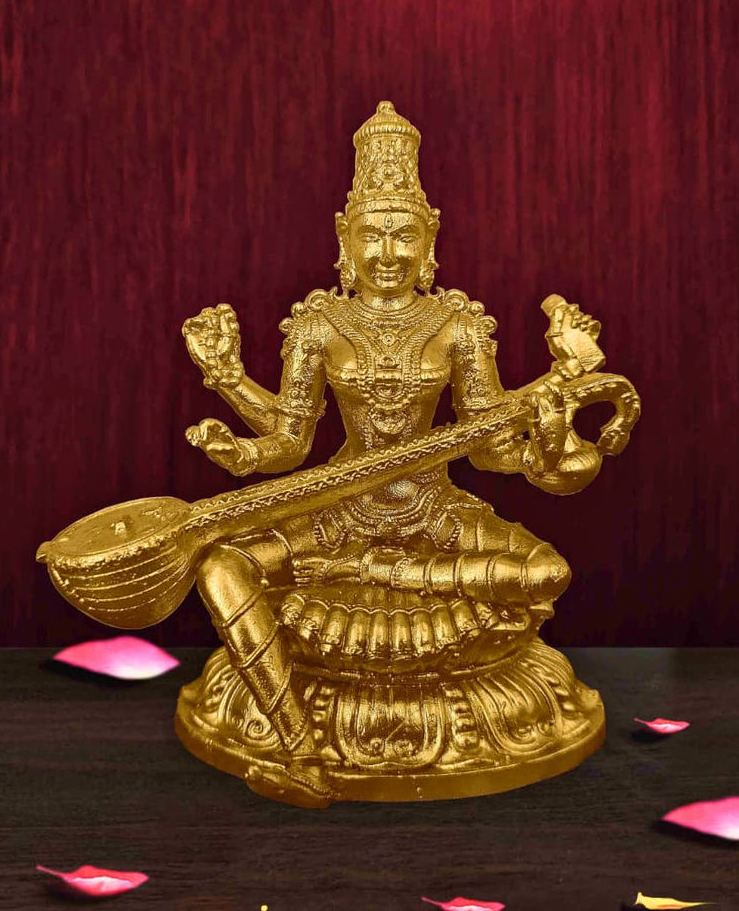
The first three nights are traditionally devoted to Durga, the fierce protector goddess, invoked for strength and the destruction of negative forces. The next three nights turn to Lakshmi, goddess of wealth and prosperity, and the final three nights are dedicated to Saraswati, goddess of knowledge, music, and the arts. This progression, from power to prosperity to wisdom, reflects a devotee's journey through the qualities needed to live a complete and balanced life.
The Navadurga: Nine Forms of the Goddess
Running alongside this three-goddess structure, each of the nine nights is also assigned to one of the Navadurga, nine distinct forms of the goddess described in Hindu scripture, each representing a different stage of her power and grace.
Navaratri Day by Day: The Nine Nights Explained
Day 1: Shailaputri
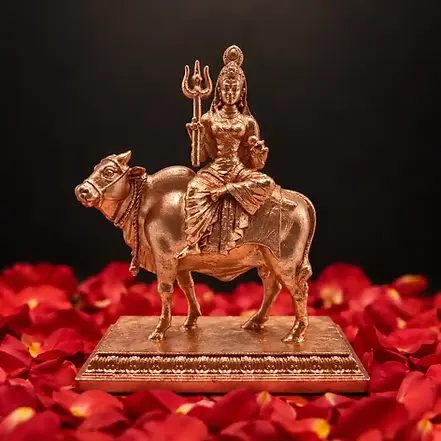
The first night is dedicated to Shailaputri, "daughter of the mountain," a form of the goddess born to the Himalayas and considered a reincarnation of Sati. Depicted holding a trident and a lotus while seated on the bull Nandi, Shailaputri represents the pure and unshaken beginning of the goddess's journey, and worship on this day opens the festival's first triad devoted to Durga.
Day 2: Brahmacharini
The second night honours Brahmacharini, the unmarried ascetic form of the goddess, shown carrying a rosary and a kamandalu, or water pot. This form recalls the intense penance the goddess undertook to win Shiva as her husband, and her worship is associated with perseverance, discipline, and the pursuit of a higher goal.
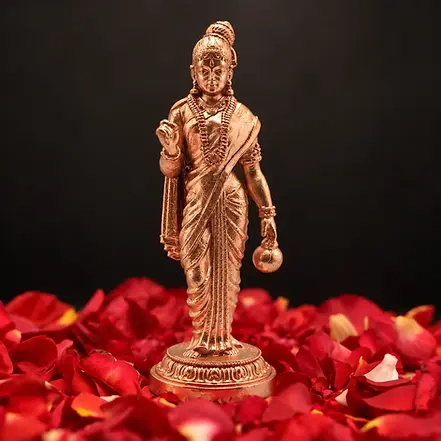
Day 3: Chandraghanta
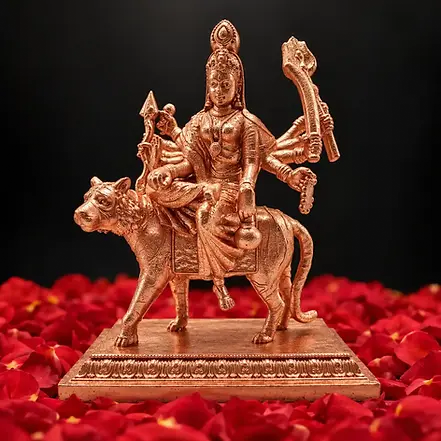
The third night is devoted to Chandraghanta, named for the crescent moon, "chandra," fixed like a bell, "ghanta," upon her forehead. Depicted with ten arms and riding a tiger, she represents the goddess after her marriage to Shiva, now equipped for battle against evil, and her worship marks the close of the festival's first triad centred on Durga.
Day 4: Kushmanda
With the fourth night, worship turns to Lakshmi's triad, beginning with Kushmanda, believed to have created the universe with her divine smile, bringing light into a world of darkness. Shown with eight arms holding a variety of weapons and a rosary, Kushmanda is worshipped for health, vitality, and the strength to overcome hardship.
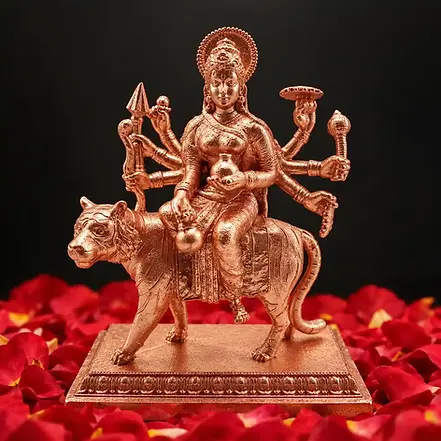
Day 5: Skandamata
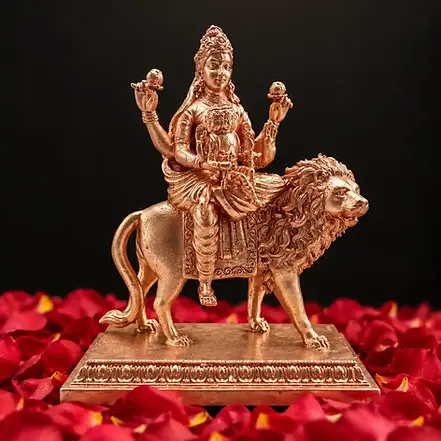
The fifth night honours Skandamata, the mother of Skanda, another name for the war god Murugan or Kartikeya. Depicted seated with her son on her lap, this form of the goddess represents maternal love and protection, and is invoked by devotees seeking the wellbeing of their families.
Day 6: Katyayani
The sixth night is dedicated to Katyayani, born to the sage Katyayana through his penance, and considered one of the fiercest forms of the goddess, closely associated with the eventual slaying of the buffalo demon Mahishasura. Riding a lion and armed for battle, her worship on this day closes the Lakshmi triad and turns devotees' attention toward the goddess's role as warrior and protector.
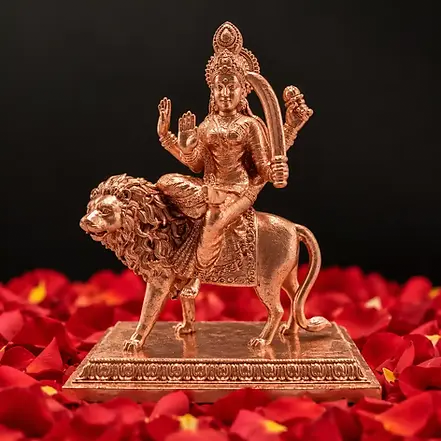
Day 7: Kalaratri
The seventh night, opening the final triad dedicated to Saraswati, is given to Kalaratri, the darkest and most formidable of the Navadurga forms, her complexion described as the night itself. Despite her fearsome appearance, Kalaratri is known as a benevolent protector, said to destroy ignorance and ward off evil forces from her devotees, and her worship is considered especially auspicious for removing obstacles.
Day 8: Mahagauri
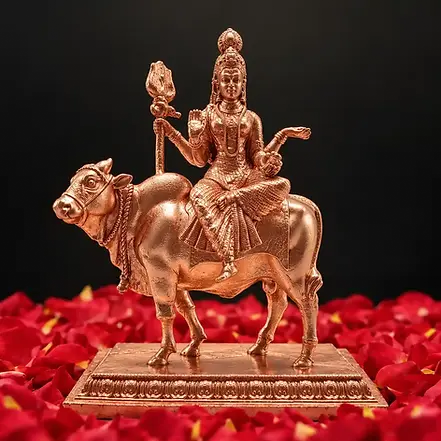
The eighth night is devoted to Mahagauri, whose name means "extremely white," representing purity, calm, and the restoration of peace after the fierce battles associated with the earlier forms. Riding a white bull and dressed in white, she is worshipped for the granting of peace and the fulfilment of wishes. In many South Indian households, this day is also marked by Ayudha Pooja, the ceremonial worship of tools, vehicles, and instruments of one's trade, offered in gratitude for the means of daily livelihood.
Day 9: Siddhidatri
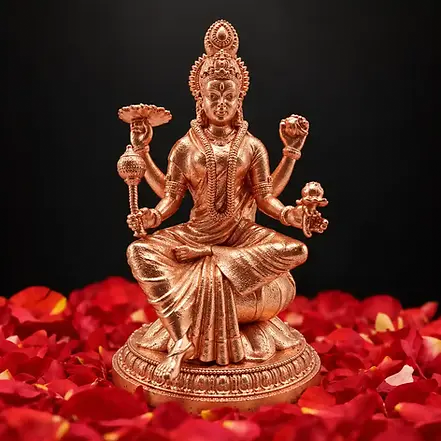
The ninth and final night belongs to Siddhidatri, "the giver of supernatural powers," believed to have granted the eight siddhis, or spiritual attainments, that even Shiva himself is said to have received from her. Seated on a lotus, she represents the culmination of the goddess's nine forms, and in many traditions this day also includes Saraswati Pooja, with books, musical instruments, and tools of learning placed before the goddess to receive her blessing before being taken up again the following day.
The Tenth Day: Vijayadashami
Though the nine nights conclude with Siddhidatri, the festival's story reaches its true climax on the tenth day, Vijayadashami, when the goddess Durga is believed to have slain the shape-shifting buffalo demon Mahishasura after nine days and nights of battle. Celebrated widely as Dussehra, this day marks the victory of good over evil and is observed with processions, the immersion of goddess idols, and, in many parts of North India, the burning of effigies of the demon king Ravana.
Golu: The South Indian Tradition of Displaying Dolls
In Tamil Nadu, Andhra Pradesh, and Karnataka, Navaratri takes on a distinctive form known as Golu or Bommai Kolu, in which households arrange elaborate tiered displays of dolls and figurines, ranging from gods and goddesses to scenes of daily life, mythology, and folk tales. Neighbours and relatives visit one another's homes during the nine nights to view these displays, exchange sweets and gifts, and sing devotional songs together, turning private worship into a shared community celebration.
The Legend Behind Navaratri: Durga and Mahishasura
The origins of Navaratri trace back to the story of Mahishasura, a demon who had earned near invincibility through a boon that no man or god could defeat him. As Mahishasura's tyranny grew unchecked, the gods combined their individual powers to create Durga, a warrior goddess equipped with weapons from each of them, precisely because he had never accounted for defeat at the hands of a woman.
The battle between Durga and Mahishasura is said to have raged for nine days and nights, with the demon repeatedly changing form to evade her, until on the tenth day Durga finally struck him down in his true form. This victory, celebrated as Vijayadashami, gives Navaratri its central meaning, framing the nine nights not simply as a sequence of individual goddess forms, but as the story of a battle building toward the triumph of righteousness.
Why Navaratri Worship Differs from Other Hindu Festivals
Where most Hindu festivals centre on a single deity or a single day of celebration, Navaratri unfolds across nine distinct nights, each with its own dedicated form of the goddess.
The festival's structure, moving from Durga to Lakshmi to Saraswati, offers devotees a complete cycle of strength, prosperity, and wisdom, rather than a single devotional theme.
Regional customs such as Golu in the south, Garba and Dandiya in Gujarat, and Durga Puja pandals in Bengal give Navaratri a far greater diversity of local expression than most other pan-Indian festivals.
Unlike festivals that mark a single mythological event, Navaratri combines both the story of a nine-day battle and a broader philosophical progression through the goddess's many aspects.
Conclusion
Navaratri stands apart as one of the richest festivals in the Hindu calendar, weaving together nine distinct forms of the goddess, three principal deities, and the timeless story of Durga's victory over Mahishasura into nine nights of devotion. Whether observed through fasting and prayer, a Golu display, or nights of Garba, the festival offers households a complete and layered way to honour the Divine Mother each year.
Comments
Log in or sign up to join the conversation.