

Observed every year on 22 July
There are moments in a nation's history that don't come with fireworks or grand parades, yet quietly shape how millions of people see themselves forever after. 22 July 1947 was one of those moments. In a room full of exhausted, determined freedom fighters, India's Constituent Assembly sat down just weeks before Independence and made a decision that would outlive every person in that room: they adopted the Tricolour as the National Flag of a country that, technically, did not yet exist.
Today, that flag flies over Parliament, classrooms, cricket stadiums, and millions of homes. But few people pause to ask how it came to look exactly the way it does — or why 22 July matters at all. This is that story.
A Flag Born Out of a Freedom Movement
The Tricolour we recognise today didn't appear overnight. It evolved over decades, shaped by the freedom movement itself. Its most direct ancestor was the flag of the Indian National Congress, which had been in informal use since the 1920s as a symbol of the independence struggle.
Much of the credit for the flag's design goes to Pingali Venkayya, a freedom fighter, agriculturist, and geologist from Andhra Pradesh. Venkayya spent years studying flags from around the world and presenting his own design concepts to Congress leaders, including Mahatma Gandhi. His early versions featured red and green bands — representing the two major religious communities — with a white band and a charkha (spinning wheel) added later at Gandhi's suggestion, to represent all communities and Gandhi's vision of self-reliance through Swadeshi.
By the time India's independence was imminent, this design had become deeply familiar to the freedom movement. But it needed one final, symbolically important change before it could represent a sovereign, secular republic rather than a single political movement.
22 July 1947: The Day It Became Official
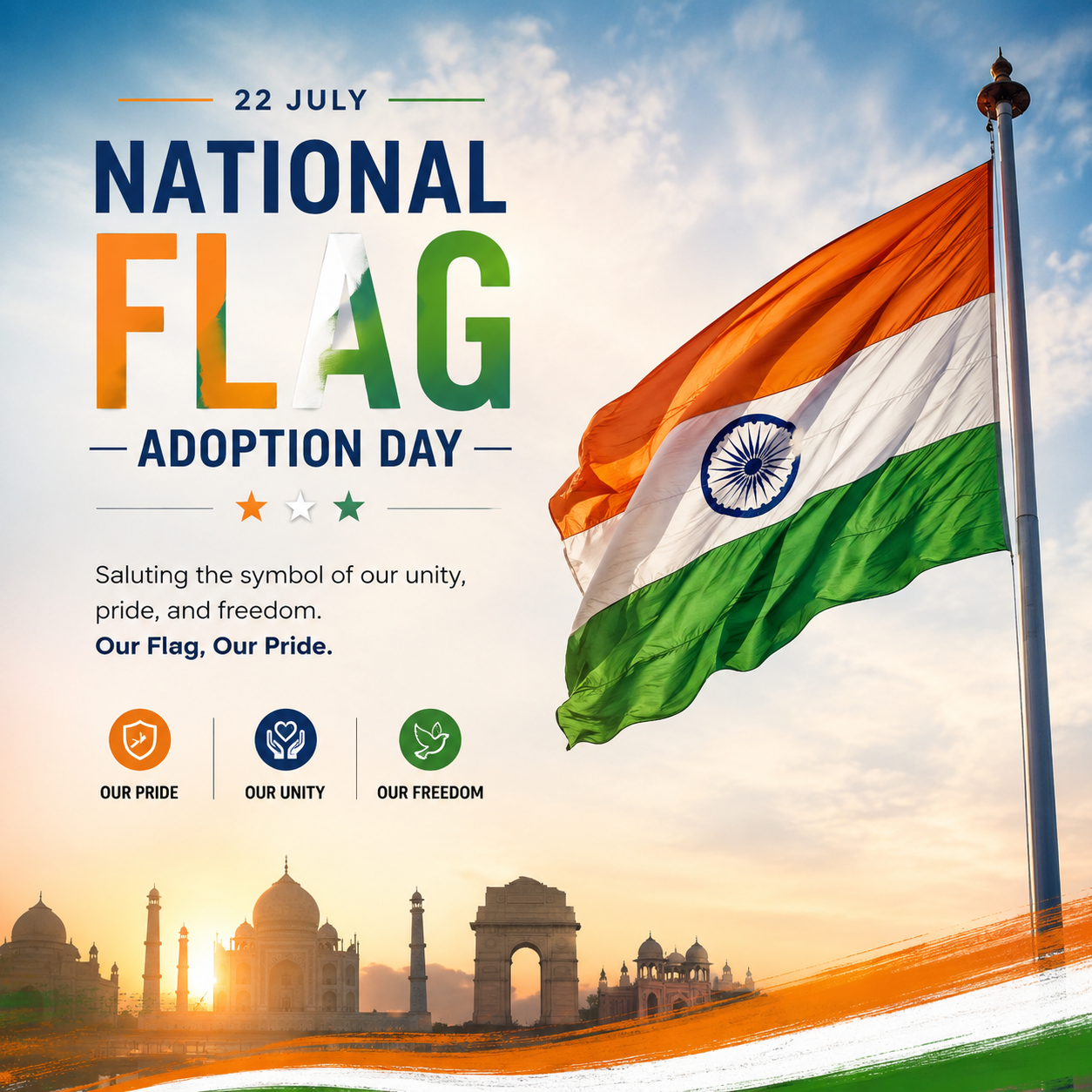
As the clock ticked down toward 15 August 1947, the Constituent Assembly of India faced a long list of urgent decisions — not least among them, what flag would fly over the new nation. On 22 July 1947, the Assembly formally adopted the Tricolour, making one crucial modification to the Congress flag: the charkha at the centre was replaced with the Ashoka Chakra, a navy-blue wheel with 24 spokes, taken directly from the Lion Capital of Sarnath — the very same emblem that would go on to become India's official state symbol.
This was a deliberate and meaningful choice. The charkha, while historically significant, was closely tied to one movement and one leader's philosophy. The Ashoka Chakra, by contrast, drew from ancient Indian civilisation itself — from Emperor Ashoka's pillars, monuments to a ruler who, after witnessing the horrors of war, embraced peace, dharma, and just governance. In choosing the Chakra, India's founders were reaching past the immediate freedom struggle toward a much older and more universal symbol, one that could belong to every citizen of the new republic rather than to a single political tradition.
Reading the Symbolism
Every element of the flag was chosen with intention, and understanding that symbolism is part of what makes the flag more than just a piece of coloured cloth:
Saffron (top band): Represents courage, sacrifice, and the spirit of renunciation — qualities the freedom struggle demanded of an entire generation.
White (middle band): Represents truth and peace, forming a clean, unifying backdrop at the centre of the flag.
Green (bottom band): Represents fertility, growth, and the promise of prosperity for the land and its people.
The Ashoka Chakra: Placed at the exact centre of the white band, this 24-spoke wheel represents dharma — often translated as righteous law or moral order — and signifies motion, progress, and the idea that a nation, like the wheel, must keep moving forward rather than stagnate.
Even the flag's proportions are precisely defined: the ratio of length to height must be exactly 3:2, and the Chakra must contain exactly 24 spokes — no more, no less. These aren't arbitrary technicalities; they're part of what ensures the flag looks identical whether it's stitched in a village workshop or flown atop the Red Fort.
From Adoption to Everyday Life: The Flag Code of India
Adopting a flag design is one thing; regulating how an entire nation displays, folds, and retires that flag is another challenge altogether. That responsibility today falls to the Flag Code of India, 2002, which consolidates decades of earlier laws and conventions into a single framework governing the display and use of the National Flag.
The Code has been updated more than once to reflect changing times. In 2021, an amendment permitted flags made of machine-spun and machine-woven polyester, in addition to the traditionally mandated hand-spun khadi, making the flag far more accessible and affordable to produce at scale. In 2022, a further amendment allowed the flag to be flown both day and night, provided it is properly illuminated — a change that aligned neatly with the launch of the "Har Ghar Tiranga" (Flag in Every Home) campaign, which has encouraged citizens to fly the National Flag at their homes every Independence Day since 2022.
Why This Date Still Matters
National Flag Adoption Day rarely gets the attention given to Independence Day or Republic Day — there are no public holidays, no televised parades. But its significance lies precisely in that quiet, procedural nature. It marks the moment when India's founders, in the middle of drafting a Constitution and negotiating the mechanics of a new state, still took the time to deliberate carefully over a symbol.
That symbol has since travelled to the summit of Mount Everest, orbited Earth aboard Indian spacecraft, draped the coffins of soldiers and statesmen, and been raised by schoolchildren in villages that didn't exist as such in 1947. Every one of those moments traces back to a single Assembly session on 22 July 1947, when a group of people decided that a nation on the verge of birth deserved a flag that belonged to everyone.
So today, when you see the Tricolour fluttering somewhere ordinary — a school gate, a government office, a family balcony — it's worth remembering that its final form wasn't inherited or imposed. It was chosen, carefully and deliberately, in the last urgent weeks before India became free.
National Flag Adoption Day is observed annually on 22 July, commemorating the Constituent Assembly's adoption of the Tricolour as India's National Flag in 1947.
Comments
Log in or sign up to join the conversation.