

Hungary's inflation outlook remains favourable, the economy is nowhere near overheating, and the forint remains relatively stable. Local factors create room for the NBH to lower rates, but we still don’t expect any moves in the coming quarters because external risks remain elevated.

We expect the National Bank of Hungary to play it safe and keep rates on hold at 5.50% on 17 November.
Our call
The National Bank of Hungary (NBH) picked the cautious option last month by keeping the base rate unchanged. We haven’t seen enough change since the October rate-setting meeting to think that this time will be different. Central bank representatives have repeatedly pointed to external risks rather than inflation itself. In other words, the room to cut is there, but the limiting factors are blocking any dovish moves.
The pace of repricing remains moderate, while the 2027 draft budget and the medium-term fiscal consolidation plan were broadly in line with market expectations. Looking at the details, the convergence plan so far appears credible, supported by the fact that the government has planned the necessary steps to be largely front-loaded. The domestic backdrop therefore looks favourable both now and in the near term. We expect this to be reflected in Hungary’s sovereign credit rating in the coming months. There is considerable room for Hungary’s rating to improve, even relative to regional peers. A potential improvement in the rating outlook could provide another positive catalyst for Hungarian assets.
Although the second-round effects of higher energy prices have not yet appeared in the October inflation print, we still think they could constrain any dovish ambitions among policymakers. There have been some favourable developments in global energy prices recently. However, as their impact feeds through to domestic inflation with a lag, they are unlikely to change the overall picture. We expect NBH staff to emphasise the risks stemming from gas and oil prices; after the double-digit repricing seen during the 2022-2023 energy crisis, no policymaker wants to play with fire again. The disciplined and consistent decisions made since Governor Mihály Varga took office have helped the market buy into the stability story.
CEE FX performance vs EUR (end-2024 = 100%)
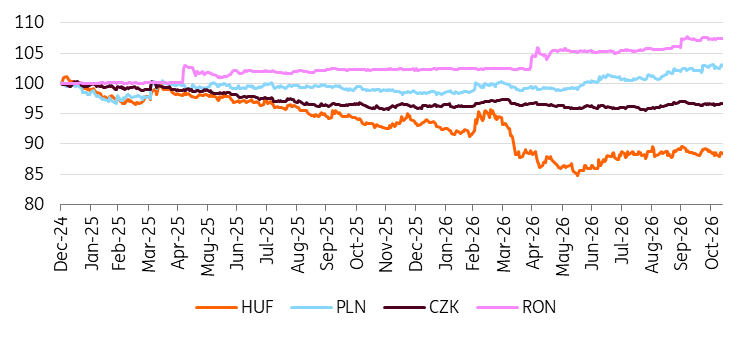
Against a backdrop of elevated global uncertainty and despite the prospect of lower local risk premiums, we expect the National Bank of Hungary to play it safe and keep rates on hold at 5.50% on 17 November. It is worth mentioning that we expect the major central banks, including the Federal Reserve and the European Central Bank, to continue hiking rates through year-end, so even with the NBH on hold, Hungary’s rate differential would still narrow.
Looking ahead, we don’t expect any change in rates in the coming quarters. Our assumption is that external developments will keep the door shut on rate-cut expectations, leaving the base rate at 5.50% by end-2026. With structural market support expected from credible fiscal plans and inflation hovering around 3.2-3.9% year-on-year in 2027, we expect some backloaded monetary easing in the second half of next year. We forecast a terminal rate of 5.00% in 2027.
Our market views
The markets have cleared a recent hurdle, the unveiling of the fiscal path for the coming years, which prompted many investors to lock in profits and close out their positions. However, the market recovered quickly following a brief sell-off, and it is clear that the bullish narrative for Hungary remains intact. Hungarian Government Bond yields and long-end IRS spreads versus the euro have returned to near the tightest levels seen in recent months, while the FX market has remained relatively stable despite heightened global volatility. With the easing of global tensions, the market has resumed pricing in NBH rate cuts, anticipating one to two cuts over a two-year horizon, depending on assumptions regarding the BUBOR premium. This aligns closely with our own forecast.
Hungarian yield curve
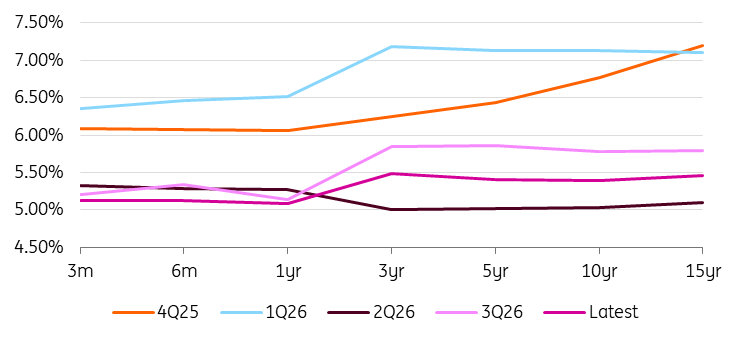
Furthermore, should the NBH adopt a cautious stance amid current global uncertainty, this would likely prove positive for the FX market and the long end of the yield curve. At the same time, the belly of the HGB curve is finding support from local technical factors and banks buying driven by tax advantages for the remainder of the year. Assuming global energy prices remain stable or decline, we expect the yield curve to continue its inversion, while EUR/HUF is likely to test the lower half of our 350-370 range.
Some background
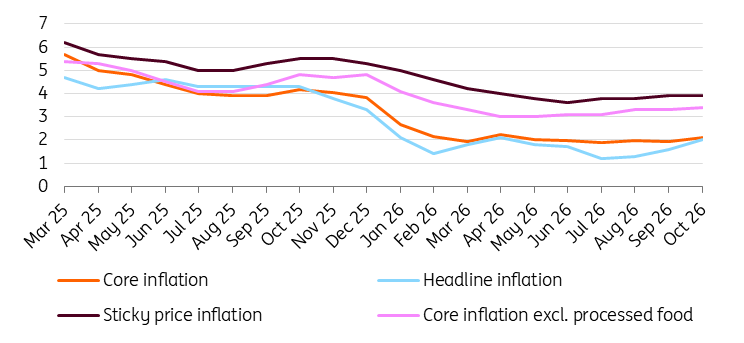
Inflation developments remain supportive from a monetary policy perspective. Despite the global energy shock, headline inflation has remained subdued, inching up to just 2.0% YoY in October, while core inflation ticked up by 0.2ppt to 2.1% YoY. We expect price growth to remain within the central bank’s new inflation target range for the rest of the year and throughout the first half of 2027.
Headline and underlying inflation measures (% YoY)
The forint has proved more resilient to recent global sell-offs than in previous episodes, with EUR/HUF hovering within the range seen in previous months. As the budget plan was broadly in line with market expectations, it did not trigger any unwanted market volatility. External factors, such as recent geopolitical developments, have caused some movement, but EUR/HUF has remained within its recent range. We don’t expect the forint to lose any of its stability in the coming quarters, as the front-loaded fiscal convergence path towards the eurozone appears credible.
Hungarian government bond yields have also absorbed the deterioration in global sentiment relatively well, supported by expectations of fiscal consolidation. If the government delivers, further yield convergence towards eurozone levels could be priced in. This would help lower Hungary’s refinancing costs. In 2027, a significant proportion of Hungary’s euro-denominated government debt will need to be refinanced.


Comments
Log in or sign up to join the conversation.