

Introduction
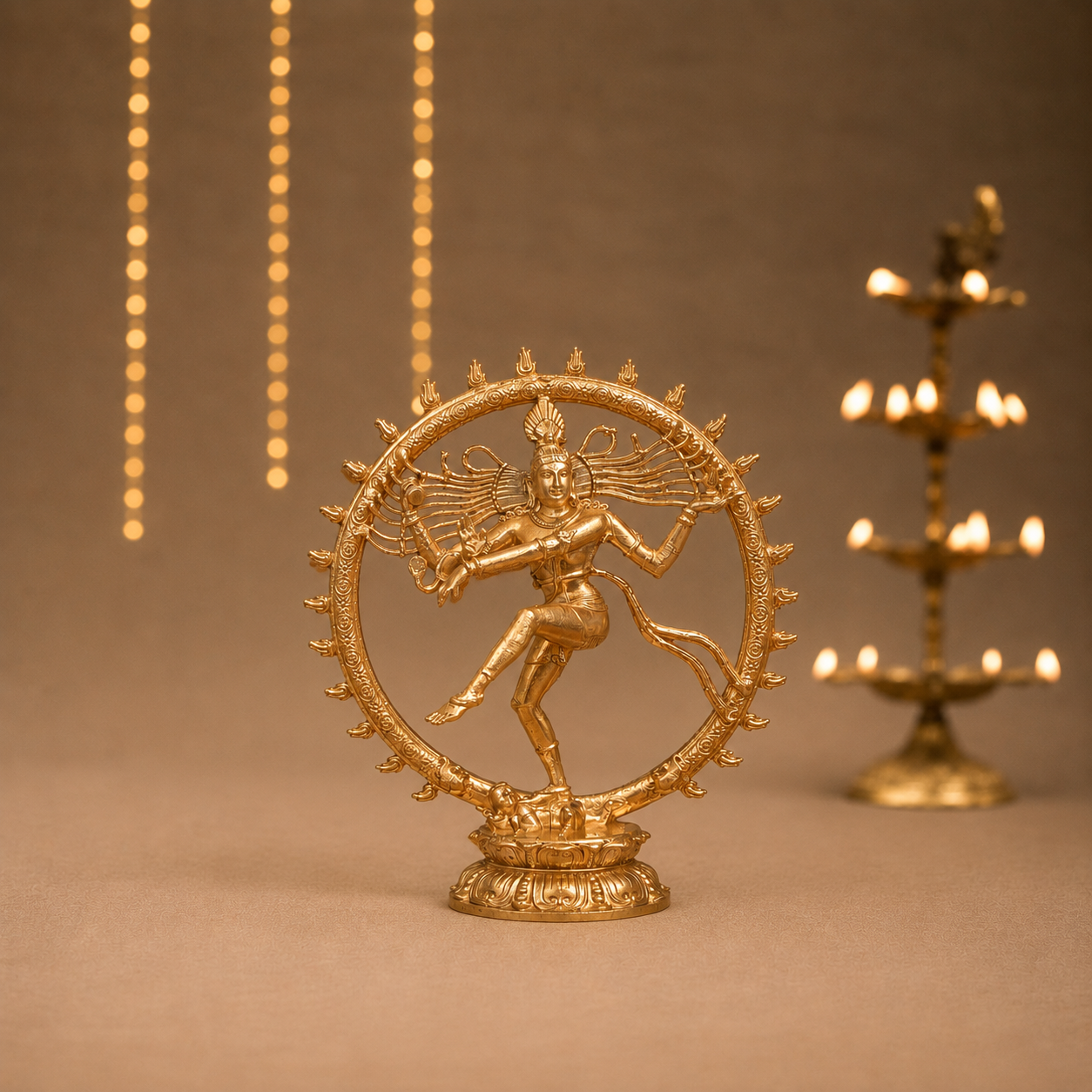
Few images in world art are as instantly recognizable or as philosophically rich as the bronze figure of Nataraja, the Cosmic Dancer. Cast primarily by the master bronze artisans of the Chola dynasty in South India between the 9th and 12th centuries CE, the Nataraja icon depicts Lord Shiva performing his eternal dance, the Ananda Tandava. The "Dance of Bliss." Far more than a decorative sculpture, every element of the Nataraja form encodes a profound vision of the universe: its creation, its preservation, its destruction, and the promise of liberation.
The Origins of the Nataraja Form
The Nataraja bronze reached its most refined and celebrated expression under the Chola kings, particularly during the reigns of Rajaraja Chola I and his successors. Using the lost-wax casting technique (cire perdue), Chola artisans produced bronzes of extraordinary technical precision and spiritual power. Temples such as the Thillai Nataraja Temple in Chidambaram, Tamil Nadu, became and remain. The spiritual heart of Nataraja worship, considered the very place where Shiva is believed to have performed his cosmic dance.
The Five Elements of the Nataraja Icon
A classical Nataraja sculpture is built around a precise iconographic structure, with each element carrying deep symbolic meaning.
1. The Circle of Fire (Prabha Mandala)
Shiva dances within a ring of flames, known as the prabhamandala. This encircling fire represents the vast, cyclical forces of the cosmos — the endless process of creation and destruction that governs all existence. It also symbolizes the sacred fire of consciousness itself.
2. The Upper Right Hand — The Drum (Damaru)
In his upper right hand, Shiva holds a small hourglass-shaped drum called the damaru. Its beat represents the primordial sound of creation — the rhythmic pulse from which the universe, time, and all matter first emerged.
3. The Upper Left Hand — The Flame (Agni)
Balancing the drum, the upper left hand holds a flame, or agni. This fire represents destruction — the dissolution of the universe at the end of a cosmic cycle, only to be created again. Together, the drum and the flame express Shiva's dual role as both creator and destroyer.
4. The Lower Right Hand — Abhaya Mudra
The lower right hand is raised in abhaya mudra, the gesture of reassurance and protection, signifying "fear not." It offers comfort to devotees and represents the preservation of the universe amid constant change.
5. The Lower Left Hand — Pointing to the Raised Foot
The lower left hand crosses the body in gajahasta (elephant-trunk pose) and points downward toward Shiva's raised left foot. This gesture signifies liberation (moksha) and serves as a refuge for the soul, showing devotees the path out of the cycle of birth and rebirth.
The Feet: Balance Between Illusion and Liberation
Perhaps the most philosophically loaded detail of the Nataraja is found beneath his feet.
The Right Foot, planted firmly, crushes a small demon-like figure called Apasmara (or Muyalaka) — the personification of ignorance, forgetfulness, and spiritual delusion. This tramping down of Apasmara represents the triumph of divine knowledge over illusion.
The Left Foot, raised gracefully in the air, represents release from worldly bondage and the attainment of spiritual liberation.
Together, the two feet illustrate the essential human journey: overcoming ignorance to reach enlightenment.
The Dancing Hair and the River Ganga
Shiva's hair flies outward in wild, dynamic locks as he dances, expressing the sheer cosmic energy of the movement. Within his hair, a small figure of the goddess Ganga is often depicted, referencing the mythological story of the Ganga river descending from the heavens, cushioned by Shiva's locks. A crescent moon is also nestled in his hair, symbolizing the passage of time and the cycles of the cosmos.
The Symbolism of the Dance Itself
The Ananda Tandava is understood to represent five fundamental cosmic activities, known as the Pancha Kritya:
Srishti (Creation) — represented by the damaru's beat
Sthiti (Preservation) — represented by the abhaya mudra
Samhara (Destruction) — represented by the flame
Tirobhava (Concealment/Illusion) — represented by the foot upon Apasmara
Anugraha (Grace/Liberation) — represented by the raised foot
In this single, unified pose, Nataraja embodies the entire cycle of the universe — birth, existence, dissolution, illusion, and ultimately, grace and release.
A Universal Symbol
Beyond its religious significance, the Nataraja has come to be seen as a powerful symbol of cosmic energy and motion in modern contexts as well — a bronze statue of Nataraja stands, notably, at CERN in Switzerland, gifted by the Indian government as a symbol of the dance of subatomic particles, drawing a striking parallel between ancient philosophy and modern physics.
Conclusion
The Nataraja is far more than a masterpiece of bronze casting. It is a complete philosophical and cosmological statement rendered in metal. Every drum-beat, flame, raised hand, and trampled figure speaks to a cycle that is at once cosmic and deeply personal: creation, preservation, destruction, illusion, and liberation. It is little wonder that this image, born in the temples of Tamil Nadu over a thousand years ago, continues to be celebrated today as one of the greatest achievements of both spiritual thought and artistic mastery.
Bronze Idols for Pooja Room
A pooja room is more than a corner of the house; it's where the day begins and ends with quiet devotion. Choosing the right idol for that space matters, and bronze has been the material of choice for generations of Hindu households. Its cool, sacred sheen, its weight in the hand, and the way it seems to hold the presence of the deity have made bronze pooja idols a lasting tradition rather than a passing trend.
Why Bronze Works So Well for a Pooja Room
Bronze idols are prized for a few simple reasons. The metal is believed to retain divine vibrations, making it especially suited for daily worship. It's also remarkably durable. A well-cared-for bronze idol can last for generations, often becoming a piece that's handed down within the family along with the memories attached to it. And unlike many materials, bronze only grows more beautiful with age, developing a natural patina that many devotees consider auspicious.
Finding the Right Idol for Your Space
Every pooja room is different, so a few things are worth checking before you choose:
Size — measure your altar or shelf space so the idol sits comfortably without crowding other items.
Deity and form — from Ganesha and Murugan to Amman, Shiva, and Perumal, the right choice often comes down to your family's kuladeivam or personal devotion.
Finish — some idols carry a traditional antique dark tone, while others have a polished, gold-look finish; either works beautifully in a pooja setting, depending on your taste.
Weight and placement — larger handcrafted idols can be heavy, so it helps to know exactly where the idol will stand before it arrives.
Handcrafted with Traditional Techniques
Each bronze idol is handcrafted by skilled artisans using traditional lost-wax casting methods rooted in South Indian, Chola-era craftsmanship. Every detail — from the deity's expression to the smallest ornamental flourish — is shaped by hand, which is part of why no two idols are ever quite identical.
Visit Us
Whether you're setting up a new pooja room, adding to an existing one, or looking for a meaningful gift, seeing the idol in person can make choosing easier. Visit Idol Bronze at our T. Nagar, Chennai store — Shop No.12, Ankur Plaza, 113, Gopathi Narayanaswami Chetty Rd, near Vani Mahal — open Monday to Saturday, 9:30 AM to 6:30 PM. Prefer to shop from home? Browse our full bronze idol collection online, with free shipping across India.
Comments
Log in or sign up to join the conversation.