

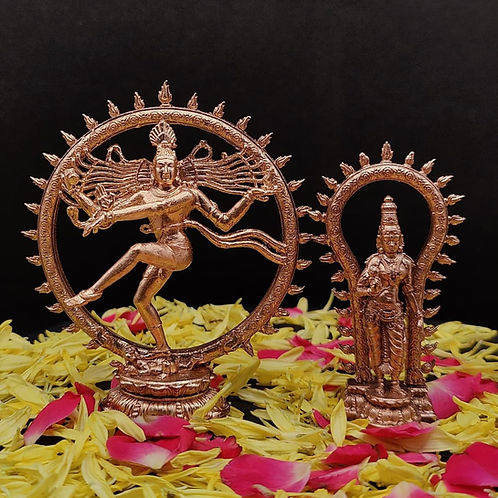
Nataraja and Sivagami idol — Lord Shiva captured mid-motion in his cosmic dance beside his composed, radiant consort. Together, the pair brings to life one of Hindu philosophy's most striking visual ideas: boundless divine energy held in balance by grace and stillness.
Where Nataraja embodies the rhythm that drives creation, preservation and dissolution, Sivagami — also called Sivakami — represents the calm, compassionate presence that gives that rhythm its meaning. This combined form has inspired sculptors, poets and devotees for centuries, and it remains one of the most admired pieces in Idol Bronze's collection of handcrafted bronze and brass idols.
Who are Nataraja and Sivagami?
Nataraja, meaning "Lord of Dance," is the form of Shiva performing the Ananda Tandava — the Dance of Bliss — inside a ring of cosmic fire known as the Prabha Mandala. Every gesture in the icon carries meaning: the drum in his upper right hand sounds the rhythm of creation, the flame in his upper left hand signifies destruction, his lower right hand offers protection, and his raised foot points toward liberation. Beneath his feet lies the demon Apasmara, representing ignorance being subdued by divine awareness.
Sivagami, standing beside him, is Parvati in her Tamil Shaiva form. Her name is generally read as "she who is dear to Shiva" — a title that reflects her role not as a passive bystander but as the devoted, graceful witness to his dance. In sculpture, she is shown standing calmly, hands folded or gently poised, her serenity offsetting the dynamic energy of Nataraja beside her.
How Sivagami Differs from Parvati's Other Forms
Unlike Durga or Kali, who are depicted as fierce and active, Sivagami is deliberately composed. She is Parvati in her gentlest aspect — present, attentive and unshaken by the intensity of Shiva's dance. This contrast is central to the pairing: the icon works precisely because one figure moves and the other remains still.
The Philosophy Behind the Pairing
The Nataraja and Sivagami form is often read as a visual expression of the relationship between dynamic cosmic energy and the steady awareness that observes it. Shiva's dance represents constant change — the universe being created, sustained and dissolved in an unending cycle. Sivagami's calm presence represents the unmoving witness consciousness that remains untouched by that change.
A Balance, Not a Merger
This is different from forms like Ardhanareeswarar, where Shiva and Parvati are fused into a single half-male, half-female body to show their fundamental oneness. In the Nataraja and Sivagami composition, the two remain distinct individuals standing side by side — a deliberate choice that emphasizes companionship and witnessing rather than complete union.
The Legend of the Dance at Thillai
The story most closely tied to this form comes from the ancient forest of Thillai, the old name for Chidambaram. According to tradition, two great sages — Patanjali, said to be a partial incarnation of the serpent Adisesha, and Vyaghrapada, a sage who had the feet of a tiger as a boon — longed to witness Shiva's cosmic dance with their own eyes rather than merely hear of it through scripture.
Shiva Agrees to Dance
Pleased by their devotion, Shiva agreed to perform the Ananda Tandava for them in the Thillai forest. Parvati, as Sivakami, stood beside him as the dance unfolded, her calm presence completing the scene the two sages had been granted to witness.
Why Chidambaram Became Sacred
This event is regarded as the reason Chidambaram became one of the holiest Shaiva sites in South India. The forest where the sages watched the divine dance is remembered in the very name of the town's presiding deity — Thillai Nataraja — and the moment is re-enacted symbolically in temple ritual to this day.
The Temple Connection
The Thillai Nataraja Temple in Chidambaram remains the principal home of this form. Within the same temple complex stands a dedicated shrine to Sivakami Amman, honoring her as Nataraja's eternal companion and witness. Pilgrims traditionally visit both shrines, treating the darshan of Nataraja and the darshan of Sivakami as two halves of one complete experience.
Festivals such as Aani Thirumanjanam and the Margazhi Thiruvadhirai (Arudra Darshan) draw large numbers of devotees each year, with processions and rituals that recreate the sense of divine dance witnessed long ago in the Thillai forest.
Spiritual Significance of Nataraja and Sivagami
Balance of energy and stillness — the pairing reminds devotees that constant motion needs a steady, aware presence to give it purpose.
Devotion as witnessing — Sivagami's role teaches that quiet, attentive devotion is as powerful as active worship.
Cycles of life — Nataraja's dance reflects the inevitability of change, encouraging acceptance rather than resistance.
Companionship in worship — together, the two represent the ideal of shared spiritual journey rather than solitary practice.
Why Is This Form Different from Other Shiva-Parvati Icons
Compared to Somaskanda, where Shiva and Uma sit together with the infant Murugan in a domestic family scene, Nataraja and Sivagami is far more cosmic and symbolic than domestic. And compared to Ardhanareeswarar's single fused body, this form keeps both figures separate, letting movement and stillness sit visibly side by side rather than blended into one. That visual separation is what makes the icon such a popular subject for both temple sculpture and home worship — it tells a complete story in a single glance.
Conclusion
Nataraja and Sivagami together form one of the most complete symbols in Hindu iconography — one figure in eternal motion, the other in eternal calm, each giving meaning to the other. Rooted in the legend of the Thillai forest and preserved in the sanctum at Chidambaram, this pairing continues to speak to devotees about the balance every spiritual life is asked to hold between change and steadiness.
Comments
Log in or sign up to join the conversation.