


The Nasdaq 100 (NDX) technology index remains in a strong bullish trend. However, from an Elliott Wave perspective, the index appears to be trading within wave (5) of an impulse, representing the final leg of the current degree, which could complete at the end of 2026 or the beginning of 2027.
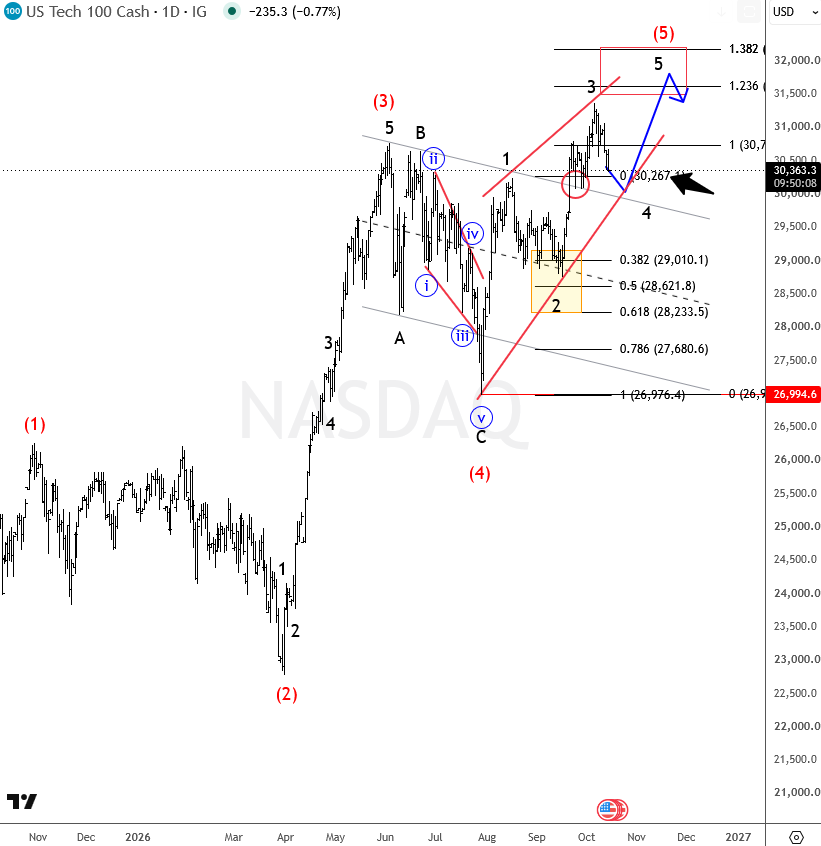
Wave (5) is a motive wave and should develop in a five-wave structure, either as a standard impulse or an ending diagonal/wedge pattern, as illustrated on the daily chart. Subwave 5 of (5) could still be missing till the end of the year, with the first upside target in the 31,500–32,000 area. This scenario could unfold after the current subwave 4 pullback completes.
Elliott Wave Basics: The Five-Wave Impulse and Ending Diagonal
According to Elliott Wave theory, a motive impulse consists of five waves labeled 1, 2, 3, 4, and 5. Waves 1, 3, and 5 move in the direction of the main trend, while waves 2 and 4 are corrective pullbacks. Wave 3 is often the strongest advancing wave, while wave 5 represents the final push before a larger correction may begin.
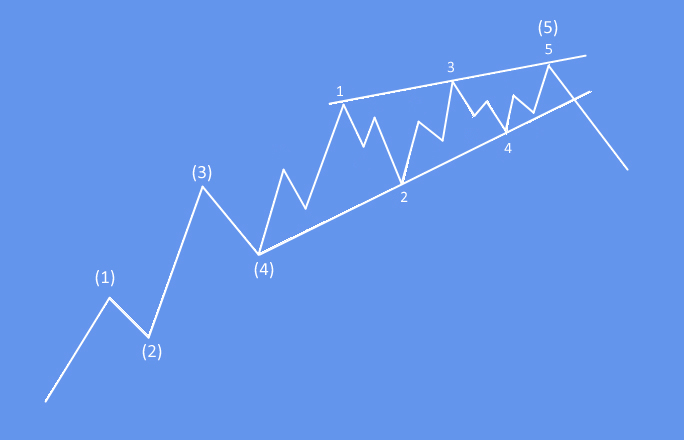
The fifth wave can develop as a standard impulse or, in some cases, as an ending diagonal, also known as a wedge pattern. An ending diagonal typically forms near the end of a larger price move and features overlapping price action within a converging or, occasionally, expanding structure. It can signal that the prevailing trend is approaching exhaustion, although price may still make one final move toward new highs or lows before a larger reversal or correction begins.


Comments
Log in or sign up to join the conversation.