

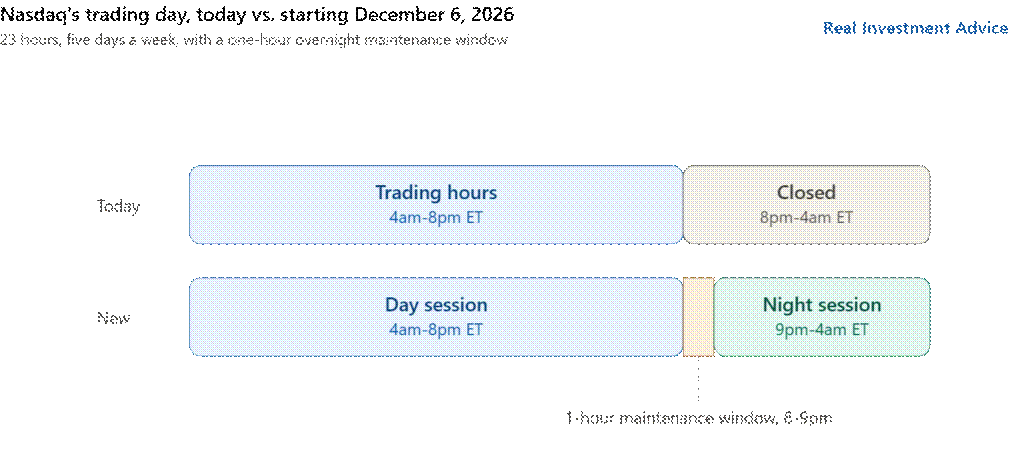
Starting December 6, 2026, Nasdaq will offer a trading session starting at 9 p.m. to 4 a.m. ET. The new hours, in addition to the standard 9:30 a.m. to 4:00 p.m. ET and current pre- and post-market trading sessions, would extend the exchange’s trading to nearly 23 hours a day, five days a week, from Sunday evening through Friday evening. Doing so would not only allow Nasdaq to capture higher domestic volumes and increase its revenue, but also provide value for international investors and better rival 24/7 crypto trading.
During the tech melt-up of the dotcom boom in 1999, Nasdaq proposed keeping its exchange open for 24 hours. The market crashed, and it wasn’t enacted. Below we share a few concerns worth considering regarding Nasdaq’s longer sessions.
Poor liquidity in off-peak hours will result in wider bid-offer spreads and more volatility
Wells Fargo analysts reportedly called the proposal “the worst thing in the world,” arguing it would push equity trading further toward feeling like a casino rather than a market for long-term capital allocation
Running compliance, risk management, and trading desks across a near-continuous 23-hour cycle, with just a one-hour maintenance window, is a real staffing and operational burden for brokerages, exchanges, and the firms that support them.
Questions remain about whether information processors, like those disseminating price data, and clearing firms can fully support the Nasdaq proposal.
Whether 2026 rhymes with 1999 and the proposal is quashed remains to be seen. Either way, Nasdaq and Wall Street have a lot to consider before moving ahead with the proposal.
What To Watch Today
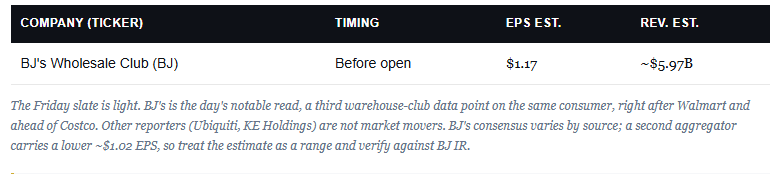
Earnings
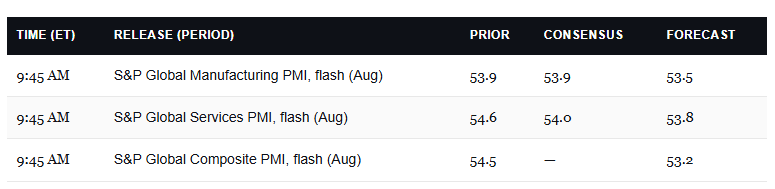
Economy
Market Trading Update
A couple of sessions ago, we marked the August 21 gamma cliff on the calendar in The Gamma Cliff: August 21st, Mark The Date. That mechanical OPEX setup arrives today with a real fundamental company attached to it. Walmart’s earnings landed before the bell yesterday, and the tape’s reaction to a genuinely good quarter is supporting the recent softness in the economy.
Overall, the headline was a beat. Adjusted earnings came in at $0.81 against the $0.73 the Street expected, on revenue of $187.94 billion. eCommerce grew 23% globally, U.S. comparable sales rose 2.6%, and management raised the full-year outlook. On paper, that’s a clean print. However, the stock fell sharply.
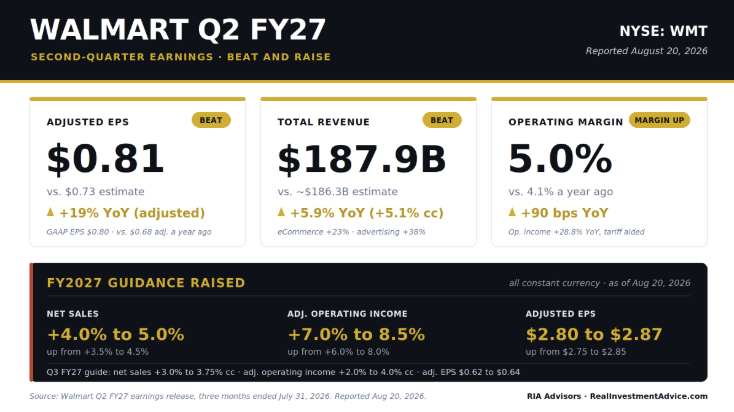
There were a couple of reasons why the beat didn’t hold. First, a large chunk of the upside came from tariff refunds booked in the quarter, and CFO John David Rainey told investors to read Q2 and Q3 together because the company is plowing those refunds back into price. Secondly, the forward math shows it. Q3 operating income is guided to grow just 2% to 4%, and Q3 adjusted EPS of $0.62 to $0.64 sits essentially flat against the $0.62 Walmart earned a year ago. The beat was real, but the soft guidance suggests the consumer is weakening, as we have noted previously.
Add to the fact that at 40 times forward earnings, WMT is trading at a premium. Yes,.WMT is a superb operator, but you were paying a growth multiple for low-single-digit sales growth. Howard Marks has made the point for decades. There’s no asset so good that it can’t be priced badly. The price gap sliced through previous support in a single session and extended the decline from the May 19 record of $135.16 to roughly 23%.
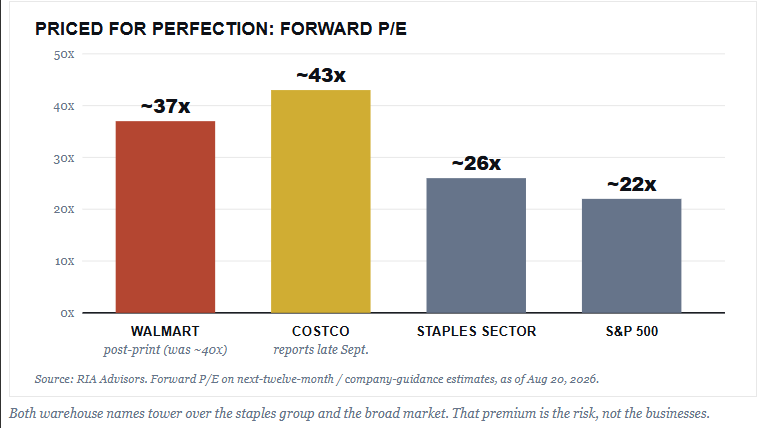
This brings us to Costco (COST), which is the same trade, but one notch more expensive. Cost trades at roughly 43x forward earnings, with a PEG north of 4, against roughly 26x for the staples group. If the best-run retailer in the world can shed 9% on a beat-and-raise, Costco is at risk if it misses.
So, what are we doing with our WMT position now? It is not a sell, but we aren’t adding to it yet either. The franchise, the advertising business, and the membership engines are real, and full-year guidance has increased. Once WMT finds a bottom and we see buyers return, we will rebalance the position back to the target weight.
BuyBacks Are Not Yield Curve Control Or Operation Twist
Yesterday’s announced increase in the Treasury’s buyback program, as we detailed HERE, drew comparisons to two more famous bond market interventions: the Fed’s 2011-2012 Operation Twist and yield curve control (YCC). Both comparisons are inaccurate.
Yield curve control occurs when a central bank explicitly targets an interest rate level and buys whatever quantity of bonds it takes to maintain that level. YCC is QE, but unlike more traditional QE, where the central bank targets a quantity of bonds without a rate target, under YCC the central bank intentionally buys enough bonds to reach a specific interest rate target. The Fed used YCC during and after WWII (1942 to 1947) to cap long-term rates at 2.50%. More recently, Japan pinned its 10-year yield to near zero from 2016 to 2024.
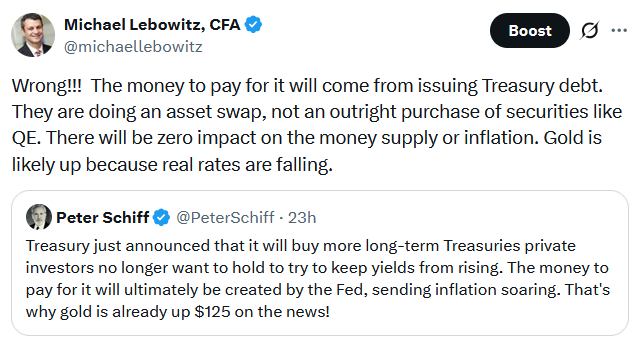
Treasury’s buyback program shares none of that architecture. There’s no announced yield target and no open-ended commitment, just a cap: $4 billion per operation. Importantly, the Treasury will issue debt to buy back debt; thus, it is not adding to the money supply or reserves on bank balance sheets that could increase the money supply. YCC is a central bank tool, and this is a Treasury Department one.
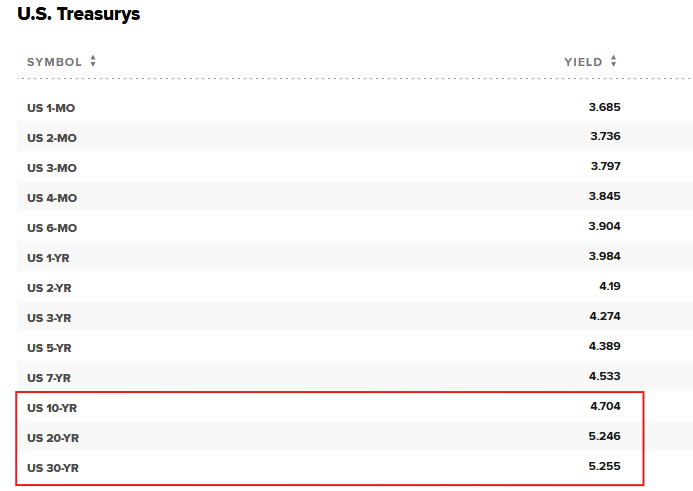
The Operation Twist comparison is not much better. Under Operation Twist, the Fed sold short-term securities and bought long-term ones simultaneously to reshape the yield curve. Treasury’s buybacks aren’t immediately offset by a matching short-end sale. In fact, the Treasury could issue “on-the-run” 10- and 30-year notes and bonds to buy cheaper bonds that lie between the two maturities. For instance, as we show below, the yield on the 20-year bond is about 25 basis points too cheap to the yield curve. The Treasury could issue 10- and 30-year bonds to buy back 20-year bonds and save 25bps.
We have no doubts that the Treasury is increasing buybacks in part to cap the recent increase in yields. However, comparing this Treasury debt management operation to Fed operations is a big error.
Tweet of the Day

Comments
Log in or sign up to join the conversation.