


NASDAQ 100 (NDX) has been consolidating throughout June and continues to respect the structure of what appears to be a bullish Elliott Wave ABCDE triangle. Rather than signaling weakness, this type of sideways price action often represents a pause within a larger uptrend before the final impulsive advance begins.
With the start of July, the market may have the catalyst needed to resume the primary bullish trend and push toward fresh all-time highs. However, with today's holiday and the trading week coming to an end, lower market participation could delay any meaningful breakout until next week.
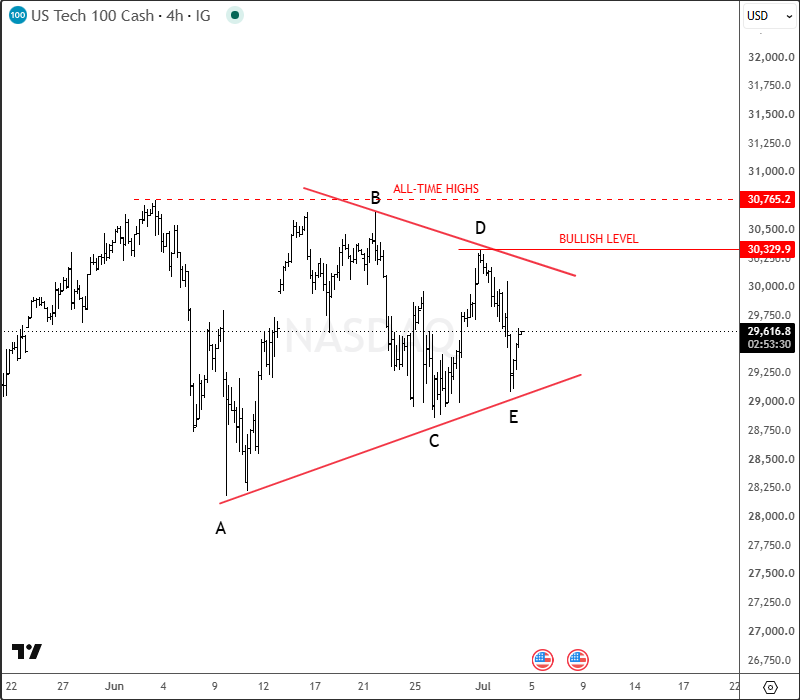
From an Elliott Wave perspective, triangles are continuation patterns. They consist of five overlapping waves labeled A-B-C-D-E, each subdividing into corrective three-wave structures. As the pattern matures, price volatility contracts between converging trendlines, reflecting a temporary balance between buyers and sellers before the prevailing trend resumes.
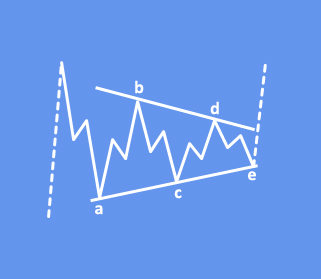
One of the key characteristics of a bullish triangle is that the final wave E often falls short of or slightly overshoots the lower boundary before reversing sharply. Once wave E is complete, the market typically breaks above the upper trendline with increasing momentum, beginning the next impulsive advance. Because triangles are continuation patterns, the post-breakout move is often swift and can cover a distance at least equal to the widest part of the triangle.
For the current NASDAQ 100 structure, the bullish outlook remains valid as long as the triangle continues to unfold. A confirmed breakout above the upper triangle trendline and the 30,329 level would provide the first technical confirmation that wave E has likely ended and that the next bullish impulse is underway. Until then, the ongoing consolidation remains consistent with a healthy pause within the broader uptrend rather than a sign of a larger bearish reversal.



Comments
Log in or sign up to join the conversation.