

Stocks are bouncing higher this morning, so I thought I'd provide a quick, "my $0.02 take" on the action so far.
From my seat, stocks appear to be rebounding based on the following...
- The word that China is going to lift the lock-down in Wuhan for healthy citizens on 4/8 (Public transportation in China may resume as early as tomorrow)
- The White House is talking about easing restrictions on economic activity as early as next week (There are lots of articles on the idea that "the cure is worse than the sickness" with regard to the economy)
- Oil is up on talk of a joint US-Saudi oil alliance
- Congress appears to be getting close on a stimulus bill
- Stocks were due for a bounce
Next, I'd like to point out a positive that you may not be thinking about. It appears that the discounts between the price of various bond ETFs (LQD is the poster child here) and the underlying NAVs are being removed. It has been amazing to me that no one on Wall Street was willing to capture these spreads over the past couple of weeks. But with Fed saying they will do "whatever it takes," traders are beginning to see opportunities again.
The Question of the Day
One of the key questions for today is if this is the "dead cat bounce" or "sigh of relief rally" that everyone has been looking for. Recall that typically, these moves take your breath away to the upside and make you feel like everything is "all better now". I would expect to see a day with at least a 10% gain on Dow/S&P. Will that be today?
Bounce Targets
In terms of where a "sigh of relief" rally could go, I'll turn to Fibonacci retracement levels and the fact that these bounces tend to recover between 30% and 40% of the initial drop. Below is a chart showing the various Fib targets.
S&P 500 Daily With Fibonacci Retracement Levels
(Click on image to enlarge)
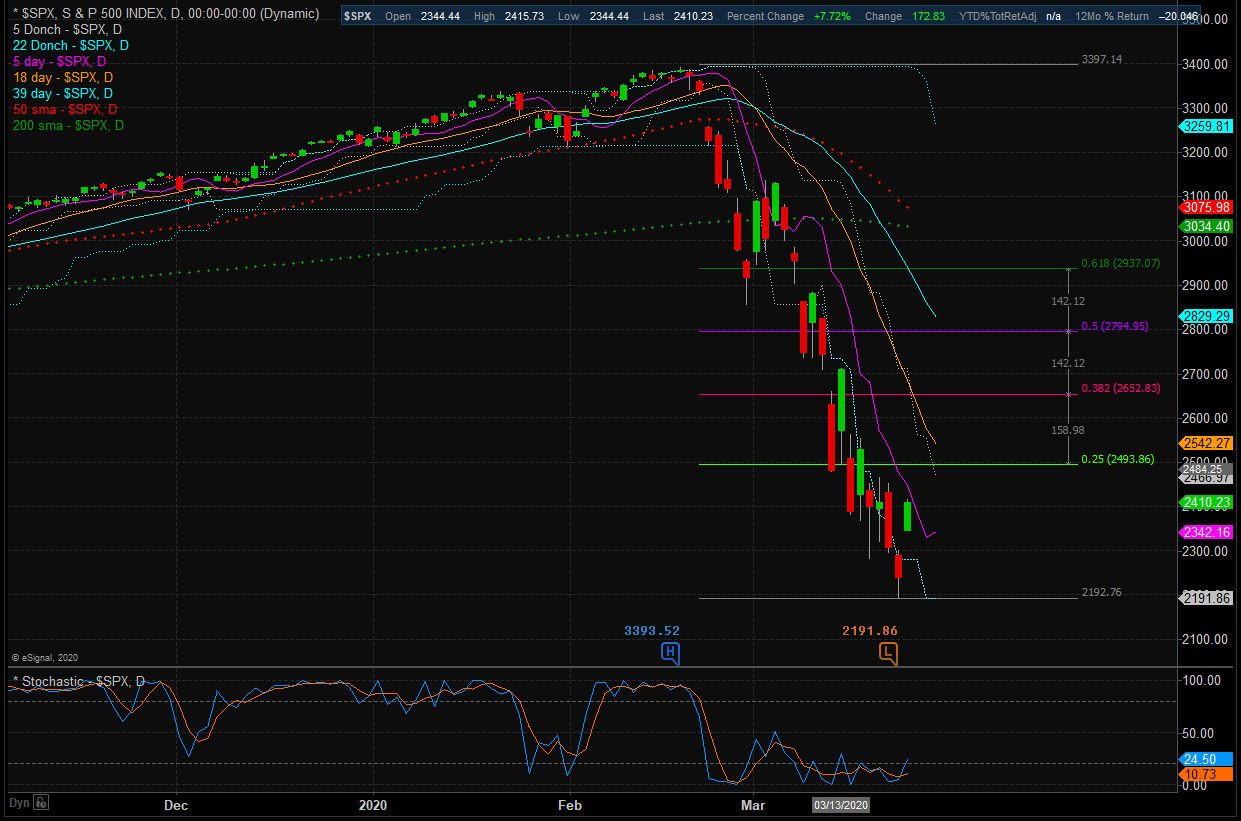
So, the first upside Fibonacci target is 2494, which would be a gain of about 11% from yesterday's close. If the bulls can get this done, the next target – and the most important Fibonacci target - is at 2653 (or +18.6% from Monday's close). For me, the key here is since these levels are very well known by traders, they present logical turning points for the next phase – the "retest."
What I have learned about crashes since 1987, (and make no mistake about it; a crash is what we've got here. This is NOT an economics-based decline, it's an economic cessation-based decline) is that it is very hard and/or dangerous to "play" the first bounce. You see, the only way to know the bottom is actually in is with a healthy dose hindsight. And unfortunately, the whipsaws that can occur if you are wrong with your timing during this phase can be massive.
In my experiences with market crashes, I've found it is important to be patient during the initial rally and to look for what I'll call the "second buy signal." An example here would be the second crossing of a short-term moving average (the orange line in the chart above).
As we've discussed many times previously, stocks usually bounce up then retest the lows after the initial rally fails (from a human standpoint, the initial rally tends to fail due to investors using the bounce to lighten their exposure). The retest causes anyone who "wants out" the opportunity to get out – which winds up producing something call "selling exhaustion." And in my experience, this is when it is best to get back into the pool.
Today is Important
I think the key to today isn't where the market opened, but where it closes. I wouldn't be surprised to see a short squeeze-induced melt up this afternoon. (At the same time, a rally failure wouldn't be terribly surprising either - ha!) But gun to the head, I'd bet on a strong finish today.
Looking Ahead
From here, my strategy is to look for an opportunity to "put the offense back on the field." The biggest question on this front is if a V-Bottom can occur. In short, if the dreaded V-Bottom occurs then one must move sooner rather than later, which can be challenging to say the least.
Therefore, we have to ask the question, how can a V-Bottom occur (in both the market and the economy)? Here are my thoughts...
- A quick flattening of the infection curve in the U.S.
- Better than expected virus news out of Italy/Spain (Note that we are already seeing "good news" out of South Korea)
- A quick re-opening of the US economy - This would need to be accompanied the virus not resurfacing
- An oil deal that creates big rally in crude
- Instant turnaround in high yield spreads
Frankly, I am not sure I completely buy into most of the arguments above. But in this business, it is important to always question your thesis and ask how your strategy might be off.
The bottom line is things change FAST in this game and you must be able to keep up with a change in the outlook/narrative.


Comments
Log in or sign up to join the conversation.