

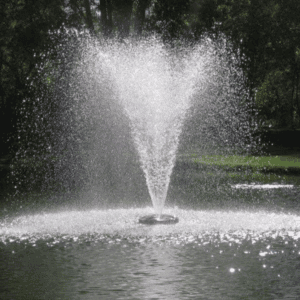
Pond fountains are often designed to create movement and improve water circulation during the day, but their visual impact does not have to end at sunset. Adding multi color LED fountain lights can make a fountain more visible at night by illuminating the water spray and allowing different colors to create changing visual effects.
LED fountain lighting can also be practical because many systems use relatively low-voltage lighting components and can be integrated with compatible floating fountains. The choice of lighting should consider the fountain's size, spray pattern, power requirements, water depth, and the type of nighttime appearance desired.
What Are Multi-Color LED Fountain Lights?
Multi-color LED fountain lights are lighting fixtures designed to illuminate a fountain's water display using different colors.
Unlike fixed white lighting, RGB or other color-changing LED systems can produce multiple hues and may allow users to change colors through a controller, remote, or compatible control system. The light interacts with the moving water, making individual streams and spray patterns more visible after dark.
The effect depends heavily on positioning. Fountain-lighting guidance recommends positioning fixtures so their beams intersect with the spray rather than pointing directly toward viewers. This can improve illumination while reducing harsh glare.
Why Use LED Lights on a Pond Fountain?
There are several reasons pond owners choose LED lighting.
First, LEDs can provide strong illumination from relatively compact fixtures. This makes them suitable for floating fountain assemblies where space and weight are important considerations.
Second, color-changing LEDs provide greater flexibility than fixed lighting. A homeowner can use a single color for an understated landscape effect and switch to brighter or changing colors for special occasions.
Third, many fountain-lighting systems use low-voltage components. A current installation guide for color-changing fountain lights, for example, specifies a 12-volt outdoor-rated transformer for the lighting system.
However, the lighting system still needs appropriate electrical protection because it operates around water.
How Does Color-Changing Fountain Lighting Work?
A color-changing LED fixture contains multiple LED channels that can be combined to create different colors. Depending on the system, a controller determines which LEDs illuminate and how their output changes.
Some systems allow users to select individual colors, while others offer programmed transitions or predefined sequences.
For a pond fountain, the visual effect comes from both the light and the water movement. A tall, narrow spray may create a concentrated column of color, while a wider nozzle can distribute the illumination across a larger area.
This is why the fountain's nozzle pattern should be considered before selecting a lighting configuration.
How Many Lights Does a Fountain Need?
There is no universal number of lights for every fountain.
The appropriate number depends on:
Fountain diameter
Spray height
Spray width
Number of nozzles
Light intensity
Fixture position
Viewing angle
Desired brightness
A smaller fountain may only require a few strategically positioned fixtures. For example, Friendly Fountains currently lists a lighted 1/3 HP fountain configuration using three 12-volt, 6-watt LED lights, available in white or color-changing versions.
The objective is even illumination rather than simply increasing the number of fixtures. Too few lights can leave portions of the spray dark, while excessive brightness can produce glare.
What Is a 1/3 HP Pond Fountain?
A 1/3 HP pond fountain uses a motor rated at one-third horsepower to pump water through a fountain nozzle.
Horsepower is only one specification, however. Pump flow rate, nozzle design, water depth, and fountain geometry all affect the final water display.
One current 1/3 HP floating fountain specification lists a 4,000 GPH pump, 120V operation, interchangeable spray nozzles, and a floating platform design.
Another 1/3 HP fountain system lists multiple spray patterns with displays reaching different heights and widths depending on the nozzle selected.
Therefore, buyers should compare complete fountain specifications instead of choosing equipment solely by horsepower.
Is a 1/3 HP Fountain Suitable for Smaller Ponds?
A 1/3 HP fountain can be appropriate for small to mid-sized ponds, depending on the specific model and site conditions.
The fountain must have sufficient water depth for safe and effective operation. One current 1/3 HP model is specified for small to mid-sized ponds, while other comparable systems list a minimum operating depth of approximately 24 inches.
Pond owners should always check the manufacturer's requirements because minimum depth, recommended pond size, flow rate, and spray dimensions can differ between models.
How Should LED Lights Be Positioned?
Correct positioning can make a significant difference in the nighttime appearance of a fountain.
Lights are commonly placed around the fountain's nozzle assembly and directed upward so that the beams pass through the water spray. Fountain-lighting guidance recommends placing fixtures below the water surface and close enough to the nozzle to illuminate the streams evenly.
Avoid positioning lights directly toward the main viewing area. This can create glare and make the fixture itself more noticeable than the fountain.
Instead, the goal is for viewers to see the illuminated water rather than stare into the light source.
White vs. Multi-Color Fountain Lighting
Both white and color-changing LEDs have advantages.
White Lighting
White LEDs can create a clean, natural appearance. They are particularly suitable for landscapes where the fountain should remain visually subtle after dark.
White illumination can also make water movement easier to see without introducing strong color effects.
Multi-Color Lighting
Color-changing LEDs create a more dramatic appearance. They can be useful for parties, celebrations, holidays, outdoor entertainment areas, or properties where the fountain serves as a nighttime focal point.
A color-changing system can also provide variety without requiring the lighting fixtures themselves to be replaced.
Does Lighting Affect Pond Wildlife?
Artificial lighting can influence activity around a pond.
Lights may attract insects, which can subsequently attract frogs, fish, birds, and other wildlife. Excessive or continuous lighting may also affect natural nighttime behavior.
For this reason, a timer can be useful. Fountain-lighting guidance recommends moderate illumination and timed operation to balance aesthetics with the surrounding pond environment.
A practical approach is to operate the lights during the hours when the fountain is most likely to be viewed rather than leaving them illuminated throughout the entire night.
What Electrical Safety Measures Are Important?
Water and electricity require careful installation.
Outdoor pond fountains should use appropriate GFCI protection. A GFCI monitors electrical current and can disconnect power when it detects a ground fault. This is particularly important around water features where moisture, damaged wiring, and electrical equipment can create additional risks.
Low-voltage lighting does not eliminate the need for proper electrical protection. Lighting components should be installed according to the manufacturer's instructions, with suitable transformers, connectors, cables, and outdoor-rated equipment.
Installation guides for color-changing fountain lighting also specify protecting control components from direct exposure to the elements.
Electrical work should follow local codes, and a qualified electrician should be used when professional electrical installation is required.
Can You Add Lights to an Existing Fountain?
In many situations, compatible LED lighting can be added to an existing floating fountain.
Before purchasing a separate light kit, verify:
Fountain model
Float design
Nozzle configuration
Voltage requirements
Transformer specifications
Fixture mounting method
Cable length
Number of lights supported
Compatibility is especially important because not every lighting kit is designed for every fountain.
If the fountain manufacturer offers a lighting kit specifically designed for the fountain model, that can simplify installation and reduce compatibility concerns.
How Do You Maintain Fountain Lights?
Regular inspection can help identify problems before they become more serious.
Check the fixtures for:
Mineral deposits
Algae buildup
Physical damage
Loose connections
Damaged cables
Reduced brightness
Water intrusion
Clean fixtures according to their manufacturer's instructions. Do not handle electrical components while the system is connected to power.
It is also useful to inspect the fountain intake and pump because leaves, sediment, and other debris can reduce water flow. A restricted flow can change the fountain's spray pattern and consequently affect how evenly the lights illuminate the water.
What Should You Consider Before Buying?
Before choosing a color-changing fountain-lighting system, evaluate the entire water feature.
Consider the pond's dimensions, fountain horsepower, nozzle pattern, operating depth, electrical access, desired lighting effect, and viewing distance.
For a 1/3 HP pond fountain, confirm the pump's flow rate and spray dimensions before deciding how many lights you need. A fountain producing a wide spray may require different light positioning than one producing a tall, concentrated column.
Also consider whether you want fixed colors, gradual transitions, or programmable effects. The simplest system may be sufficient for a residential landscape, while more advanced controls can be useful for event spaces.
Final Thoughts
Multi color LED fountain lights can transform a pond fountain from a daytime water feature into a more noticeable nighttime centerpiece. Their ability to produce different colors gives homeowners flexibility to create subtle landscape lighting or more dramatic displays for special occasions. When pairing lighting with a 1/3 HP pond fountain, look beyond the motor rating. Pump flow, nozzle selection, spray dimensions, operating depth, light placement, and electrical requirements all influence the finished result. A current 1/3 HP fountain specification, for example, provides 4,000 GPH of flow and interchangeable nozzles, while a lighted version uses a three-light LED configuration for nighttime illumination.
Comments
Log in or sign up to join the conversation.