

September 13, 2017 concludes the 180-day lockup period on MuleSoft Inc. (NYSE: MULE).
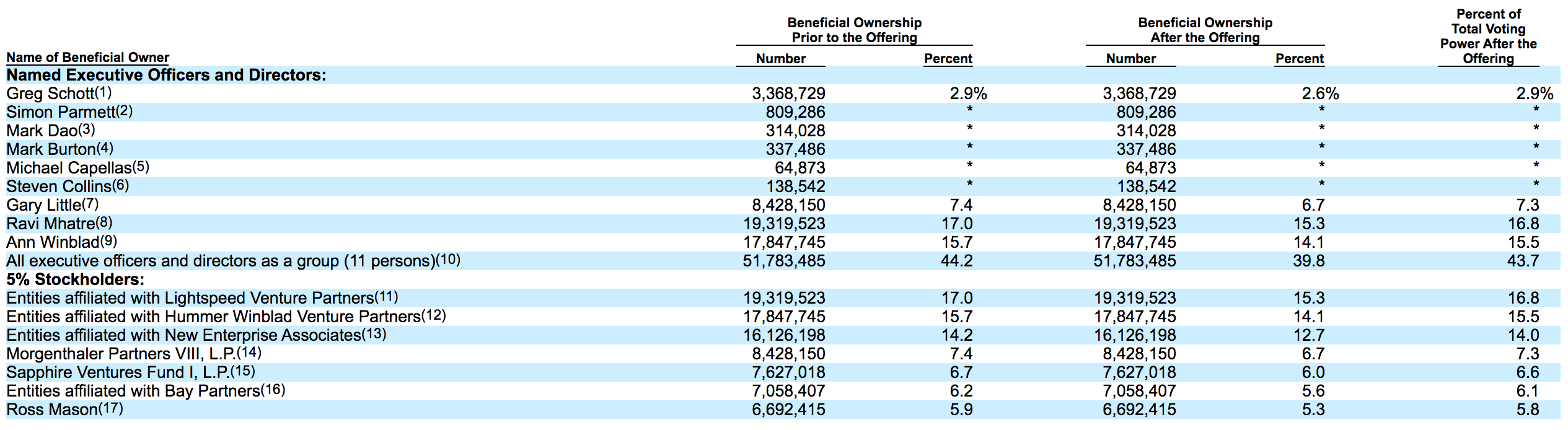
When the lockup period ends for MULE, its pre-IPO shareholders, directors and executives will have the chance to sell their 112.9 million shares for the first time since the IPO. The potential for a sudden increase in stock available in the open market may cause a significant decrease in the price of MuleSoft shares.
Currently, MULE trades in the $21.50 to $23 range, well above its IPO price of $17. This represents an increase of ~27%.
Our firm’s research has shown significant price declines surrounding many IPO lockup expirations, particularly for firms like MULE where a large number of shares - here, approximately 89% - are restricted. Additionally, VC investors tend to be particularly eager to sell once restrictions are lifted.
(Click on image to enlarge)
Business Overview: Provider of the Anypoint Platform
MuleSoft owns and operates its Anypoint Platform, which integrates and connects applications, devices, and data sources. Clients may use the platform either on-site or access it via the cloud. The hybrid integration platform enables clients to connect their applications, devices, and data into a network with pluggable APIs rather than gluing them together with customized integration code.
This means that additional applications can be built rapidly with building blocks, giving organizations the ability to scale, innovate, and change applications, which prevents bottlenecks. The company was formerly known as MuleSource Inc. and changed its name to MuleSoft, Inc. in September 2009. MuleSoft, Inc. was incorporated in 2006 and is headquartered in San Francisco, California.
Financial Highlights
MuleSoft reported the following highlights for the second quarter of fiscal 2017, which ended on June 30, 2017:
- Total revenue was $69.2 million, an increase of 57% year over year.
- GAAP gross margin was 73.5%, an increase of 40 basis points compared to the same period in 2016. Non-GAAP gross margin was 75.1% for Q2 2017, an increase of 160 basis points compared to the same period in 2016.
- GAAP operating loss was $19.0 million, compared to a GAAP operating loss of $11.8 million for the same period in 2016. Non-GAAP operating loss for Q2 2017 was $12.1 million, compared to a non-GAAP operating loss of $10.4 million for the same period in 2016.
- GAAP net loss per share was $0.15 based on 128.8 million weighted average shares outstanding in the second quarter of 2017. The GAAP net loss per share for the second quarter of 2016 was $0.60.
- Non-GAAP net loss per share was $0.10 based on 128.8 million non-GAAP weighted average shares outstanding in the second quarter of 2017. The non-GAAP for the second quarter of 2016 was $0.10.
Management Team
CEO Gregory Schott has been in his position since 2009. His previous experience comes from positions at SpringSource, Agile Software, Digital Generation Systems, The Boston Consulting Group, Westinghouse, and IBM. Mr. Schott received an MBA from Stanford University and a B.S. summa cum laude, in Mechanical Engineering from North Carolina State University.
President of Field Operations Simon Parmett has served in his position since November 2016, and joined MuleSoft in 2011. His previous experience comes from senior positions at Oracle, Agile Software, and SG Partners. Mr. Parmett holds an MBA from the Amos Tuck School of Business at Dartmouth College and a BA in Economics from the University of Pennsylvania.
Competition: IBM, Oracle, Tibco
Although MuleSoft believes its product is the only complete solution for building application networks, the company lists its primary competitors as IBM, Oracle (ORCL) and Tibco. According to Morningstar, other industry peers include SAP (SAP), Adobe (ADBE), Salesforce.com (NYSE:CRM), Intuit (INTU), Autodesk (ADSK), Workday (WDAY), and ServiceNow (NOW).
|
Market Cap (mil) |
Net Income (mil) |
P/B |
P/E |
|
|
MuleSoft |
$2,778.0 |
($58.0) |
10.9 |
n/a |
|
SAP |
$124,952.0 |
$3,447.0 |
4.3 |
30.5 |
|
Adobe |
$75,066.0 |
$1,443.0 |
9.6 |
53.0 |
|
$67,435.0 |
($80.0) |
8.0 |
n/a |
|
|
Industry Average |
$2,682.0 |
$293.0 |
6.9 |
115.3 |
Early Market Performance
MuleSoft’s IPO priced at $17 per share is a much higher price than its expected price range of $12 to $14. The stock closed on the first day of trading at $24.75. Since then, the stock reached a high of $28.38 on May 26. Shares declined rapidly in early July to reach a low of $19.03 on July 6, but the price has recovered slightly to now trade in the $21.50 to $22 price range. MULE's return from IPO is currently more than 26%.
Conclusion: Short MULE Shares Prior To 9.13
Restricted shares are held by several venture capital firms, eleven company officers and one individual owner (listed above).
We anticipate that the VC investors will be particularly eager to cash in on gains and move on to their next investment. If even a few of these major insiders choose to sell, they could overwhelm the supply of shares currently on the market and send the share price down.

After MULE's strong IPO and early market performance, we believe that the previously-restricted venture capital firms and insiders will be ready to take profits and see an enormous opportunity to short MULE shares ahead of the event.
We recommend investors sell shares ahead of the lock-up expiration and event-driven traders consider shorting the stock.

Comments
Log in or sign up to join the conversation.