

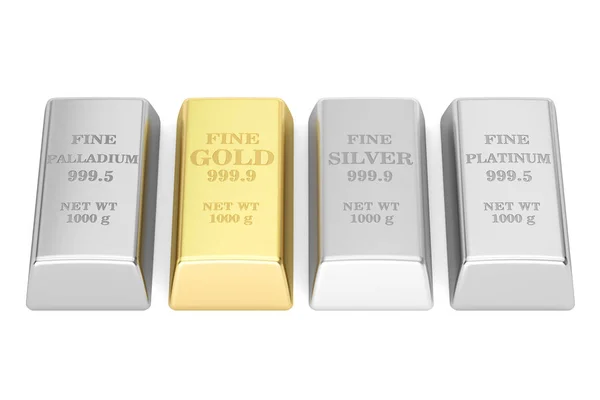
Clients asked me to explain in more detail some of the metal and materials terms I previously discussed with them.
Monetary metals (MMs), sometimes called metal or metallic money, are the metals that have historically functioned or served as money in societies or can be or were considered synonymous with money. Many or most people would only think of gold and silver as MMs, since the yellow metal and the white metal were used as such by law in the past. However, some centuries ago, both copper and bronze were utilized as MMs as well, although they were never viewed as valuable as gold or silver.
Precious metals (PMs) are metallic elements that occur naturally, are found in Earth´s crust (surface) and are relatively rare or scarce, i.e., they are limited in quantity. Many or most people would only think of gold, silver and platinum as PMs. But eight metals are regarded as precious. The four main PMs are gold, silver, platinum and palladium. Rhodium, ruthenium, iridium and osmium are the other PMs. From a chemical stability standpoint, the PMs are also noble metals in the sense that they are typically highly corrosion and oxidation-resistant. Copper may be considered a MM, but it is not a PM; it is a base or industrial metal.
Platinum group metals (PGMs) are a family of six PMs. The major or primary PGMs are platinum, palladium and, to a lesser extent, rhodium. Ruthenium, iridium and osmium are the minor or secondary PGMs. Platinum is the most important metal in the group. The PGMs are not considered MMs.
Both the U.S. government and the European Commission (EC) of the European Union (EU) view the PGMs (except osmium) as strategic raw materials (SRMs), because of their extensive usage in the key chemical, energy (fuel, petroleum) and electronic industries. Thus, the PGMs are of critical or strategic importance to the two large economic areas. Platinum and palladium, sometimes the whole group of platinum metals as well, are therefore commonly called industrial or strategic PMs.
The EC categorizes certain raw materials, i.e., metals and minerals, as critical since their production is geographically concentrated in one or a few countries and has low or no potential for recycling and/or substitution; hence, the supply of these naturally occurring materials is considered critical for the EU countries. Occasionally, the names rare earth elements (REEs), rare earth metals or rare earth minerals are used instead of critical raw materials (CRMs).
At times, critical may refer to both the economic significance and the risk of supply interruption, while strategic may refer to the global production being sufficiently diversified, and thus the supply risk is relatively low, but the production is viewed as a fundamental and vital economic resource.
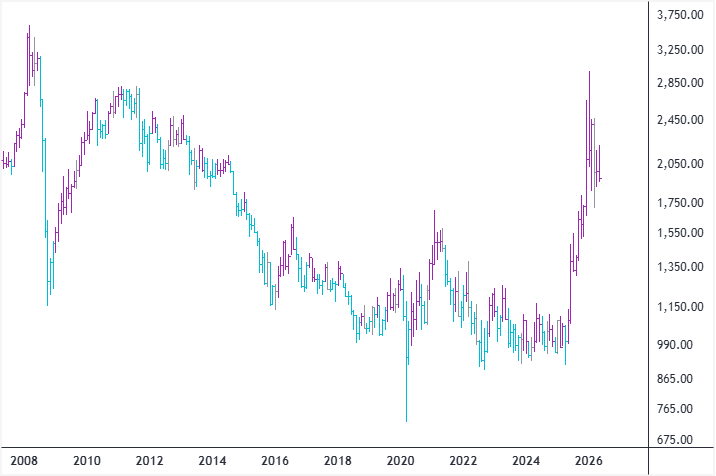
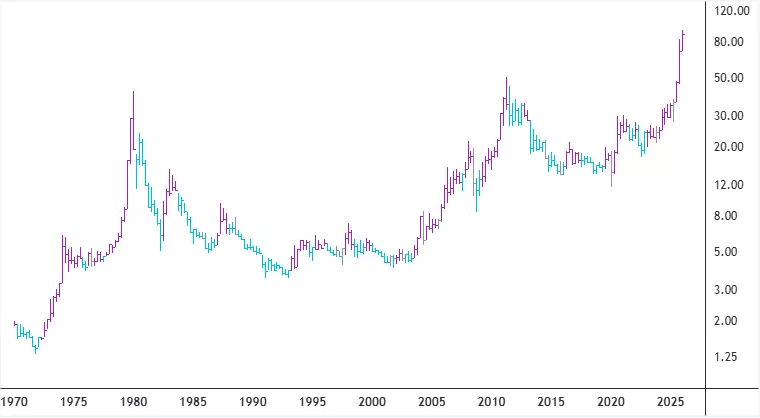
Unlike the inflation-adjusted price of gold, the prices of silver and platinum - adjusted for U.S. inflation - have not risen to new all-time highs.
Price of Platinum Adjusted for U.S. Inflation (BLS´s CPI) - Monthly Graph
Comments
Log in or sign up to join the conversation.