

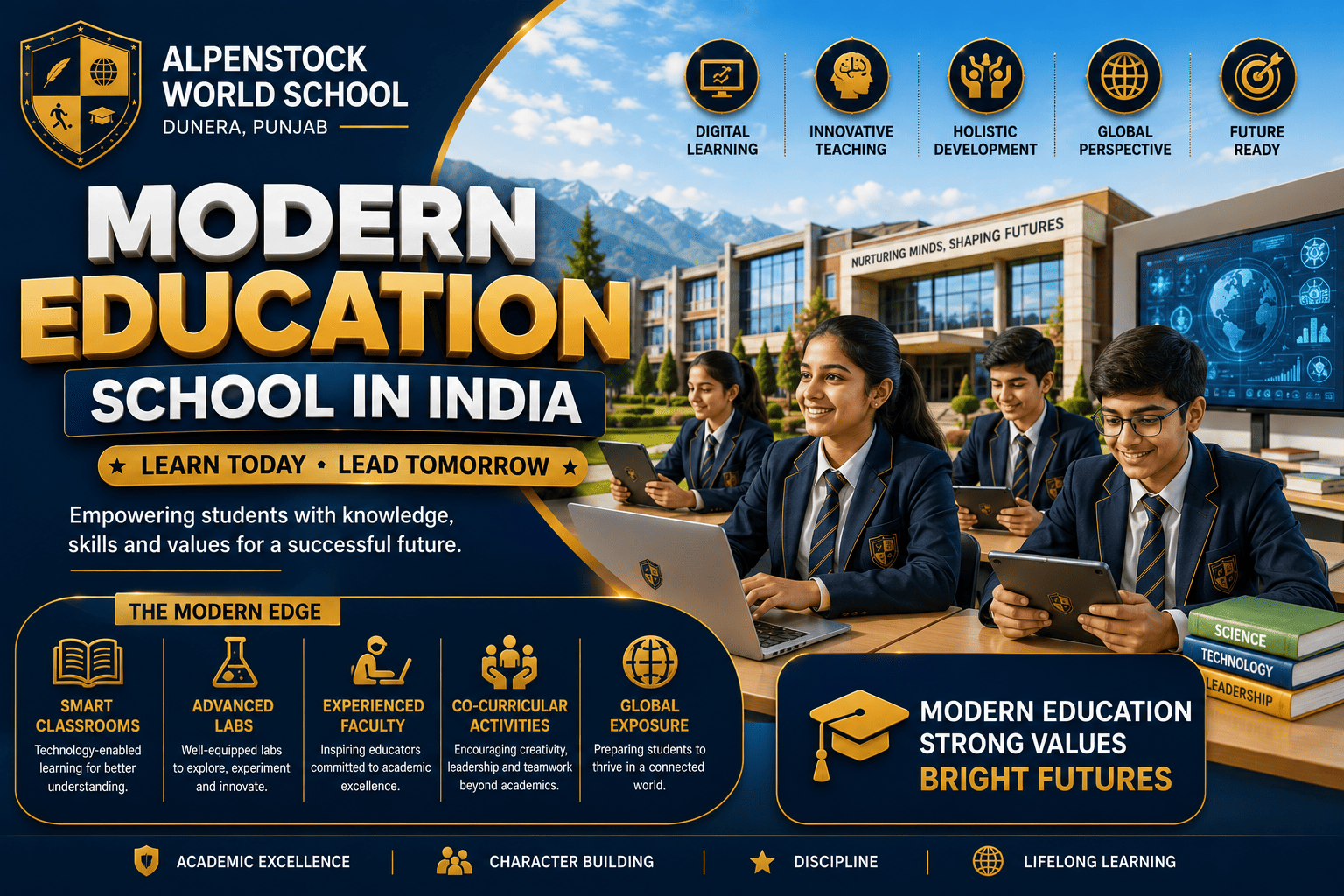
Education is changing faster than ever. Students today are preparing for careers that may require skills beyond traditional academic knowledge. Technology, international collaboration, artificial intelligence, digital communication, and changing workplace expectations have made it essential for schools to provide a broader and more future-focused learning experience.
As a Modern education school in India, Alpenstock World School focuses on developing students through a balanced combination of academics, technology, communication, creativity, activities, and personal development. The objective is to help learners become confident, adaptable, and responsible individuals who are prepared for higher education and future career opportunities.
What Is Modern Education?
Modern education is more than learning from textbooks and preparing for examinations. It encourages students to understand concepts, ask questions, solve problems, collaborate with others, use technology responsibly, and apply knowledge in practical situations.
A modern learning environment focuses on skills such as:
Critical thinking
Communication
Creativity
Collaboration
Digital literacy
Leadership
Problem-solving
Adaptability
These skills can help students navigate university life and professional environments where teamwork, innovation, and continuous learning are increasingly important.
1. Technology-Enabled Learning
Technology has become an integral part of modern education. Digital resources can make lessons more interactive and give students access to different ways of understanding and exploring concepts.
As a School with digital learning in Punjab, Alpenstock World School integrates technology-supported learning with classroom education. Digital tools can help students research topics, prepare presentations, explore educational resources, and engage with concepts visually.
The purpose of digital learning is not simply to introduce students to devices. It is about teaching them how to use technology as a tool for learning, creativity, research, and communication.
This familiarity can be valuable as students move towards universities and careers where digital platforms are part of everyday academic and professional life.
2. Strong Academic Foundations
Technology and activities are valuable, but strong academics remain the foundation of future success.
Alpenstock World School provides an ICSE-oriented academic environment that encourages students to develop conceptual understanding, language skills, analytical thinking, and subject knowledge.
Parents searching for a Top ICSE school in Punjab often look beyond examination preparation. They may also consider the curriculum, teaching environment, activities, technology, student development, and opportunities for holistic growth.
A strong academic foundation can help students make informed decisions about higher education and explore different career pathways.
3. Developing Communication Skills
Communication is one of the most important skills for global careers. Students may eventually interact with people from different cities, countries, cultures, and professional backgrounds.
Modern education therefore encourages students to express themselves clearly through speaking and writing.
At Alpenstock World School, opportunities for presentations, discussions, group activities, and participation can help students develop confidence in communication.
Good communication can support students in university presentations, interviews, group projects, competitions, internships, and professional environments.
Students who learn to listen carefully, explain their ideas, respect different opinions, and communicate confidently can become more effective collaborators.
4. Building Critical Thinking
The modern workplace requires people who can analyse information and make thoughtful decisions.
Critical thinking encourages students to move beyond simply memorising information. They learn to ask questions, examine different perspectives, identify problems, and consider possible solutions.
Classroom discussions, projects, activities, and practical learning can create opportunities for students to apply critical-thinking skills.
For future professionals, this ability can be valuable across fields such as business, science, technology, medicine, engineering, design, education, and communication.
5. Encouraging Creativity and Innovation
Creativity is not limited to artistic subjects. It can also involve finding new solutions, approaching challenges differently, developing ideas, and improving existing processes.
Alpenstock encourages students to explore their interests through academic and co-curricular opportunities. Activities involving arts, sports, projects, presentations, and creative expression can provide students with opportunities to discover their strengths.
A creative mindset can help students become more comfortable with experimentation and learning from mistakes—qualities that are increasingly valuable in innovative professional environments.
6. Learning Through Collaboration
Many global careers involve teamwork. Professionals may work with colleagues located in different cities or countries and may need to collaborate using digital platforms.
School activities can provide an early opportunity to understand how teamwork works.
Group projects, sports, classroom activities, and collaborative tasks can teach students how to divide responsibilities, communicate with teammates, manage disagreements, and work towards shared goals.
These experiences can strengthen interpersonal skills that are difficult to develop through individual study alone.
7. Developing Leadership and Confidence
Leadership is another important quality for students preparing for future careers.
A good leader needs more than authority. Leadership involves responsibility, communication, decision-making, empathy, confidence, and the ability to support others.
Schools can help students develop these qualities by giving them opportunities to participate in activities, take responsibility, lead teams, organise tasks, and contribute ideas.
At Alpenstock World School, holistic development creates opportunities for students to grow beyond academics and become more confident in their abilities.
8. Preparing Students for a Global Environment
Globalisation has connected education and employment across borders. Students may choose to pursue higher education in another country, work with international organisations, or collaborate with global teams while remaining in India.
This requires an open-minded and adaptable approach.
Modern education can help students understand different perspectives, respect diversity, communicate effectively, and remain curious about the world.
A global outlook does not mean forgetting local values. Instead, it means helping students become confident individuals who can participate in a wider world while maintaining strong personal and cultural foundations.
9. Importance of Holistic Development
Academic performance is only one aspect of a student's development.
Sports can teach discipline and teamwork. Performing arts can build confidence and expression. Visual arts can encourage creativity. Activities can develop social skills and leadership.
A balanced school environment gives students opportunities to explore different interests and discover abilities that may not always appear through academic assessments.
This holistic approach can help students develop emotional confidence, social awareness, physical fitness, creativity, and responsibility alongside academic knowledge.
10. Preparing Students for Future Careers
No school can predict exactly what every student will become. However, schools can prepare students with transferable skills that remain useful as industries change.
The most valuable future-ready abilities include:
Digital literacy: Understanding and using technology effectively.
Communication: Expressing ideas clearly and confidently.
Problem-solving: Finding practical solutions to challenges.
Critical thinking: Evaluating information and making informed decisions.
Creativity: Developing new ideas and approaches.
Collaboration: Working effectively with different people.
Adaptability: Responding positively to changing circumstances.
Alpenstock World School's approach combines these skills with academic learning to create a foundation for future opportunities.
Why Parents Choose a Future-Ready School
Choosing a school is an important decision because the environment can influence a child's academic, social, and personal development.
Parents increasingly look for schools that provide more than classroom instruction. They want opportunities for technology-enabled learning, activities, sports, arts, communication, leadership, and personal growth.
A modern school should also encourage students to become independent learners who can continue developing their skills throughout life.
Alpenstock World School aims to create such a learning environment by combining academics with technology and holistic development.
Frequently Asked Questions
What is a Modern education school in India?
A Modern education school in India combines academic learning with technology, critical thinking, communication, creativity, collaboration, and practical experiences. The focus is on preparing students for higher education, careers, and changing real-world environments.
How does digital learning benefit students?
Digital learning can make lessons more interactive and help students research, create presentations, access educational resources, and develop digital literacy. These skills can support students in higher education and future workplaces.
Why consider an ICSE school for future education?
ICSE-oriented education can provide a broad academic foundation while supporting conceptual understanding, language development, and analytical skills. Parents should also evaluate teaching quality, activities, technology, and overall student development when selecting a school.
How does Alpenstock prepare students for global careers?
Alpenstock combines academic learning with digital education, communication, activities, sports, arts, collaboration, and leadership opportunities. This holistic approach helps students develop transferable skills that can support future academic and professional pathways.
Conclusion
The careers of tomorrow will require students to be adaptable, digitally confident, creative, communicative, and capable of solving complex problems. Preparing for that future starts with the right educational environment.
Alpenstock World School combines academic learning with technology, activities, communication, creativity, collaboration, and holistic development. As a Modern education school in India, it aims to help students build the knowledge and skills needed to approach higher education and future career opportunities with confidence.
For parents seeking a school that looks beyond traditional classroom learning, a future-focused educational approach can provide children with a strong foundation for a rapidly changing global world.
Comments
Log in or sign up to join the conversation.