


Finominal did a review of the Russell Investments Growth Portfolio. It's a model portfolio consisting entirely of Russell's mutual funds. The review came via email, so no link to share.
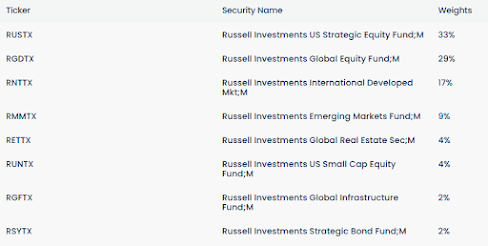
Some of their funds are shockingly big. The first two listed have $3 billion and almost $4 billion, respectively. The Morningstar ratings for the various funds are mixed.
Finominal notes general underperformance and a slightly lower Sharpe Ratio versus the All Country World Index, which can be tracked with the ACWI ETF and is suggested as a one-fund replacement for the entire Russell Portfolio. There is quite a bit of overlap/duplication between the two largest funds, which I believe makes for poor model construction.
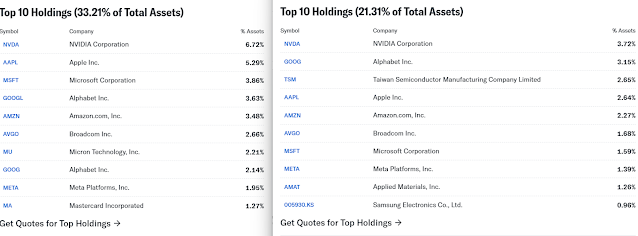
Arguably, the 79% split between RUSTX, RGDTX, and RNTTX could just all go into RGDTX, the global fund.
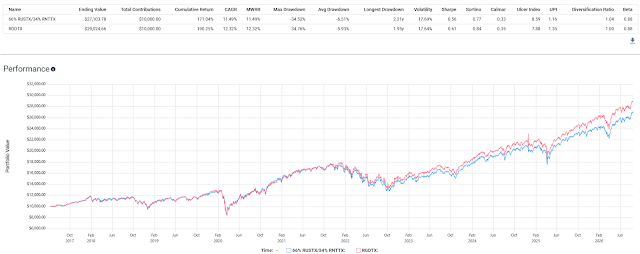
The concept of building model portfolios is very useful, but too often, models are more about fund sales than providing robust or even just differentiated solutions.
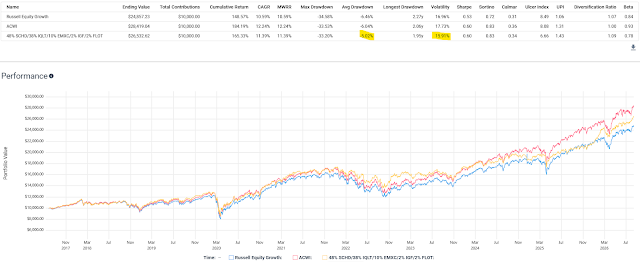
Portfolio 3 is close to what we looked at recently, using factors (dividends and quality) to get sort of broad exposure to global markets while being intentionally light on tech. EMXC is very heavy in tech that is volatile, but adding 10% in still leaves the portfolio underweight versus the model and ACWI at about 15% versus 30%. Portfolio 3 tracked pretty closely for most of the backtest, but in 2022, at its low, it was 500 basis points better than the model and ACWI, so it differentiated when you'd want it to. Going forward, if something bad happens with tech, I would expect Portfolio 3 to do a little better than the model, and if tech continues to do very well, then Portfolio 3 should lag.
Models really can be a good way to go, but owning more funds just to create the appearance of complexity is something to watch out for, and another one is when all the funds are from the same provider, like in the case of Russell using only their funds. That's pretty common, but there's no reasonable way that can be optimal.
False complexity and just one fund provider are pretty simple filters to narrow the field and then better focus on more useful models and what they are likely to do. For example, the SCHD/IQLT dominated model should lag if tech takes another big move up, as I said. The model, simple as it is, is valid and potentially robust, at least a bit, but eventually the regime will change, and it would need to be updated. If the model is well constructed, it shouldn't need to be changed constantly, though; frequent changes are a different type of strategy than a model portfolio.



Comments
Log in or sign up to join the conversation.