

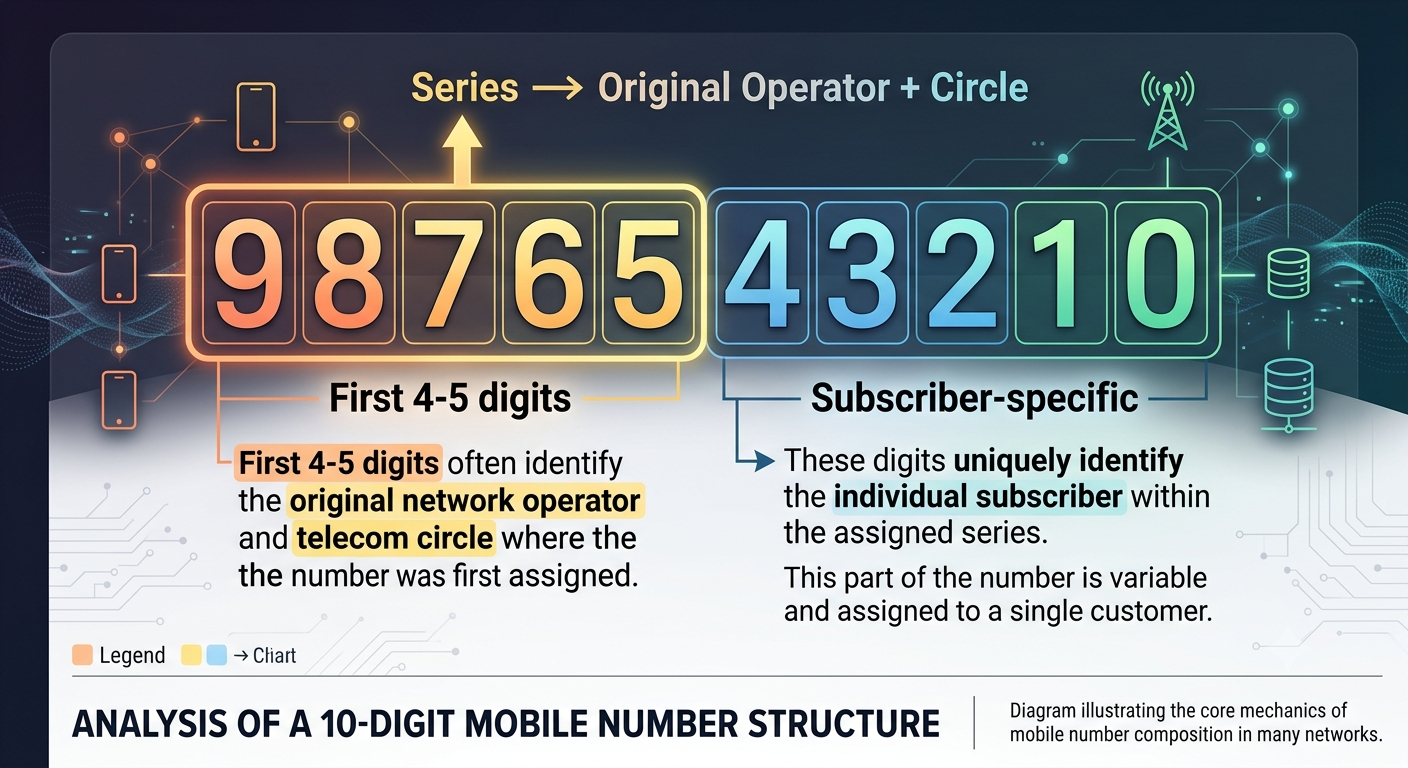
Pick up almost any Indian mobile number and, before you even run it through a tool, it's already telling you something — which operator originally issued it, and roughly which part of the country it's registered in. A mobile number finder just makes that information explicit and fast, but understanding the system underneath it makes the results far more useful than treating it as a black box.
This article looks specifically at how mobile number identification works in India — the numbering structure, telecom circles, and the one big complication (number portability) that trips up a lot of lookup results.
How Indian Mobile Numbers Are Structured
Every 10-digit Indian mobile number isn't random. The first few digits — typically the first four to five — form a "series" that was originally allocated by the Department of Telecommunications (DoT) to a specific operator within a specific telecom circle (a defined geographic licensing zone, roughly mapping to a state or group of states).
This is why a basic mobile number lookup can usually tell you two things almost instantly just from the number itself:
Original issuing operator — based on which series the number falls into (a block historically assigned to Airtel, Jio, Vi, BSNL, and so on).
Telecom circle of registration — India is divided into 22 telecom circles for licensing purposes (covering states and metro regions like Delhi, Mumbai, and Kolkata separately), and the number series maps to one of these.
This is fundamentally different from how many other countries structure mobile numbers, where area codes are tied to a fixed metro region with much more rigid geographic precision. India's circle system is broader — it tells you a region, not a city — and it's based on original allocation, not necessarily where the SIM is being used today.
The Big Complication: Mobile Number Portability (MNP)
Here's where pure number-series lookups start to break down. Since 2010, India has allowed Mobile Number Portability — the ability to switch operators while keeping the same number. Someone whose number was originally issued in a Jio series can port to Airtel (or vice versa) and keep dialing the exact same ten digits.
This means a basic series-based lookup might tell you the original operator, not necessarily the current one. A proper mobile number finder accounts for this by cross-referencing live porting databases rather than relying purely on the static numbering series — which is the difference between a tool that's accurate today and one that's stuck reflecting allocations from years ago.
A few practical implications of this:
"Operator" results can be wrong if a tool only uses series data. Always treat the operator field as "originally issued by," unless the tool explicitly states it checks live porting status.
Circle/region data tends to stay more reliable than operator data, since porting changes the carrier but doesn't typically reassign the number to a different circle.
Spam and scam patterns sometimes cluster around ported numbers, since a recently ported number can momentarily slip past a carrier's existing fraud-detection history tied to the old operator.
What a Mobile Number Finder Can Tell You — Realistically
Putting the mechanics together, here's a realistic picture of what a basic, free lookup can offer for an Indian mobile number:
Telecom circle / region — reasonably reliable, since this is tied to original allocation and rarely changes.
Originally issued operator — reliable as a historical fact, less reliable as a "who's calling me right now" indicator due to porting.
Current operator (if the tool checks live MNP data) — more useful, but not every free tool does this lookup, since it typically requires access to porting databases that aren't fully public.
Name and address — generally not available for mobile numbers through free tools. This level of detail is far more achievable for landline numbers, where directory-style records have historically been more public, but Indian mobile subscriber data is protected and isn't something a legitimate free lookup tool will hand over.
Why This Matters Beyond Curiosity
Knowing the mechanics isn't just trivia — it has practical uses:
Spotting mismatched claims. If a caller claims to be calling from a local business in one city but the number's circle clearly traces to a completely different region, that's a reasonable flag worth noting, even though it's not proof of anything on its own.
Understanding SMS and call patterns. Bulk SMS headers and certain call patterns are sometimes tied to specific circles or operator blocks, which is part of why telecom regulators track number series so closely for spam enforcement.
Setting realistic expectations. Knowing upfront that "name and address" isn't realistically available for a mobile number search saves time chasing tools that overpromise on this specific data point.
A Quick Practical Checklist
When running a mobile number finder search on an Indian number, it helps to:
Treat the circle/region result as the most stable data point.
Treat the operator result as "originally issued by" unless the tool confirms it checks live porting data.
Not expect a name or address match for mobile numbers — that's a landline-era expectation that doesn't carry over.
Cross-reference with a second tool or a quick search if the result needs to inform a real decision (blocking, reporting, or trusting a caller's claim).
The Bottom Line
A mobile number finder in the Indian context is really reading a numbering and licensing system that's decades old, layered on top of a portability rule that's been reshuffling operator-to-number mapping since 2010. Understanding that layering is what separates someone who reads a lookup result correctly from someone who takes "Operator: Airtel" at face value when the number actually ported away years ago.
Comments
Log in or sign up to join the conversation.