

I had so many questions over the past two days that I am going to try to answer them in the context of this update. Let me reiterate for the umpteenth time: using politics to drive investing decisions is a loser’s game. Sorry to be so blunt again. I heard from folks celebrating the midterm results as an all-out buy signal for stocks and risk. Not only did I laugh, I told them they would soon part with their money, not because I saw Thursday’s plunge coming, but because it’s among the dumbest things I have ever heard. I asked what from the midterms was going to juice the economy, corporate earnings or put more money into consumers’ pockets. No answer. Thanks, not a single client of ours fell in that group.
Wednesday’s post-election action made my head shake. I could not figure out why the market was soaring early and what changed overnight. After all, there was a 95% chance of divided government or shared power heading into Tuesday. And in the end, while the majority was stronger than expected, it wasn’t enough to override a presidential veto.
Thursday was a mini-crash. That’s my qualitative label. And it was far more damaging than Wednesday was constructive. Losses were multiples of what the gains were. To me, watching all day, it looked largely machine-driven and not mom-and-pop selling 100s or 1000s of shares. I won’t get wonky on you and talk about market structure, vol control funds, and gamma.
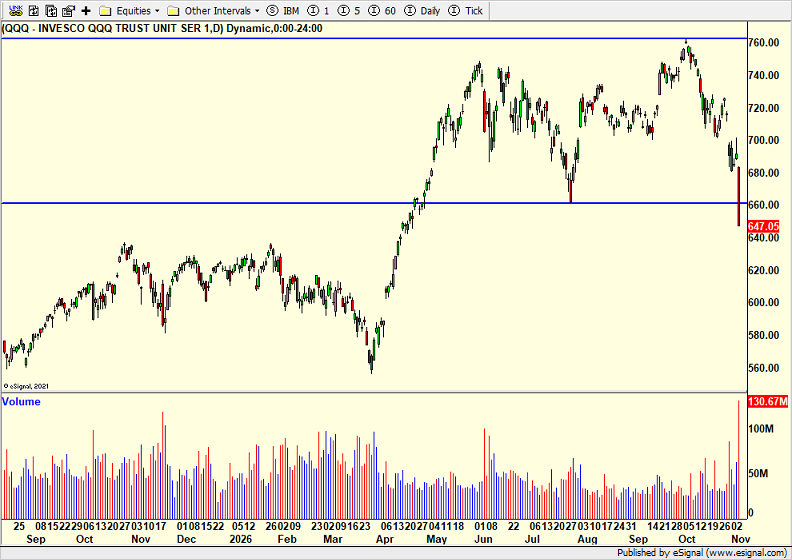
The Nasdaq 100 went from new highs to six-month lows in just over a month. Many times I have written that one of the key ingredients to a panic low is a spike in volume for the QQQs. On Thursday, that number hit 130M, the highest level since the tariff tantrum in April 2025. That checks one box.
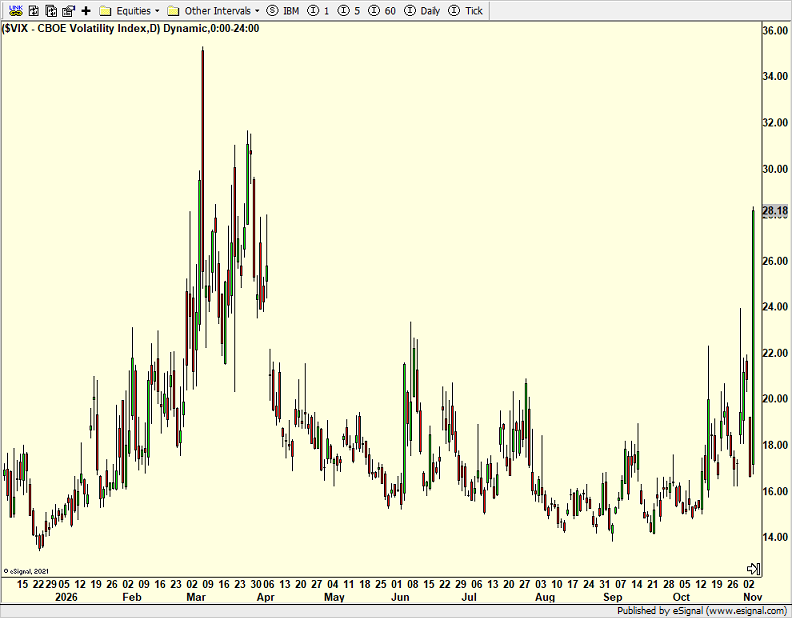
Next is volatility. While it certainly spiked, I would have expected a move over 30, which may still be coming.
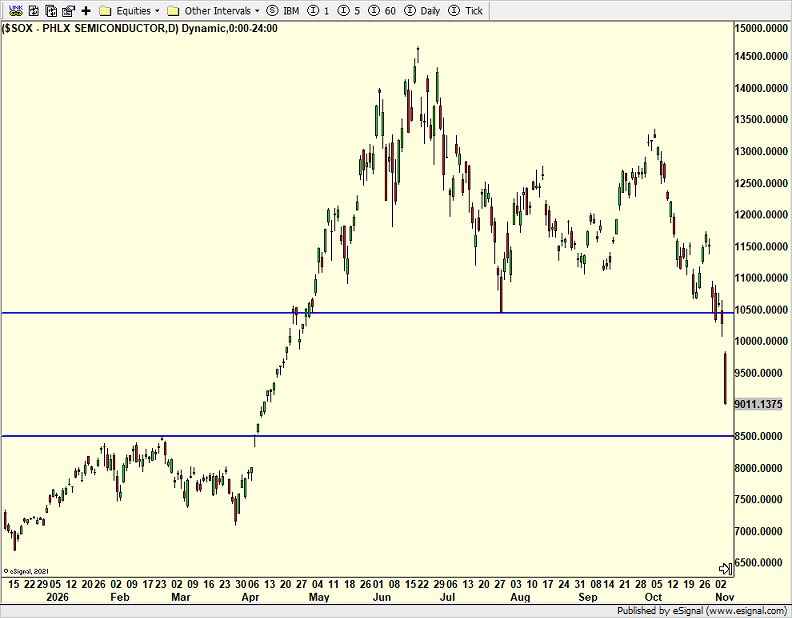
The former high-flying semiconductors are below. They are a proxy for the AI trade. And they have almost given back the entire post-Q1 bottom rally. As Q4 began, one of our sub-models targeted the index to 8500. I kinda dismissed it because the magnitude seemed too big to achieve. I was wrong. Thankfully, our sector model hasn’t owned semis in many quarters, and Unloved Gems has small positions in Nvidia (NVDA) and Intel (INTC), which were pruned into strength as we often do.
My conclusion so far is that the market is getting closer to at least a tradable low. Interestingly, when I was looking for a Q3 correction and subsequent bottom to launch the stock market into 2027, I thought it would look like this and line up nicely with the seasonal trends. Q4 corrections are atypical, but not impossible, as we saw in a big way in 2018, 2008, 2000, and 1987. Apolitically, midterm years have a high tendency to see major stock market bottoms, just usually not after October. And as I will continue to mention often, the stock market remains in its strongest period on many time frames from 90 days to the next year.
Today looks like at least a morning bounce. If it holds through lunch, then the bulls should be okay into next week. If not, then we should see strong afternoon selling spilling over to next week with a higher probability of a strong internal or momentum low.
With any decline of significance, don’t forget about ROTH conversions, tax-loss harvesting, adding money, and raising risk. I am happy to speak further about this with you, either over the weekend or next week.
On Tuesday we bought IGV. We sold SSO, some SBUX and some AIN. On Wednesday we bought GDXJ, SPYQ, JNK and COLO. We sold EWY, some EWT, some AIN, some PFE, and some QQQ. On Thursday, we bought TLT and more VGK. We sold PDBC, SPYQ, XAR, some IYR, some JNJ, some PFE, some V, and some XBI.



Comments
Log in or sign up to join the conversation.