

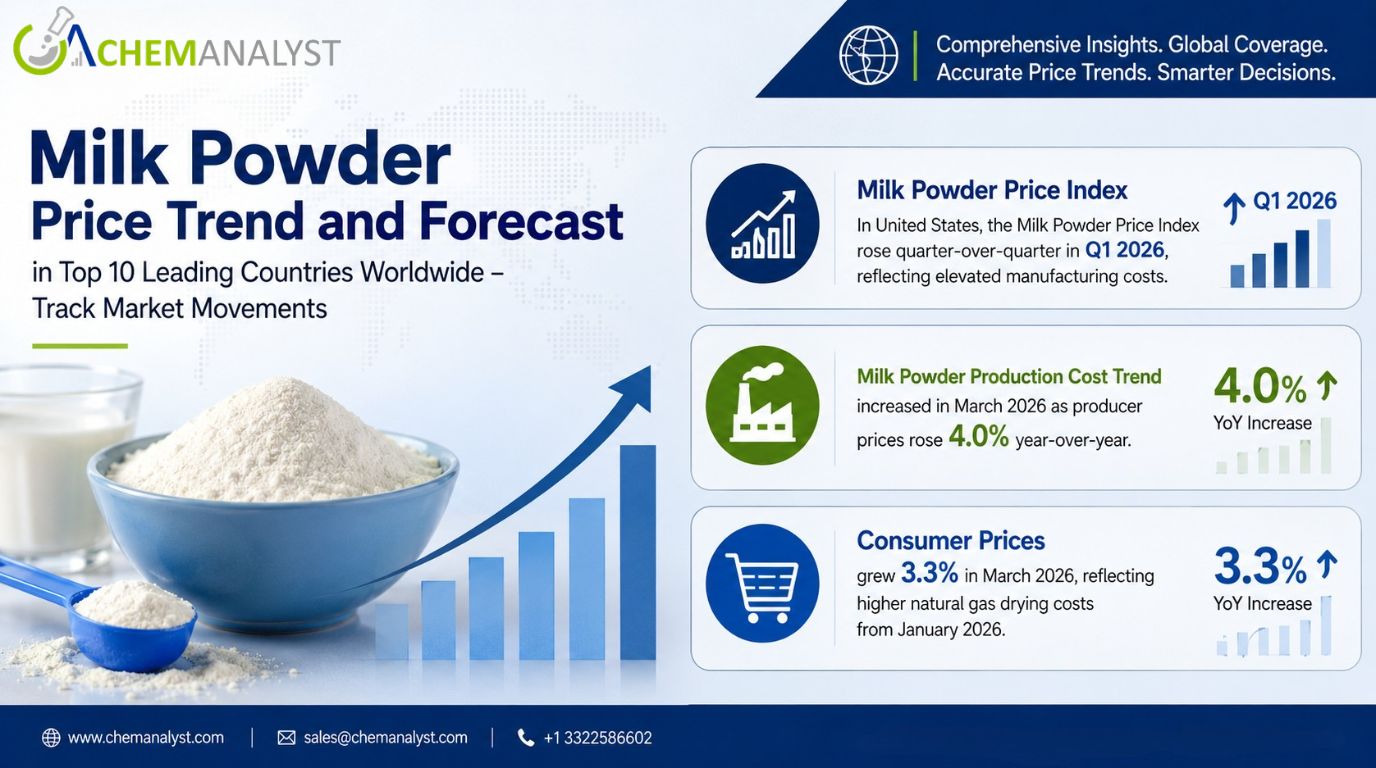
The global Milk Powder Price market experienced mixed regional movements during Q1 2026 as changing production costs, raw milk availability, inflation trends, and consumer demand reshaped international dairy trade dynamics. While the United States recorded price increases due to elevated manufacturing expenses, China and Germany witnessed declining milk powder prices driven by oversupply and falling feedstock costs.
According to ChemAnalyst Milk Powder Price: - https://www.chemanalyst.com/Pricing-data/milk-powder-2339
Milk powder remains one of the most traded dairy commodities worldwide because of its long shelf life, versatile applications, and growing demand across food processing, bakery, confectionery, infant nutrition, and beverage industries. As global dairy markets adjust to post-pandemic consumption patterns and shifting agricultural economics, milk powder price volatility continues to influence procurement strategies and international trade.
Industry analysts noted that production costs, energy prices, freight expenses, and raw milk supply conditions were the key factors impacting milk powder pricing during the first quarter of 2026.
North America Milk Powder Price Trend
United States Milk Powder Price Increased in Q1 2026
In North America, the Milk Powder Price Index in the United States increased quarter-over-quarter during Q1 2026. The price rise was primarily attributed to elevated manufacturing costs and increasing producer price inflation across the dairy processing sector.
The Milk Powder Production Cost Trend strengthened notably in March 2026 as producer prices increased by 4.0% year-over-year. Higher labor expenses, packaging costs, transportation charges, and energy expenditures contributed to the upward pricing pressure.
Milk processors across the United States also faced rising operational costs linked to:
Energy-intensive drying operations
Higher natural gas and electricity rates
Increased transportation expenses
Packaging material inflation
Supply chain adjustments
These factors collectively pushed milk powder production economics upward, forcing manufacturers to revise selling prices.
Rising Manufacturing Costs Tightened Margins
Milk powder manufacturing is highly energy-dependent due to spray drying and dehydration processes. As utility costs remained elevated in Q1 2026, processors experienced shrinking profit margins despite stable domestic milk supply conditions.
The dairy sector also saw continued wage inflation in logistics and manufacturing operations, adding further cost burdens to milk powder producers. Market participants observed that many suppliers passed these additional costs downstream to food manufacturers and wholesalers.
U.S. Consumer Demand Supported Market Stability
Despite rising prices, domestic demand for milk powder remained relatively stable due to strong consumption from:
Bakery and confectionery industries
Ready-to-drink beverage manufacturers
Infant nutrition producers
Protein supplement manufacturers
Foodservice operators
Export demand also remained supportive as several international buyers sought consistent North American dairy supply amid fluctuating global inventories.
Analysts believe the U.S. milk powder market could maintain moderate price firmness through mid-2026 if production costs remain elevated and energy prices continue to fluctuate.
APAC Milk Powder Price Trend
China Milk Powder Price Declined Due to Raw Milk Oversupply
In the Asia-Pacific region, China recorded a quarter-over-quarter decline in the Milk Powder Price Index during Q1 2026. The market downturn was largely driven by structural raw milk oversupply and weaker procurement activity from processors.
China’s dairy sector has been facing prolonged oversupply conditions as domestic milk production continued to exceed processing demand. Increased farm productivity and expanded dairy herd capacity contributed to abundant raw milk availability, placing downward pressure on milk powder prices.
The oversupply environment resulted in:
Increased milk inventory levels
Lower procurement prices for raw milk
Reduced production costs for processors
Competitive pricing among dairy suppliers
Consequently, milk powder manufacturers reduced pricing to maintain inventory movement and stabilize market share.
Read the LinkedIn Article: - https://www.linkedin.com/pulse/milk-powder-price-forecast-2026-manufacturing-inflation-kishan-singh-sibmc/
Consumer Inflation Supported Baseline Dairy Consumption
Although prices declined, China’s Milk Powder Demand Outlook remained relatively stable due to improving consumer activity and moderate inflationary support.
China’s consumer price index (CPI) increased by 1.0% in March 2026, helping sustain baseline household consumption and retail dairy demand. This moderate inflation environment supported spending on essential food categories, including dairy products.
Retail demand for milk powder products remained steady across:
Infant formula
Nutritional supplements
Dairy beverages
Bakery applications
Household cooking products
However, analysts noted that aggressive market competition and elevated stock levels limited opportunities for substantial price recovery during the quarter.
Export Competition Intensified Regional Pressure
Chinese milk powder suppliers also faced heightened competition from other APAC exporters, particularly New Zealand and Southeast Asian dairy producers. Competitive international pricing reduced export opportunities and further pressured domestic market sentiment.
Industry observers indicated that China’s milk powder market may continue facing oversupply challenges unless production output moderates or export demand improves significantly during the second half of 2026.
Europe Milk Powder Price Trend
Germany Milk Powder Prices Fell in Q1 2026
In Europe, Germany experienced a quarter-over-quarter decline in the Milk Powder Price Index during Q1 2026. The price reduction was primarily driven by sharply lower raw milk feedstock costs and easing production expenses.
Germany, one of Europe’s leading dairy exporters, witnessed declining farm-gate milk prices amid ample milk supply conditions and softer feed costs. Lower raw milk procurement prices significantly reduced manufacturing expenses for dairy processors.
As feedstock costs declined, milk powder producers adjusted prices downward to remain competitive in both domestic and export markets.
Falling Feedstock Costs Supported Lower Production Expenses
Raw milk is the primary feedstock in milk powder manufacturing, making farm-level pricing a critical determinant of finished product costs.
Several factors contributed to falling feedstock prices in Germany, including:
Improved milk production efficiency
Lower livestock feed prices
Favorable weather conditions
Stable agricultural supply chains
Reduced farm operating costs
These conditions enabled processors to reduce overall milk powder production costs during Q1 2026.
Retail Sales Growth Stabilized Demand Outlook
Despite declining prices, Germany’s Milk Powder Demand Outlook remained stable due to resilient retail activity and moderate consumer spending growth.
Retail sales increased by 0.7% year-over-year in February 2026, supporting steady dairy product consumption across Europe’s food and beverage sectors.
Demand from food manufacturers remained particularly important for:
Chocolate and confectionery production
Ice cream manufacturing
Bakery applications
Processed dairy foods
Nutritional products
Although demand remained healthy, abundant supply conditions continued to prevent significant price rebounds during the quarter.
Key Factors Influencing Milk Powder Prices in 2026
Raw Milk Supply Conditions
Raw milk availability remains the single most important factor affecting milk powder prices globally. Oversupply conditions in China and Europe pressured prices downward, while balanced supply in North America allowed costs to rise alongside manufacturing expenses.
Energy and Manufacturing Costs
Milk powder production requires intensive thermal processing and spray drying technology. Rising electricity and natural gas prices in the United States significantly increased production costs during Q1 2026.
Consumer Demand Trends
Demand from infant nutrition, bakery, confectionery, sports nutrition, and beverage sectors continues to influence milk powder procurement globally.
Stable retail spending in China and Germany helped prevent sharper price declines despite oversupply pressures.
International Trade and Export Competition
Global dairy trade competitiveness continues to shape regional milk powder prices. Export-oriented markets are particularly sensitive to changing freight rates, currency movements, and international supply conditions.
Inflation and Economic Conditions
Consumer inflation directly impacts purchasing behavior and food consumption trends. Moderate inflation in major economies supported baseline dairy demand during Q1 2026.
Global Milk Powder Market Outlook for 2026
North America Expected to Remain Firm
Industry experts expect North American milk powder prices to remain relatively firm during the coming quarters due to ongoing manufacturing cost inflation and stable domestic demand.
Energy prices, labor costs, and transportation expenses are likely to remain key pricing drivers in the United States.
China Could Continue Facing Oversupply Pressure
China’s milk powder market may continue experiencing downward pricing pressure if raw milk oversupply persists. Analysts believe inventory management and export recovery will be critical factors for future market stabilization.
Europe May See Balanced Recovery
European milk powder markets could gradually stabilize if retail demand continues improving and milk production growth moderates later in 2026.
Germany’s export competitiveness may improve if lower feedstock costs persist while international demand strengthens.
Milk Powder Price Forecast
The global Milk Powder Price Forecast for 2026 suggests continued regional divergence influenced by production economics, supply-demand fundamentals, and international dairy trade patterns.
Key expectations include:
Moderate price firmness in North America
Continued pricing pressure in China
Stable-to-soft pricing trends in Europe
Increased market sensitivity to energy and logistics costs
Strong demand from food manufacturing sectors
Analysts also anticipate that weather conditions, livestock feed prices, and geopolitical trade developments could significantly impact dairy pricing trends during the remainder of the year.
Conclusion
The Milk Powder Price market in Q1 2026 reflected contrasting regional dynamics across North America, APAC, and Europe. The United States experienced price increases due to elevated manufacturing costs and producer inflation, while China and Germany recorded declining prices amid oversupply and falling feedstock expenses.
Global dairy markets remain highly interconnected, with raw milk availability, production economics, consumer demand, and export competitiveness continuing to shape pricing behavior. As the industry moves through 2026, stakeholders across the dairy supply chain will closely monitor energy costs, inflation trends, and international trade developments to navigate ongoing market volatility.
With milk powder serving as a critical ingredient across multiple industries, understanding regional price movements and production trends will remain essential for manufacturers, traders, procurement professionals, and investors worldwide.
Contact US:
Email-Id: - [email protected]
Contact No: - +1 (332) 258-6602
Address: - 420 Lexington Avenue, Suite 300
New York, NY
United States, 10170
Comments
Log in or sign up to join the conversation.