

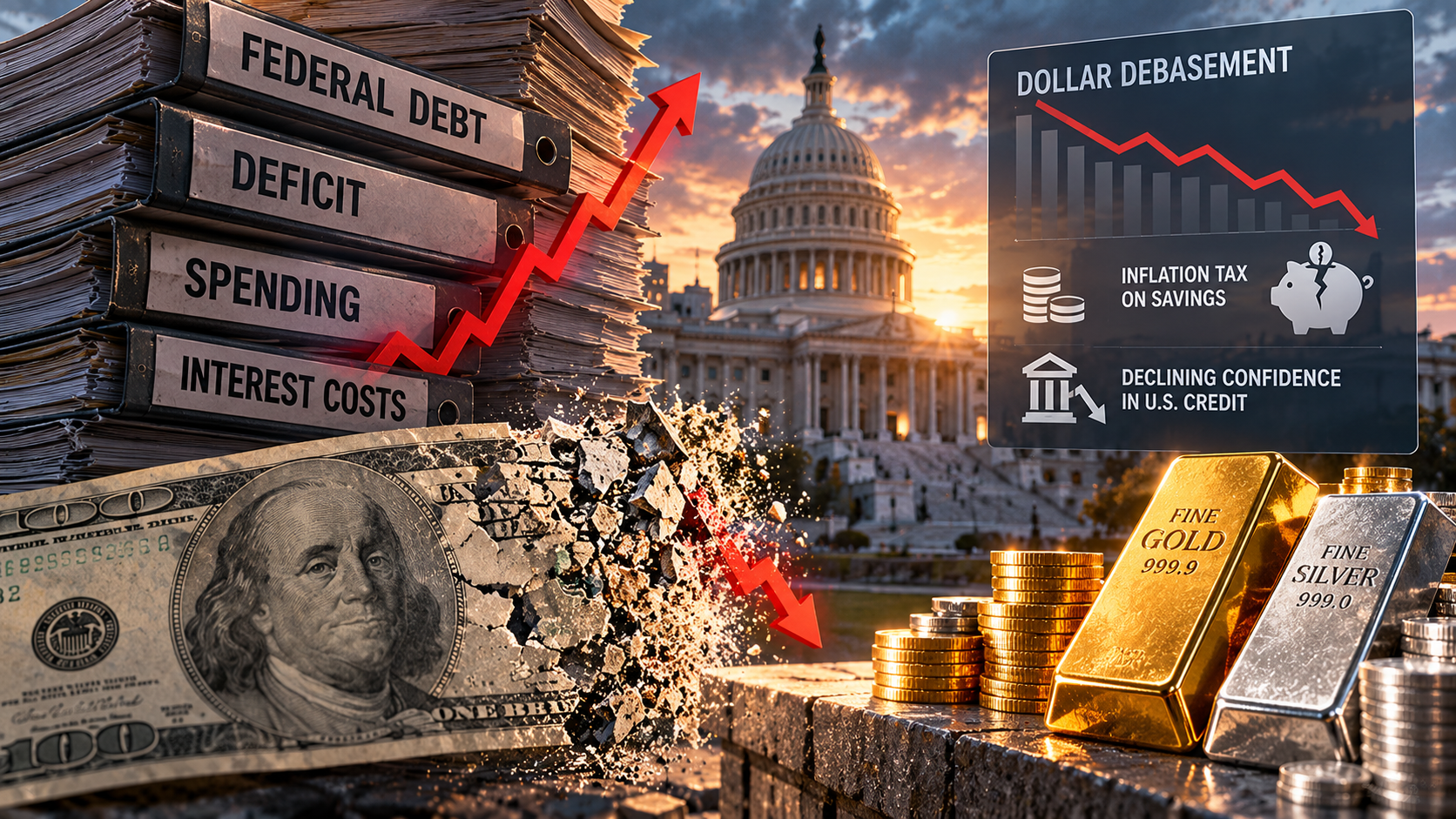
In the closing chapter of this Midweek Memo episode, host Mike Maharrey turns to federal deficits, national debt, inflation, and the reasons investors look to precious metals. He says budget figures often provoke a brief reaction of shock, followed by a shrug. Even as deficits grow, many people assume they do not matter because the economy has continued to function.
Maharrey acknowledges why that response can seem reasonable. The United States has run large deficits for decades, and daily life has carried on. But he argues that the effects of borrowing can accumulate over time. A problem that develops gradually may not feel urgent until it begins to affect confidence in the dollar, the government’s ability to borrow, and the purchasing power of household savings.
For Maharrey, the link between federal finances and the value of money is central to understanding the precious metals market. He says rising debt and persistent government spending are not only political or budgetary issues. They can also influence the dollar’s credibility and the decisions made by investors and foreign governments.
Borrowing Could Weaken Confidence in U.S. Credit
Maharrey cites a warning from the Bipartisan Policy Center following a large budget shortfall the previous year. The organization said that a rapidly worsening fiscal situation and expectations of substantially rising federal debt could undermine confidence in the United States’ creditworthiness.
He emphasizes that the warning was written the year before the episode, arguing that the fiscal pressures it described had continued. In his view, concerns about the government’s finances can have practical consequences. Reduced confidence could contribute to slower economic growth, higher unemployment, and declines in investment wealth.
The government’s borrowing costs are another possible consequence. If investors become less willing to buy U.S. debt, the Treasury may need to offer higher yields to attract them. Maharrey says bond yields had reached levels not seen since 2001, presenting that move as evidence of weaker demand for government debt.
He describes the change as a reassessment by investors who may be less willing to keep lending to a government that continues to borrow without a credible plan to rein in spending. The comparison he uses is that of a borrower who has already run up large debts but shows little intention of changing course. The image is meant to capture a concern about creditworthiness, not simply the size of one year’s deficit.
A Bipartisan Problem With Short-Term Political Incentives
Maharrey cautions against treating the debt problem as the responsibility of only the president currently in office. He calls fiscal irresponsibility a bipartisan pattern and says every president since Calvin Coolidge has left office with more national debt than when he took office.
His broader argument is that the federal government has a long-term spending problem that politicians have little incentive to confront. Elected officials tend to focus on the next election, he says, while meaningful spending changes could impose immediate costs on voters. That creates a political preference for postponing difficult decisions, even as the debt continues to grow.
Maharrey argues that additional revenue alone would not resolve the problem. He dismisses the idea that tariffs, taxes on billionaires, or cuts to a few smaller programs would be enough to close the gap. In his assessment, addressing the debt would require a substantial contraction in government spending, including reductions to major programs such as Social Security and Medicare.
He also recognizes the difficulty of that prescription. Large changes to those programs would be politically painful, and he questions whether elected officials are willing or able to make them. But he says investors and foreign governments are paying attention to the gap between the country’s borrowing needs and its willingness to change course.
How Debt and Money Creation Feed Inflation
Maharrey links government spending to inflation through a sequence of borrowing and money creation. In his account, spending beyond current revenue leads to more borrowing and debt. He says that debt can then be monetized through the creation of money, adding to inflationary pressure and reducing the purchasing power of the currency.
He stresses that this is not the only force affecting prices. The episode also mentions war as another factor. But Maharrey argues that continued government spending and borrowing create an underlying inflationary pressure that persists even when particular events or market conditions change.
He connects this process to the everyday experience of paying more for groceries and gasoline. The point, he says, is that inflation does not have to arrive as a sudden collapse in the dollar’s value. It can steadily erode what people can buy with their savings and income.
Maharrey describes the stated goal of 2% annual inflation as a continuing loss of purchasing power. At that rate, he says, the dollar would lose roughly 10% of its purchasing power over five years and 20% over ten years. The figures illustrate the cumulative effect he wants listeners to consider when evaluating cash savings over time.
He calls that gradual loss an “inflation tax.” The government can collect revenue directly through taxes, he says, but inflation also transfers purchasing power away from the public. In his view, the cost of government must ultimately fall on people, whether through taxes imposed today, taxes borne by future generations, or currency debasement.
Gold and Silver in the Debasement Trade
Maharrey connects these fiscal concerns to what investors call the “debasement trade.” He defines it as an investment approach that emphasizes tangible assets such as gold, silver, and other commodities as protection against the declining value of fiat currencies.
He points to China’s gold buying as an example of a country seeking to limit its exposure to the dollar. Maharrey says China is wary of the United States’ fiscal position and the dollar’s vulnerabilities, and he presents its accumulation of gold as a response to those concerns.
He encourages listeners to consider whether precious metals could play a role in their own financial plans. Rather than prescribing a particular product or allocation, he says a Money Metals specialist can help customers assess which products may suit their circumstances. The episode mentions options ranging from Canadian Maple Leaf coins to junk silver, as well as online purchases and the company’s bullion depository in Eagle, Idaho.
Preparing Before a Crisis
Maharrey closes by recalling a conversation with a friend who felt that years of warnings about federal finances had lulled people into a false sense of security. The friend used a phrase Maharrey says he often repeats: “Things happen slowly and then all at once.”
That idea summarizes the episode’s warning. A fiscal problem can build for years without causing an immediate crisis. But if confidence in U.S. debt weakens or borrowing costs rise further, the effects could arrive more abruptly than people expect.


Comments
Log in or sign up to join the conversation.