


When the CRB Commodity Index broke to a new 15-20 year high in late August, headlines briefly reported on the bull market in commodities. However, Rick Rule treated it as a nominal print that still leaves real prices far short of what the next decade will require.
“We’re making up for lost time,” he said. Mine construction and operating costs are rising 8 to 10 percent a year, compounded. That arithmetic tells you how much capital and how high a price will be needed just to hold current output. According to Rick, the commodity bull market still has “a very, very long way to go.”
Middle Innings, Almost No One Owns It
Rule believes the commodity bull market is merely in its middle innings. Extractive industries already earn some of the market’s highest returns on capital and still get some of its lowest multiples. Commodities are visible again, but they are not widely owned.
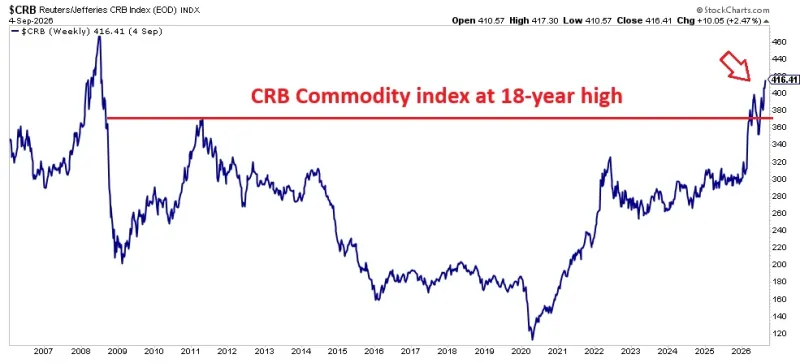
Source: Stockcharts.com
Gold is a good case in point. Precious metals and related securities are about half of 1 percent of American savings and investment assets, Rick says. The four-decade average is 2 percent and reversion to that would mean a four-fold increase in demand. “That’s precisely what I think is going to occur.”
Near term he is not calling for an immediate melt-up. Rising bond yields and a firm dollar could keep gold sideways in dollar terms. However, Rick welcomes any near-term weakness because he is planning on accumulating much more over the days and weeks ahead.
The Supply That Cannot Arrive on Time
For thirty years the world underinvested in commodities. These businesses do not restock quickly. Start a copper explorer today and, if you are lucky, you change supply in eighteen years. The Resolution mine in Arizona has been in permitting for 28 years.
The ten largest copper producers need $250 billion merely to maintain output. That does not close today’s deficit or cover 1 to 3 percent demand growth, and costs are compounding at 8 to 10 percent. In five or six years the same problem is closer to $400 billion.
Oil follows the same pattern: more than a billion dollars a day in deferred sustaining capital. The Hormuz spike was an anticipated shortage against high inventories. Rule’s structural shortage window is 2029–2031. That one cannot be negotiated away.
“No matter what we do, save a depression, we are going to be rationing major industrial commodities by price,” he said.
Invest First
Existing mines are already throwing off “mountains of free cash.” Expansions at producing assets will come first—good for those shareholders, little help for consumers. Wall Street is rewarding buybacks and dividends over the reinvestment that would make those payouts last. “Wall Street is insisting that oil companies and copper companies cannibalize themselves, which I think is a mistake.”
Rule’s order is invest first, then speculate. Buy the highest-quality names with long-life reserves and financial flexibility. In a bull market, sector beta is usually enough. He prefers the diversified super-majors—names like BHP (BHP), Rio Tinto (RIO), Glencore (GLNCY), ExxonMobil (XOM), and the Anglo American (NGLOY)–Teck (TECK) combination.
Do not skip oil and gas. The Street is pricing it on peak demand around 2030. After $8 trillion to $14 trillion spent on alternatives over 45 years, fossil fuels’ share of energy fell from 83 percent to 81 percent. Oil will be with us for a very long time, Rick believes.
A Cheaper Dollar
Part of the resource case is based on the US dollar. Rule expects the dollar to lose something like 70 to 75 percent of its purchasing power over a decade, as official figures say it did in the 1970s. Commodities are priced in that unit.
The fiscal path of least resistance points the same way. On-balance-sheet debt has crossed $40 trillion and grows by $2.5 trillion a year against about $5 trillion in federal revenues. Off-balance-sheet entitlements carry a net present value around $120 trillion. Seize the entire $8 trillion net worth of American billionaires and you cover the annual cash deficit for about three years. The 1970s answer was to inflate away fixed obligations.
“The next 10 years may not be catastrophic, but they will not be benign,” Rick says. His main argument: Investors positioning themselves in hard assets, amid a weakening currency and persistent commodity shortages, will be best positioned to benefit from a bull market that’s likely only halfway through its run.


Comments
Log in or sign up to join the conversation.