

By The Numbers
930% — Expected year-over-year earnings growth when Micron (MU) reports Q3 results Wednesday, according to analyst consensus estimates
$1 trillion — Micron's current market cap, placing it among the top tier of US semiconductor companies
Sold out through 2026 — Micron's HBM (high-bandwidth memory) capacity, with customer orders already locked in for 2027
$128 — Analyst consensus price target for MU, implying meaningful upside from current levels
3x — How much faster HBM memory is compared to standard DRAM, making it essential for AI training and inference workloads
Wednesday after the close, Micron Technology drops its Q3 earnings report. Analysts are expecting something they almost never get: nearly 1,000% earnings growth in a single year. That number sounds impossible. It isn't. Here's why Micron got there, what it means, and the one number that actually matters Wednesday night.
How You Get to 930% EPS Growth
A year ago, Micron was still climbing out of a brutal memory chip downturn. DRAM and NAND prices had cratered. Inventories piled up across the industry. Micron posted losses.
The math on 930% growth isn't magic. It's what happens when you compare today's numbers against a trough. But here's the thing about Micron's recovery: it isn't just a cyclical bounce. Something structurally different happened. AI showed up and rewired the entire memory market.
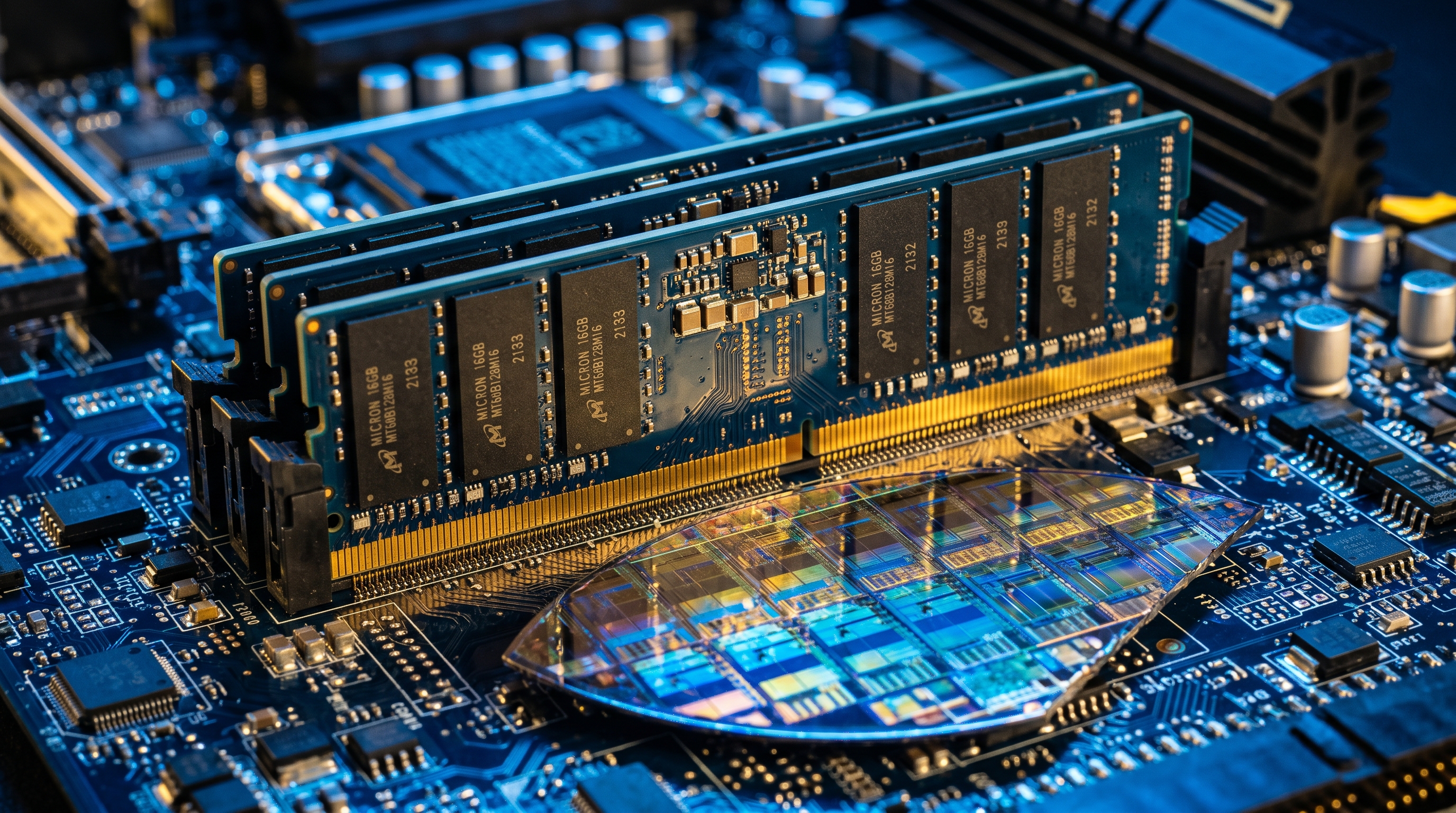
High-bandwidth memory, HBM, is the bottleneck for every major AI accelerator. NVIDIA (NVDA)'s H100 and H200 chips don't work without it. Google (GOOGL)'s TPUs run on it. Every hyperscaler building out AI infrastructure needs as much HBM as they can get. Micron is one of only three companies in the world that can make it, alongside Samsung (SSNLF) and SK Hynix (HXSCL). And right now, supply cannot keep up with demand.
Sold Out Through 2026. Orders Already In for 2027.
Micron's CEO Sanjay Mehrotra said it plainly on the last earnings call: HBM capacity is fully allocated through the end of 2026, and customers are already locking in 2027 supply. That is not a company managing a commodity cycle. That is a company with a product that customers will queue up months in advance to secure.
Hold on. Let me stop here. "Sold out" means pricing power. When you have more demand than supply, you don't have to negotiate on price. You name your number. That's why Micron's gross margins have been expanding faster than revenue. Every HBM wafer they ship carries pricing that would have been unthinkable in 2023.
Standard DRAM is fast. HBM is a fundamentally different architecture: multiple layers of DRAM stacked vertically with connections between each layer, delivering roughly three times the bandwidth of conventional memory. It's kinda like the difference between a two-lane road and a twelve-lane highway. AI models don't just want more memory. They want memory that moves data faster than standard DRAM physically can. HBM is the only solution that works at scale.
"The memory industry has structurally transformed. AI demand created a two-tier market: commoditized DRAM for standard computing, and premium HBM for AI workloads. Micron is positioned in both, but the HBM side is where the margin lives."
What to Watch Wednesday Night
The headline EPS number will dominate the post-market reaction. But the number that actually matters is HBM revenue as a percentage of total DRAM revenue. On the last call, Micron disclosed HBM was a "meaningful contributor." That's a placeholder. Wednesday, they need to give specifics.
Three things to watch in the Q3 report and call:
HBM revenue and margin. If HBM is now 20%+ of DRAM revenue and carrying gross margins above 50%, the premium pricing story is real and durable.
Q4 guidance. The street is expecting strong guidance. A beat on Q3 followed by weak Q4 guidance would be the red flag. Watch the tone on 2027 capacity contracts specifically.
Data center vs. consumer mix. Consumer DRAM (PCs, phones) is still cyclical and margin-dilutive. The more Micron's mix shifts toward data center, the more the premium story holds.
At $1 Trillion, Is MU Still Worth Owning?
A year ago, MU was trading at a fraction of today's price. The question isn't whether Micron ran. It did. The question is whether the business justifies the valuation going forward.
You don't have to trust me. Trust the math. At current analyst estimates for fiscal 2027, MU is trading at roughly 18-20x forward earnings. For a company with a structural tailwind in AI memory, sold-out capacity, and pricing power, that's not an unreasonable multiple. Compare that to NVIDIA at 35x+ or AMD at 25x+. Memory is still being treated as a commodity by the market, even as the HBM segment increasingly isn't.
The risk is real though. If AI capex slows, HBM demand slows with it. Samsung is expanding capacity aggressively. And consumer DRAM, still a meaningful part of the business, will have another down cycle eventually. Micron is not a one-way trade. It's a company navigating a structural upgrade while managing cyclical exposure.
Wednesday's report will tell you whether the HBM story is accelerating, holding steady, or showing early signs of strain. That's the only data point that changes the thesis.
P.S. Micron reports after the close Wednesday. Set an alert. The first 30 minutes of the call, when management speaks before Q&A, is where the HBM capacity update will come. That's the number the market is really trading on.


Comments
Log in or sign up to join the conversation.