

The October Preliminary came in at 96.0, up 2.8 from the September Final reading. Investing.com had forecast 92.0.
Surveys of Consumers chief economist, Richard Curtin, makes the following comments:
Sentiment rebounded in early October as consumers anticipated larger income gains and lower inflation during the year ahead. As a result, real income expectations rose to their most favorable level in two decades (see the chart). Stronger finances and lower interest rates helped to modestly bolster buying plans. These favorable trends did not change consumers' overall prospects for the national economy. A slower pace of overall economic growth is still anticipated, including some modest increases in the national unemployment rate during the year ahead. While uncertainties about trade policies have continued to depress economic prospects, its negative impact has slightly lessened (cited by 29%, down from 36%). Importantly, the impeachment inquiry has not had a significant negative impact on economic prospect; it was negatively mentioned by about half as many as negatively mentioned the GM strike (3% versus 5%). Overall, the data indicate that consumption spending will be strong enough to offset weakness in business investment spending so as to keep the economy expanding into 2020. Nonetheless, there are significant global and domestic uncertainties that will keep consumers cautious spenders, although the income gains among lower and middle income households will translate into higher spending among these households. The multiple sources of uncertainty will keep consumers focused on potential threats to their prevailing optimism about inflation, unemployment, incomes, and interest rates as well as foster continued vigilance on the level of their indebtedness. [More...]
See the chart below for a long-term perspective on this widely watched indicator. Recessions and real GDP are included to help us evaluate the correlation between the Michigan Consumer Sentiment Index and the broader economy.
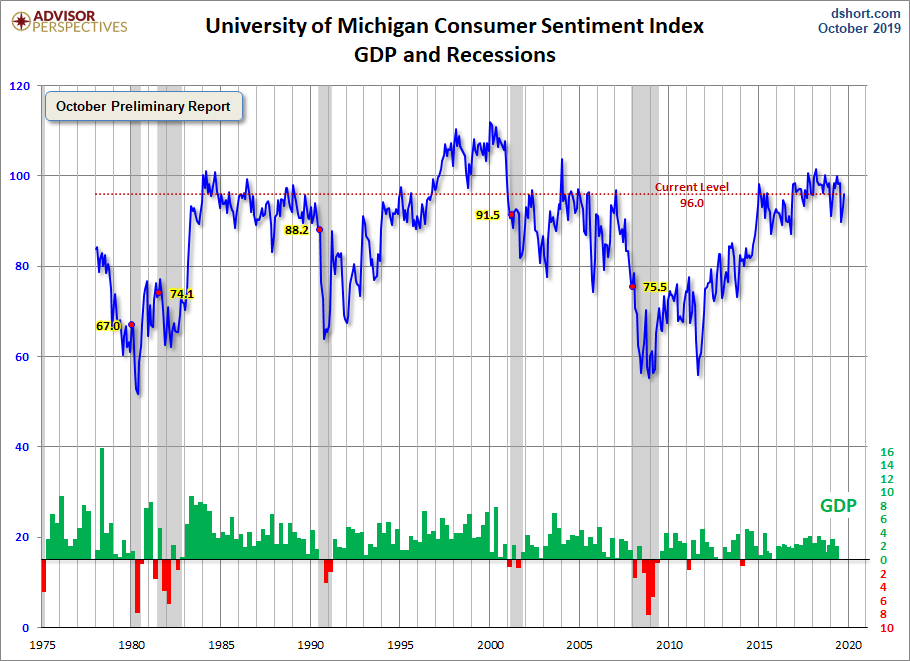
To put Friday's report into the larger historical context since its beginning in 1978, consumer sentiment is 11.3 percent above the average reading (arithmetic mean) and 12.6 percent above the geometric mean. The current index level is at the 79th percentile of the 502 monthly data points in this series.
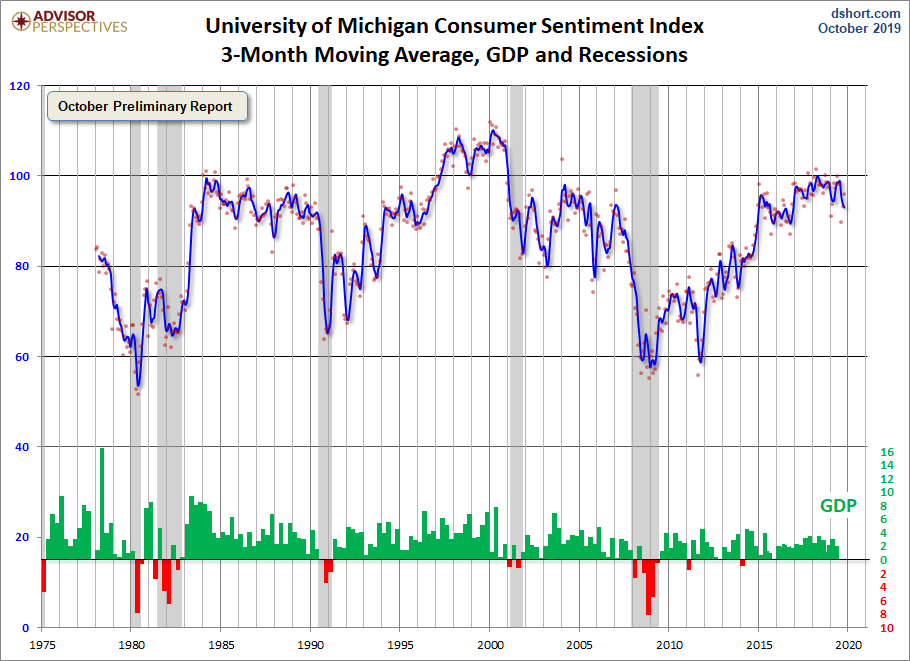
Note that this indicator is somewhat volatile, with a 3.0 point absolute average monthly change. The latest data point saw a 2.8 point increase from the previous month. For a visual sense of the volatility, here is a chart with the monthly data and a three-month moving average.
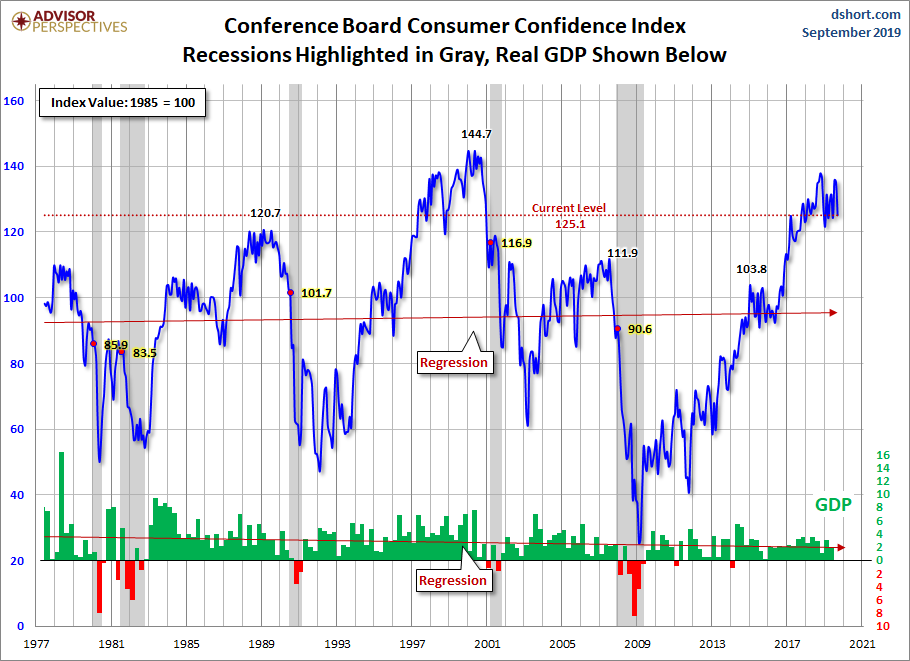
For the sake of comparison, here is a chart of the Conference Board's Consumer Confidence Index (monthly update here). The Conference Board Index is the more volatile of the two, but the broad pattern and general trends have been remarkably similar to the Michigan Index.
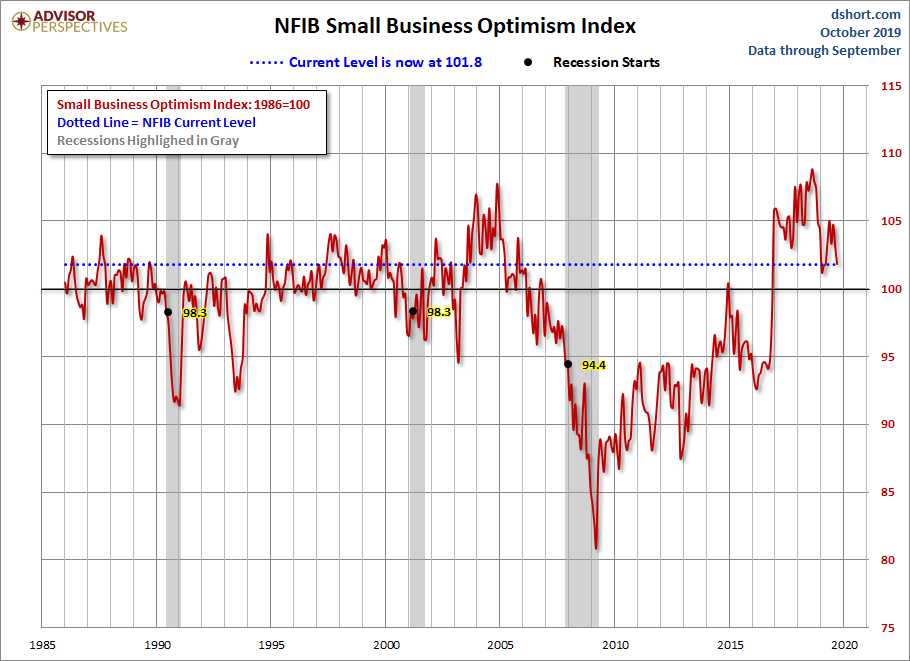
And finally, the prevailing mood of the Michigan survey is also similar to the mood of small business owners, as captured by the NFIB Business Optimism Index (monthly update here).
The general trend in the Michigan Sentiment Index since the Financial Crisis lows was one of slow improvement. The survey findings have neared the pre-recession peak.
The next update to this report will be for the October final data and will be published shortly after October 25.

Comments
Log in or sign up to join the conversation.