

The University of Michigan Final Consumer Sentiment for November came in at 98.5, down 2.2 from the October Final reading of 100.7. Investing.com had forecast 98.0.
Surveys of Consumers chief economist, Richard Curtin, makes the following comments:
Consumer sentiment narrowed its loss from mid-month, although it was still slightly below last month's decade peak. Overall, the Sentiment Index has remained largely unchanged since the start of the year at the highest levels since 2004. What has changed recently is the degree of certainty with which consumers hold their economic expectations. In contrast to the media buzz about approaching cyclical peaks and an aging expansion, with the implication of greater uncertainty about future economic trends, consumers have voiced greater certainty about their expectations for income, employment, and inflation. Inflation expectations have shown the smallest dispersion on record, and increased certainty about future income and job prospects has become a key factor that has supported discretionary purchases. To be sure, caution is warranted given that the current expansion will soon be the second longest expansion since the mid-1800s, as well as the potential for significant changes in tax policies and the new Fed leadership and Board members. Interestingly, the data indicate that neither changes in fiscal nor monetary policies have yet had any noticeable impact on consumer expectations. Overall, the data signal an expected gain of 2.7% in real consumption expenditures in 2018, and more importantly for retailers, the best runup to the holiday shopping season in a decade. [More...]
See the chart below for a long-term perspective on this widely watched indicator. Recessions and real GDP are included to help us evaluate the correlation between the Michigan Consumer Sentiment Index and the broader economy.
(Click on image to enlarge)
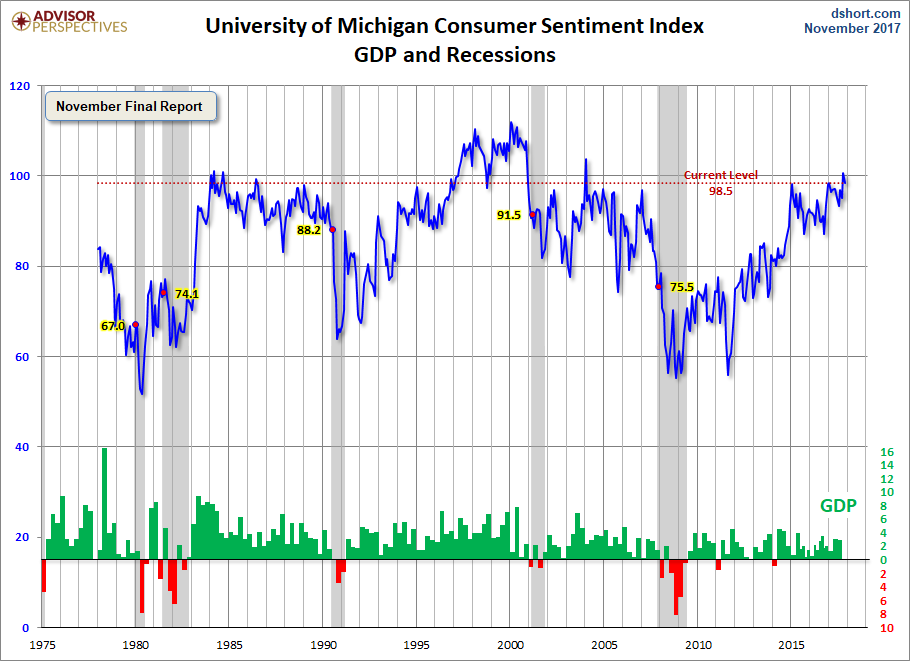
To put today's report into the larger historical context since its beginning in 1978, consumer sentiment is 14.9 percent above the average reading (arithmetic mean) and 16.2 percent above the geometric mean. The current index level is at the 89th percentile of the 479 monthly data points in this series.
The Michigan average since its inception is 85.6. During non-recessionary years the average is 87.8. The average during the five recessions is 69.3. So the latest sentiment number puts us 29.2 points above the average recession mindset and 10.6 points above the non-recession average.
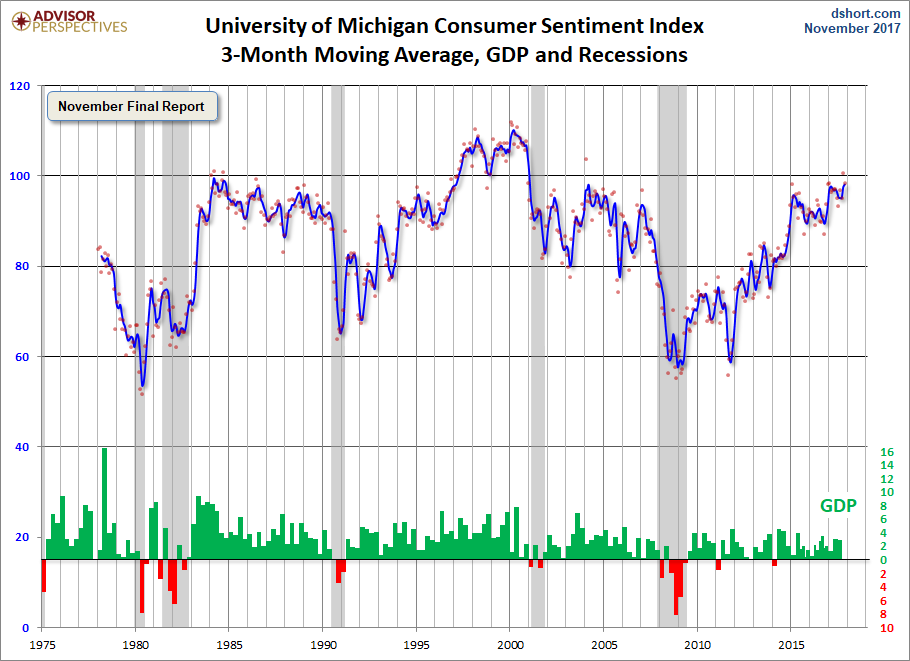
Note that this indicator is somewhat volatile, with a 3.0 point absolute average monthly change. The latest data point saw a 2.2 percent change from the previous month. For a visual sense of the volatility, here is a chart with the monthly data and a three-month moving average.
(Click on image to enlarge)
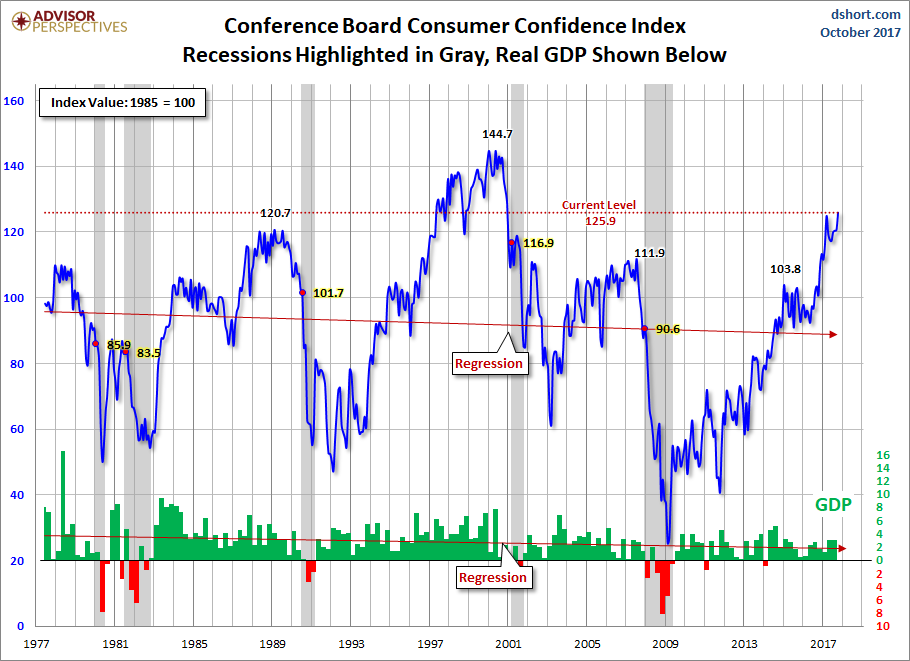
For the sake of comparison, here is a chart of the Conference Board's Consumer Confidence Index (monthly update here). The Conference Board Index is the more volatile of the two, but the broad pattern and general trends have been remarkably similar to the Michigan Index.
(Click on image to enlarge)
And finally, the prevailing mood of the Michigan survey is also similar to the mood of small business owners, as captured by the NFIB Business Optimism Index (monthly update here).
(Click on image to enlarge)

The general trend in the Michigan Sentiment Index since the Financial Crisis lows has been one of slow improvement.The survey findings since December 2015 saw gradual decline followed by a bounceback later in the year.

Comments
Log in or sign up to join the conversation.