

The May Preliminary came in at 73.7, up slightly from the April Final. Investing.com had forecast 68.0.
Surveys of Consumers chief economist, Richard Curtin, makes the following comments:
Confidence inched upward in early May as the CARES relief checks improved consumers' finances and widespread price discounting boosted their buying attitudes. Despite these gains, personal financial prospects for the year ahead continued to weaken, falling to the lowest level in almost six years, with declines especially sharp among upper income households. Improved views on buying conditions were due to discounted prices and low interest rates, although their impact was partially offset by uncertainties about job and income prospects. Perhaps the most surprising finding concerned consumers' inflation expectations. The median expected inflation rate during the year ahead rose sharply, with wide differences across age and income subgroups. As shown in the chart, the Expectations Index still indicates that no economic restoration is as yet anticipated by consumers.
Consumers were asked to identify their top concerns about the pandemic: was it the threat to their health, the required social isolation, or the impact on family finances? The health threat dominated in both months, cited by 61% in April and 57% in May. The original hypothesis was that as their primary concerns shifted from health to finances, consumers would become less accepting of constraints on reopening the economy. Those that cited damages to their finances as their top concern fell to 17% in May from 22% in the prior month. Surprisingly, it was greater concerns about social isolation that increased, cited as the top concern by 21% in May up from 14% in April. While these shifts were quite small, they indicate the growing costs of social isolation and its potential to shift opinions about reopening the economy. [More...]
See the chart below for a long-term perspective on this widely watched indicator. Recessions and real GDP are included to help us evaluate the correlation between the Michigan Consumer Sentiment Index and the broader economy.
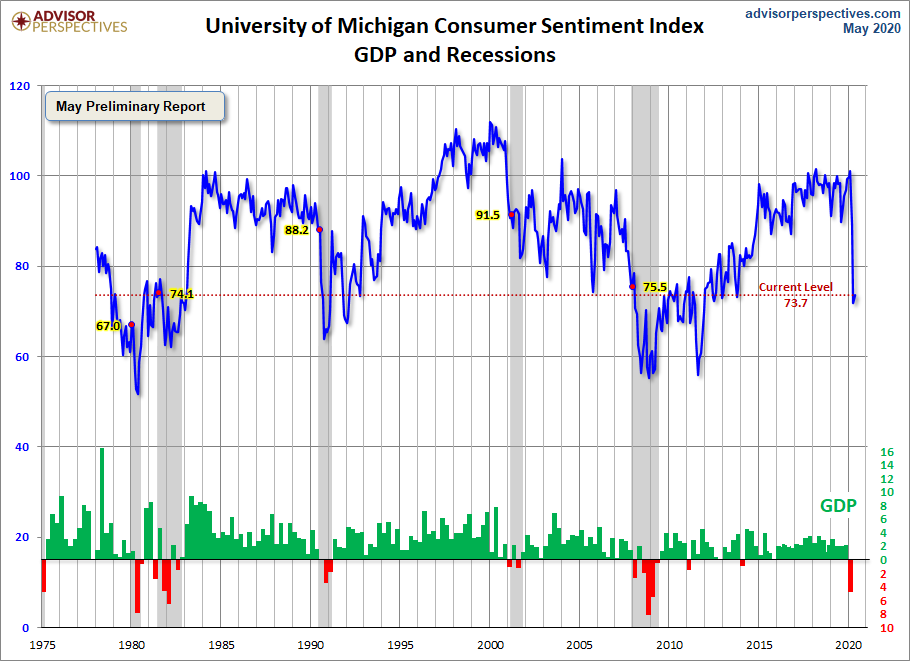
To put Friday's report into the larger historical context since its beginning in 1978, consumer sentiment is 14.6 percent below the average reading (arithmetic mean) and 13.6 percent below the geometric mean. The current index level is at the 20th percentile of the 509 monthly data points in this series.
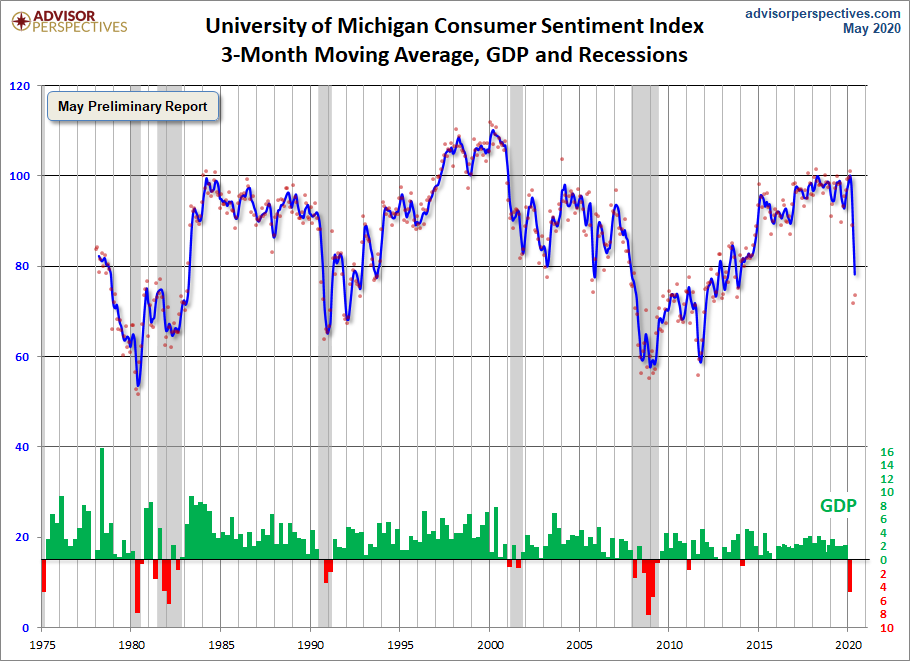
Note that this indicator is somewhat volatile, with a 3.0 point absolute average monthly change. The latest data point saw a 2.6 point decrease from the previous month. For a visual sense of the volatility, here is a chart with the monthly data and a three-month moving average.
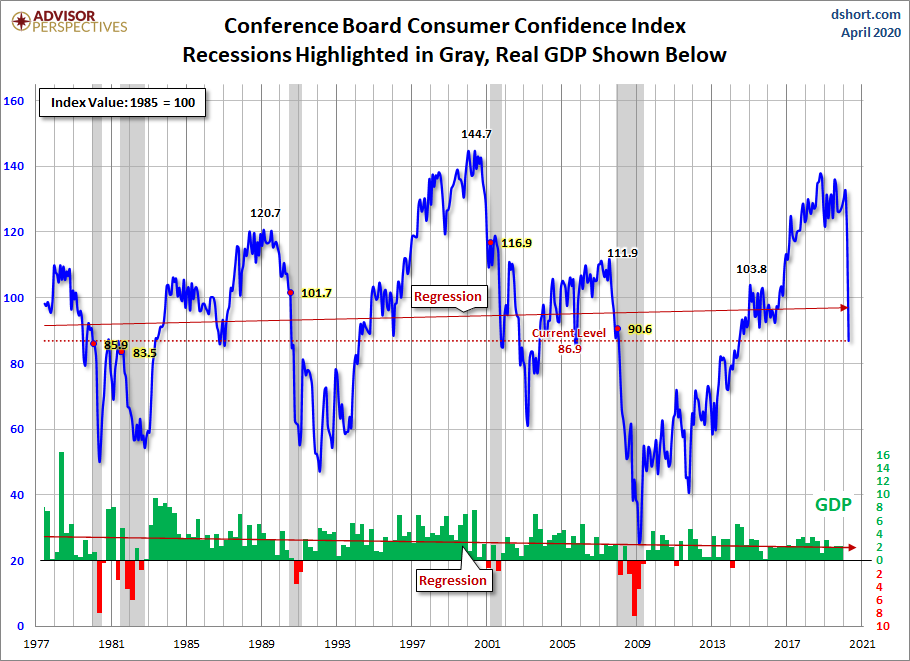
For the sake of comparison, here is a chart of the Conference Board's Consumer Confidence Index (monthly update here). The Conference Board Index is the more volatile of the two, but the broad pattern and general trends have been remarkably similar to the Michigan Index.
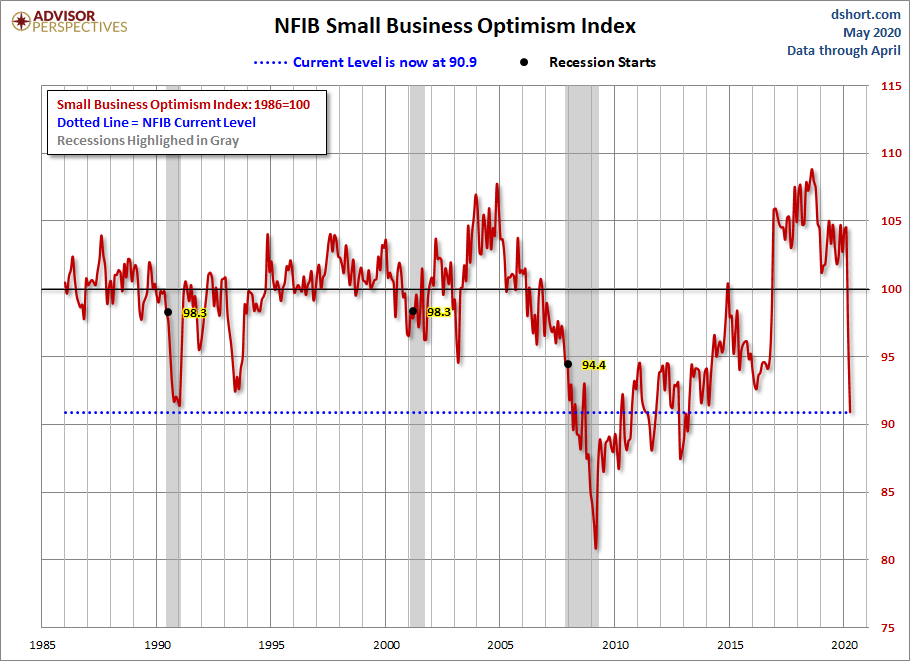
And finally, the prevailing mood of the Michigan survey is also similar to the mood of small business owners, as captured by the NFIB Business Optimism Index (monthly update here).
The general trend in the Michigan Sentiment Index after the Financial Crisis lows was one of slow improvement.
The next update to this report will be published on May 29.

Comments
Log in or sign up to join the conversation.