

The University of Michigan Final Consumer Sentiment for May came in at 98.0, down 0.8 from the April Final reading. Investing.com had forecast 98.8.
Surveys of Consumers chief economist, Richard Curtin, makes the following comments:
Consumer sentiment slipped by less than an Index-point from last month. Since Trump's election, the Sentiment Index has meandered in a tight eight-point range from 93.4 to 101.4, with the small month-to-month variations indicating no emerging trend. Consumers have remained focused on expected gains in jobs and incomes as well as anticipated increases in interest rates and inflation during the year ahead. As past expansions have shown, rising interest rates do not suppress spending gains as long as they are accompanied by more substantial increases in incomes. The May survey, however, found that consumers anticipated smaller income gains than a month or year ago, even though they anticipate the unemployment rate to stabilize at its current eighteen year low. Importantly, references to discounted prices for durables, vehicles, and homes fell to decade lows. Coupled with higher interest rates, it is likely that the pace of growth in personal consumption will remain at about 2.6% during the year ahead.
When asked to explain how their personal finances had changed, the proportion that spontaneously cited higher prices worsening their financial situation has shown a close correspondence with actual trends in the year-over-year change in the CPI-see the chart. That close relationship ended about a decade ago, and in the past year or so, as the CPI has risen, complaints about inflation have fallen. While the reasons underlying the current divergence are unclear, it nonetheless signals a change in how consumers judge the impact of inflation on their personal finances. It may also suggest a change in their behavioral reaction to inflation. [More...]
See the chart below for a long-term perspective on this widely watched indicator. Recessions and real GDP are included to help us evaluate the correlation between the Michigan Consumer Sentiment Index and the broader economy.
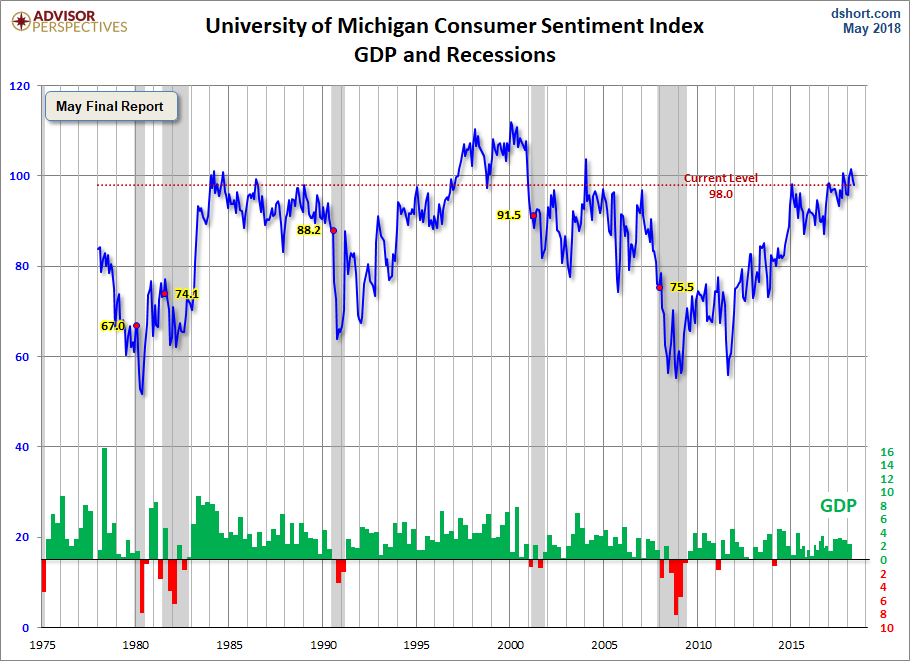
To put today's report into the larger historical context since its beginning in 1978, consumer sentiment is 14.1 percent above the average reading (arithmetic mean) and 15.4 percent above the geometric mean. The current index level is at the 87th percentile of the 485 monthly data points in this series.
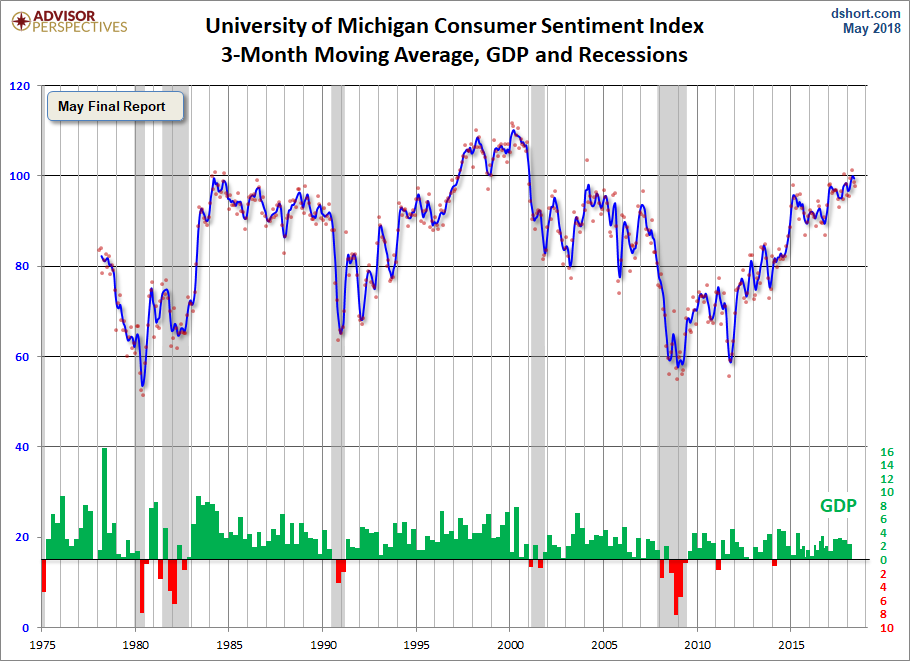
Note that this indicator is somewhat volatile, with a 3.0 point absolute average monthly change. The latest data point saw a 0.8 percent change from the previous month. For a visual sense of the volatility, here is a chart with the monthly data and a three-month moving average.
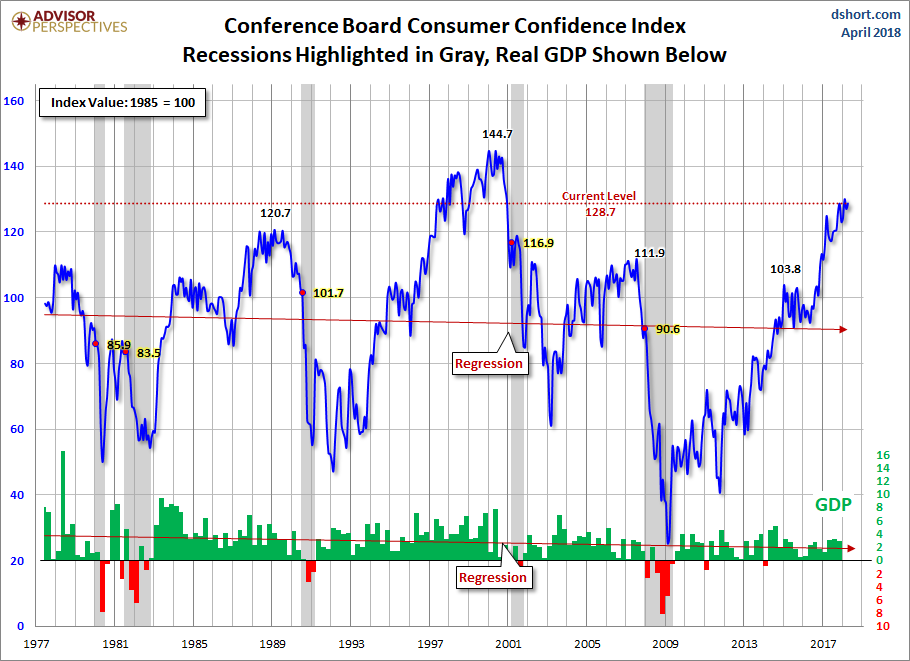
For the sake of comparison, here is a chart of the Conference Board's Consumer Confidence Index (monthly update here). The Conference Board Index is the more volatile of the two, but the broad pattern and general trends have been remarkably similar to the Michigan Index.
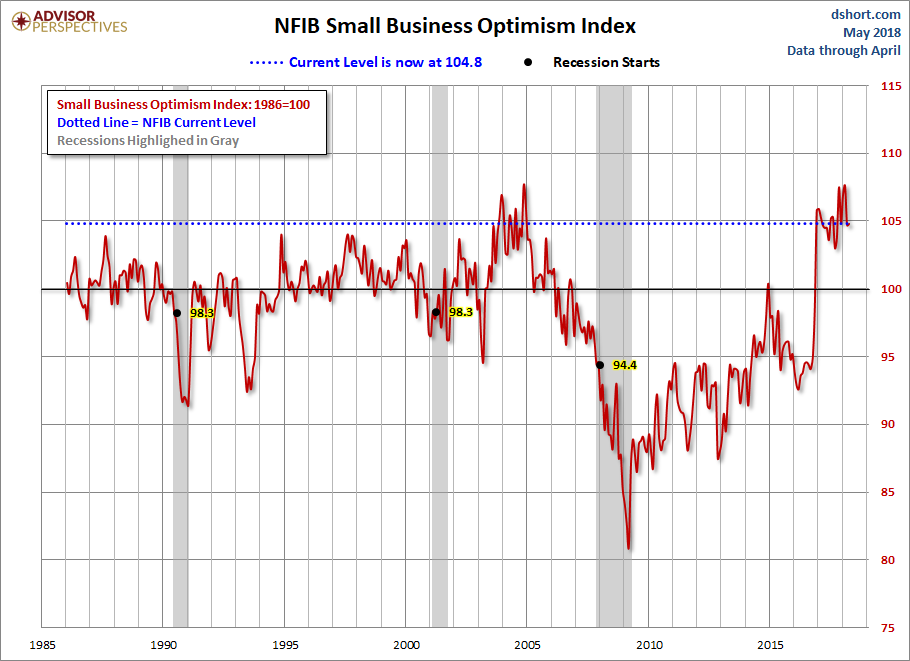
And finally, the prevailing mood of the Michigan survey is also similar to the mood of small business owners, as captured by the NFIB Business Optimism Index (monthly update here).
The general trend in the Michigan Sentiment Index since the Financial Crisis lows was one of slow improvement. The survey findings saw a jump in late 2016 with improvements that have continued through the present.
The next update to this report will be for the June preliminary data and will be published June 15.

Comments
Log in or sign up to join the conversation.