

The March preliminary came in at 95.9. Investing.com had forecast 95.0.
Surveys of Consumers chief economist, Richard Curtin, makes the following comments:
Consumer sentiment fell in early March due to the spreading coronavirus and the steep declines in stock prices. Importantly, the initial response to the pandemic has not generated the type of economic panic among consumers that was present in the runup to the Great Recession. Nonetheless, the data suggest that additional declines in confidence are still likely to occur as the spread of the virus continues to accelerate. Perhaps the most important factor limiting consumers' initial reactions is that the pandemic is widely regarded as a temporary event. The component of the Sentiment Index that posted the greatest loss involved judgements about prospects for the economy during the year ahead; this component fell by 29 points, accounting for 83% of the total point decline in early March. In sharp contrast, consumers more favorably judged the economic outlook over the next five years than last month. While the most effective containment efforts are widespread closures and self-isolation, those same actions have the largest negative impact on the economy and significantly increase the probability that the pandemic will be followed by a recession that lasts longer than the virus. The best policy antidote would be immediate relief provided by multiple sources of cash transfers and debt forbearance. To avoid a recession, speed is more essential than targeting. Moreover, maintaining confidence in the effectiveness of economic policies is essential (see the chart), otherwise the intended behavioral reactions on spending may not be forthcoming. [More...]
See the chart below for a long-term perspective on this widely watched indicator. Recessions and real GDP are included to help us evaluate the correlation between the Michigan Consumer Sentiment Index and the broader economy.
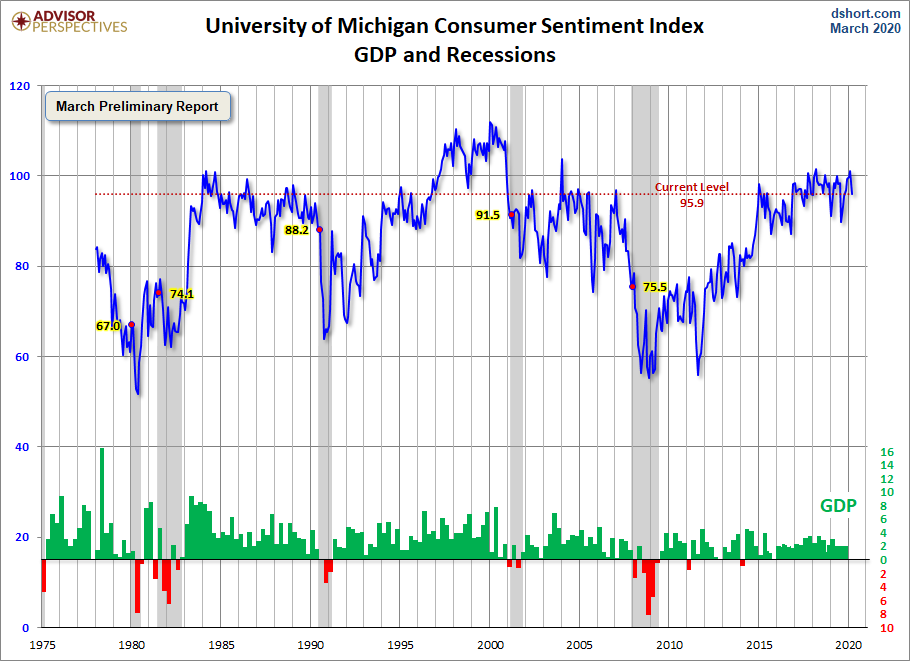
To put today's report into the larger historical context since its beginning in 1978, consumer sentiment is 11 percent above the average reading (arithmetic mean) and 12.3 percent above the geometric mean. The current index level is at the 78th percentile of the 507 monthly data points in this series.
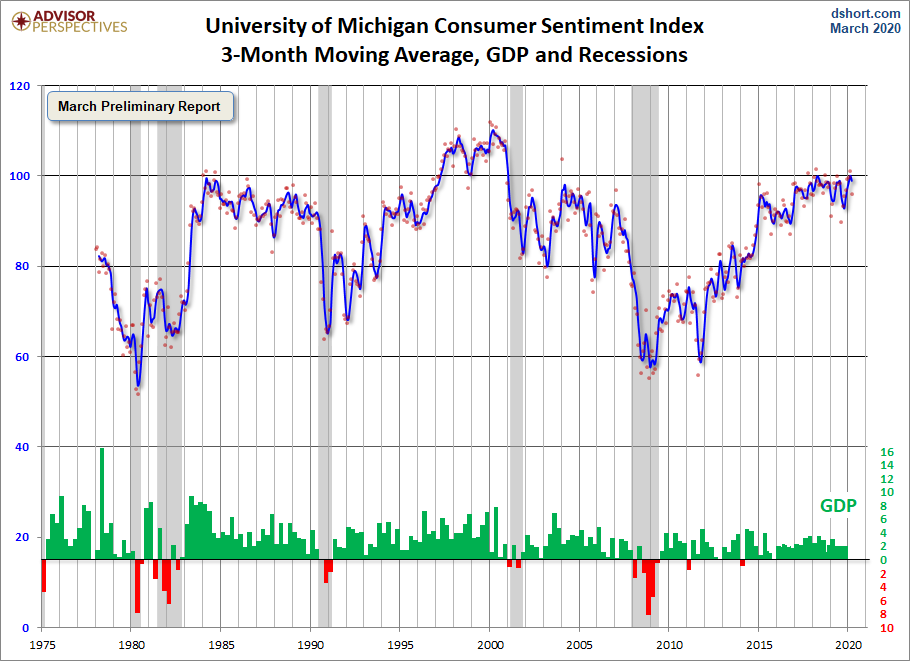
Note that this indicator is somewhat volatile, with a 3.0 point absolute average monthly change. The latest data point saw a 5.1 point decrease from the previous month. For a visual sense of the volatility, here is a chart with the monthly data and a three-month moving average.
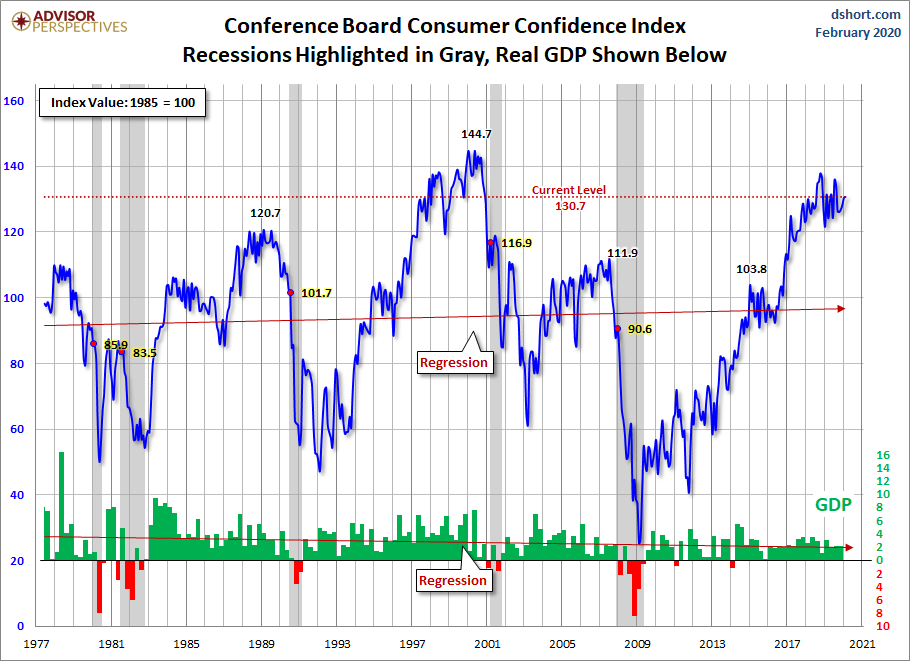
For the sake of comparison, here is a chart of the Conference Board's Consumer Confidence Index (monthly update here). The Conference Board Index is the more volatile of the two, but the broad pattern and general trends have been remarkably similar to the Michigan Index.
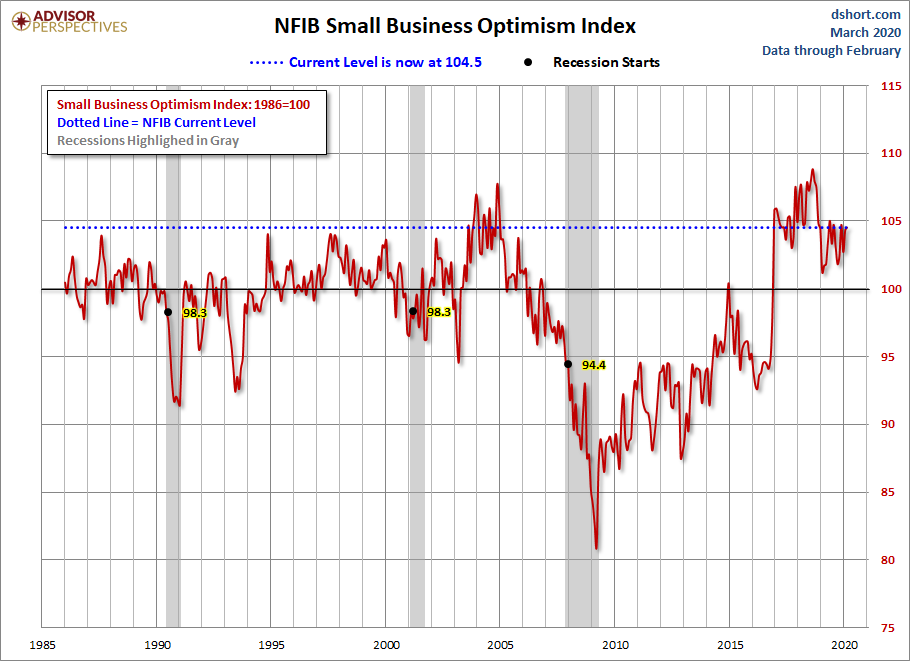
And finally, the prevailing mood of the Michigan survey is also similar to the mood of small business owners, as captured by the NFIB Business Optimism Index (monthly update here).
The general trend in the Michigan Sentiment Index since the Financial Crisis lows was one of slow improvement.

Comments
Log in or sign up to join the conversation.