

The March Final came in at 84.9, up 8.1 from the February Final. Investing.com had forecast 83.6. Since its beginning in 1978, consumer sentiment is 1.5 percent below the average reading (arithmetic mean) and 0.3 percent below the geometric mean.
Surveys of Consumers chief economist, Richard Curtin, makes the following comments:
Consumer sentiment continued to rise in late March, reaching its highest level in a year due to the third disbursement of relief checks and better than anticipated vaccination progress. As prospects for obtaining vaccination have grown, so too has people's impatience with isolation, as those concerns were voiced by nearly one-third of consumers in March, the highest level in the past year. The majority of consumers reported hearing of recent gains in the national economy, mainly net job gains. The data clearly point toward robust increases in consumer spending. The ultimate strength and duration of the spending surge will depend on the rate of draw-downs in savings since consumers anticipate a slower pace of income growth. Despite the vast decline in precautionary motives sparked by the easing of pandemic fears, those precautionary motives will not completely disappear.
Each side in the current policy debate finds support in the consumer data: the recovery is far from complete as only 45% of the fall in the Sentiment Index has been recovered, and the current and prospective stimulus and infrastructure spending has the potential to spark an inflationary psychology. The reestablishment of an inflationary psychology, however, will not occur immediately. Buy-in-advance psychology preceded actual inflation by about two years prior to 1980, with the lead time more variable but without any significant resurgence in the low inflation era (see the chart). The key issues are not to underestimate the ultimate impact of economic policies on employment and inflation, and not to overestimate the ability of economic policies to bring any excesses to a painless soft-landing. [More...]
See the chart below for a long-term perspective on this widely watched indicator. Recessions and real GDP are included to help us evaluate the correlation between the Michigan Consumer Sentiment Index and the broader economy.
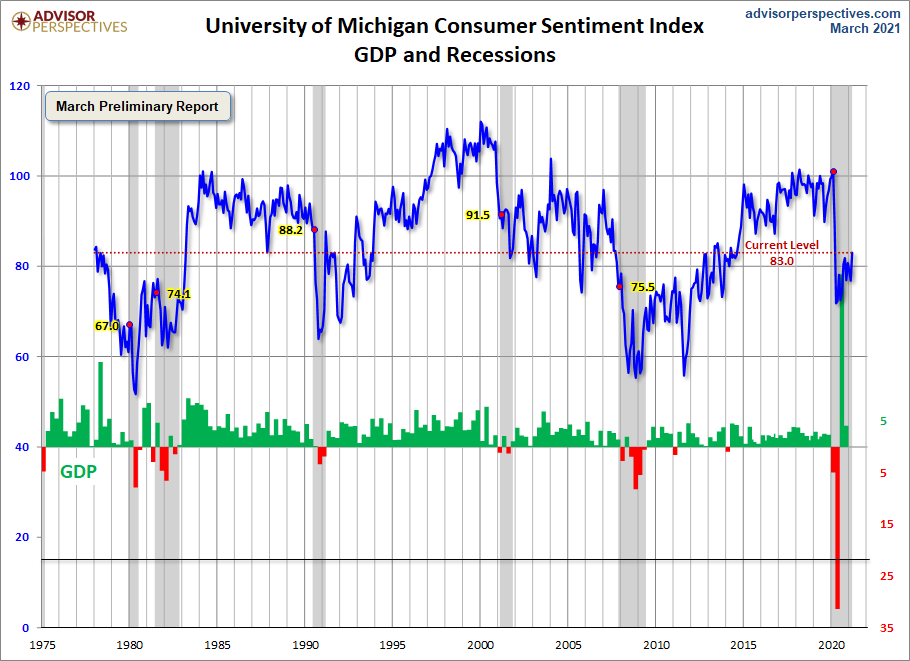
To put today's report into the larger historical context since its beginning in 1978, consumer sentiment is 1.5 percent below the average reading (arithmetic mean) and 1.3 percent below the geometric mean. The current index level is at the 40th percentile of the 519 monthly data points in this series.
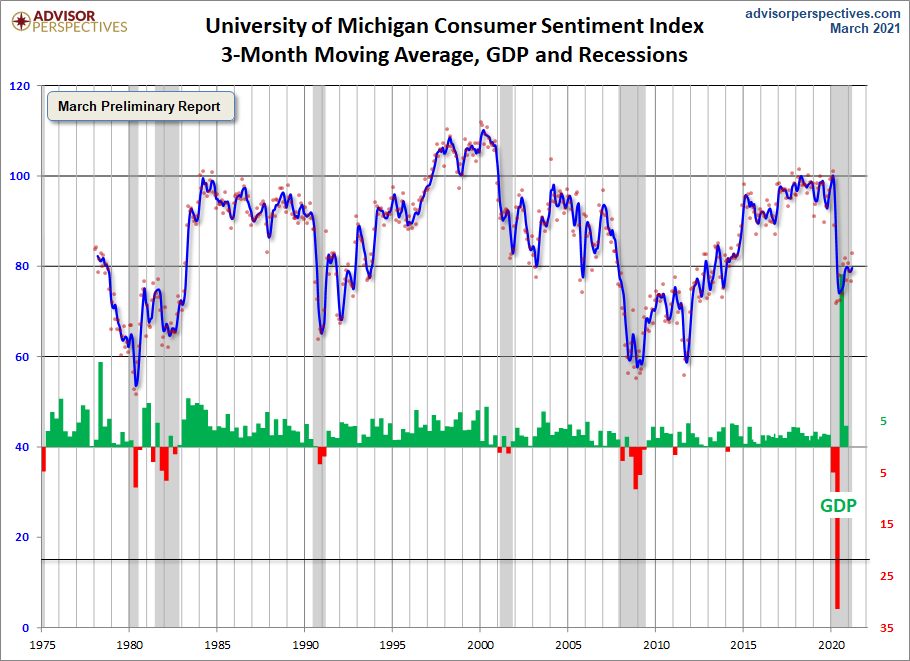
Note that this indicator is somewhat volatile, with a 3.0 point absolute average monthly change. The latest data point saw an 8.1 point increase from the previous month. For a visual sense of the volatility, here is a chart with the monthly data and a three-month moving average.
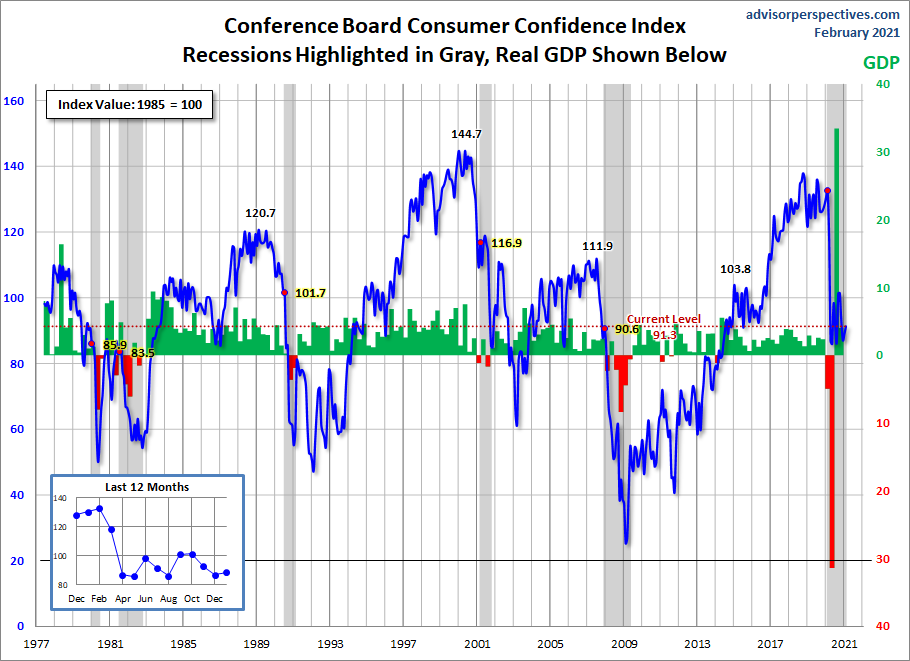
For the sake of comparison, here is a chart of the Conference Board's Consumer Confidence Index (monthly update here). The Conference Board Index is the more volatile of the two, but the broad pattern and general trends have been remarkably similar to the Michigan Index.
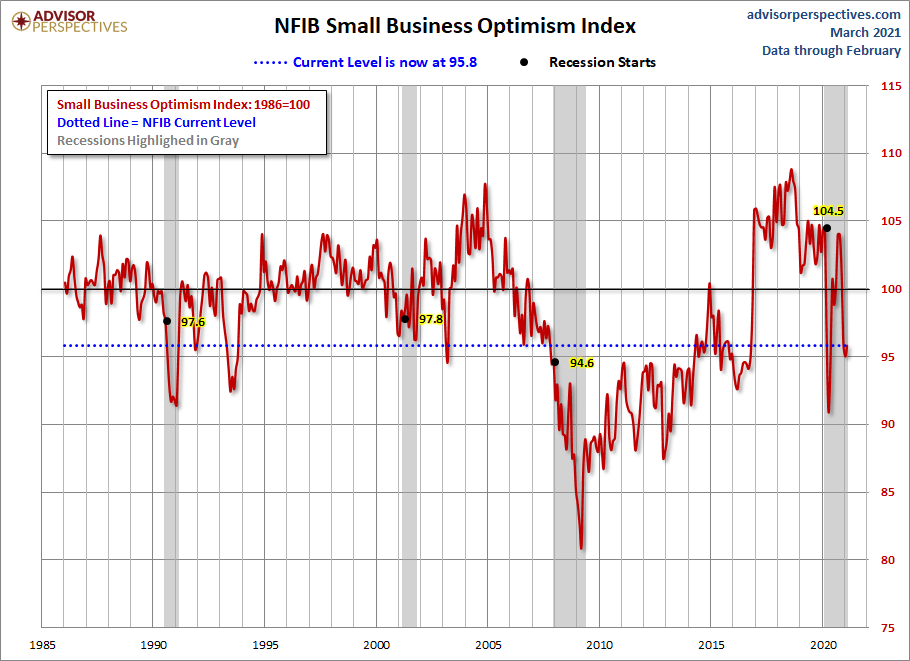
And finally, the prevailing mood of the Michigan survey is also similar to the mood of small business owners, as captured by the NFIB Business Optimism Index (monthly update here).

Comments
Log in or sign up to join the conversation.