

The April final came in at 71.8, its lowest since 2011. Investing.com had forecast 68.0.
Surveys of Consumers chief economist, Richard Curtin, makes the following comments:
April's final Sentiment Index reading remained largely unchanged from the mid-month figure (+0.8 points), and households with below median incomes expressed the same level of confidence as those with above median incomes (71.9). This merging reflects somewhat larger April declines among households with above median incomes (-19.8 points) compared with those with below median incomes (-14.0). The seven-day moving average of the Index of Consumer Sentiment indicated a second larger improvement that was quickly reversed (see the featured chart); its cause could not be linked to any direct judgements about the coronavirus. The notable divergence between the two main components of the Sentiment Index remained large. The Current Conditions Index fell by 29.4 points in the past month and by 40.5 points in the past two months, whereas the Expectations Index has posted smaller declines of 9.6 points in the past month and 22.0 points from February. While the decline in both indices indicates an ongoing recession, the gap reflects the anticipated cyclical nature of the coronavirus. In the weeks ahead, as several states reopen their economies, more information will reach consumers about how reopening could cause a resurgence in coronavirus infections. Consumers' reactions to relaxing restrictions will be critical, either putting further pressure on states to reopen their economies, or exerting added pressure to extend the restrictions even if it has negative consequences for economic prospects. The risks associated with these decisions are not equally balanced, with an incorrect decision to reopen having serious repercussions. The necessity to reimpose restrictions could cause a deeper and more lasting pessimism across all consumers, even those in states that did not relax their restrictions. [More...]
The University of Michigan's Surveys of Consumers has also published this report on Restoring Consumer Confidence.
See the chart below for a long-term perspective on this widely watched indicator. Recessions and real GDP are included to help us evaluate the correlation between the Michigan Consumer Sentiment Index and the broader economy.
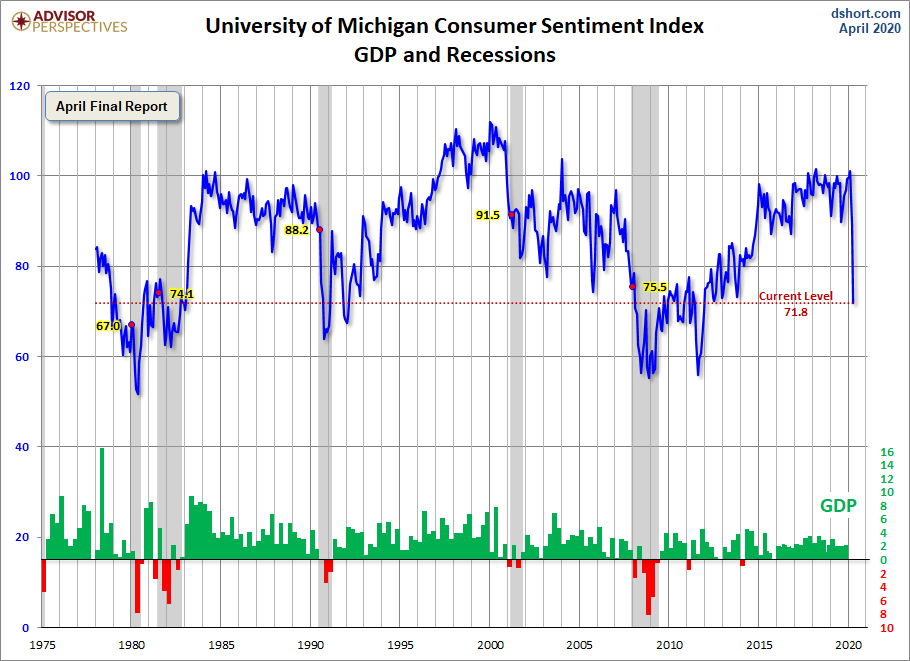
To put today's report into the larger historical context since its beginning in 1978, consumer sentiment is 16.8 percent below the average reading (arithmetic mean) and 15.9 percent below the geometric mean. The current index level is at the 16th percentile of the 508 monthly data points in this series.
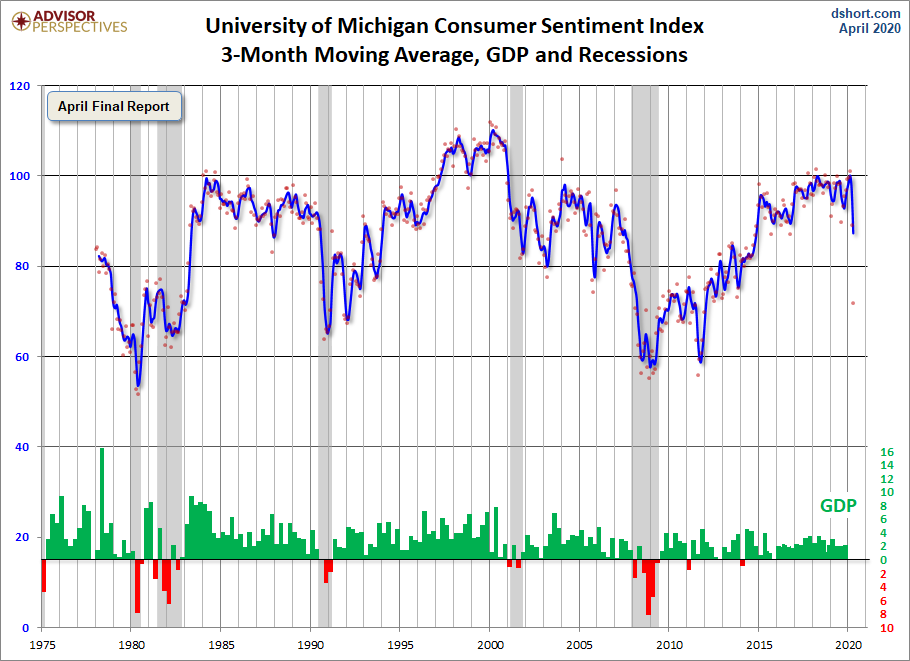
Note that this indicator is somewhat volatile, with a 3.0 point absolute average monthly change. The latest data point saw a 17.3 point decrease from the previous month, its largest monthly decline in the indicator's history. For a visual sense of the volatility, here is a chart with the monthly data and a three-month moving average.
For the sake of comparison, here is a chart of the Conference Board's Consumer Confidence Index (monthly update here). The Conference Board Index is the more volatile of the two, but the broad pattern and general trends have been remarkably similar to the Michigan Index.

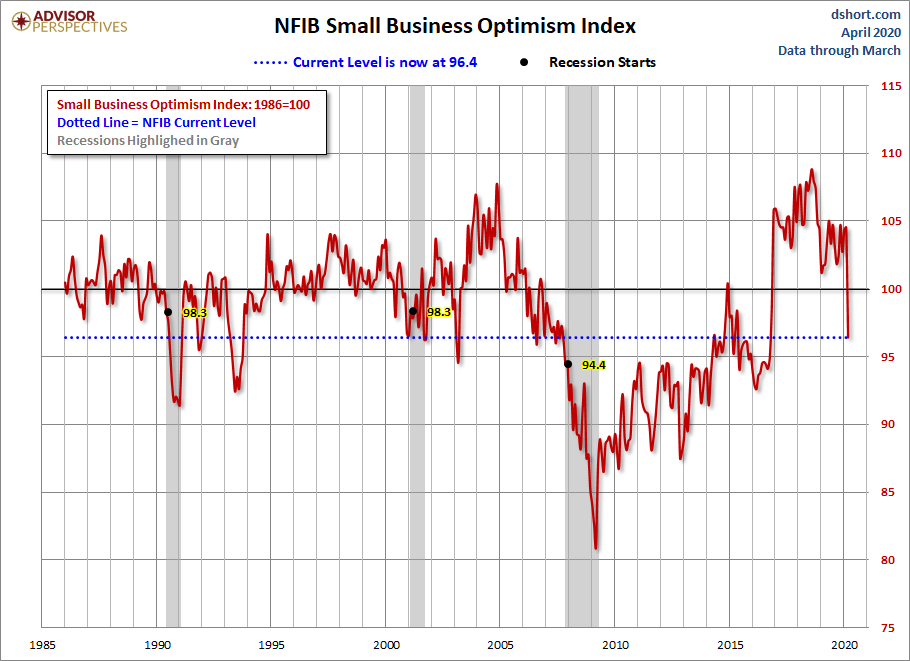
And finally, the prevailing mood of the Michigan survey is also similar to the mood of small business owners, as captured by the NFIB Business Optimism Index (monthly update here).
The general trend in the Michigan Sentiment Index after the Financial Crisis lows was one of slow improvement.
The next update to this report will be published on May 15.

Comments
Log in or sign up to join the conversation.