

Mersana Therapeutics Inc. (Pending:MRSN) expects to raise $67.5 million in its upcoming IPO ($78.0 million if underwriters exercise their option to purchase additional shares). If the underwriters price the IPO at the midpoint of the $14-$16 range, MRSN will have a market capitalization of $350.9 million.
We previewed this deal on our IPO Insights platform. MRSN filed for the IPO on June 1, 2017.
Lead Underwriters: Cowan & Company, Leerink Partners, and J.P. Morgan
Underwriters: Wedbush Securities
Business Summary: Biotechnology Company Developing Cancer Treatments
Mersana Therapeutics is a biotechnology company that identifies, engineers, and develops cancer treatments using antibody drug conjugates. The company focuses on efficacy, tolerability, and safety compared to existing therapies.
Its product candidate portfolio includes XMT-1522, which is a drug treatment for tumors that express relatively low amounts of the HER2 protein; and the anti-HER2 antibody utilized in XMT-1522. Its second product candidate is XMT-1536, which is expected to enter clinical development in 2018.
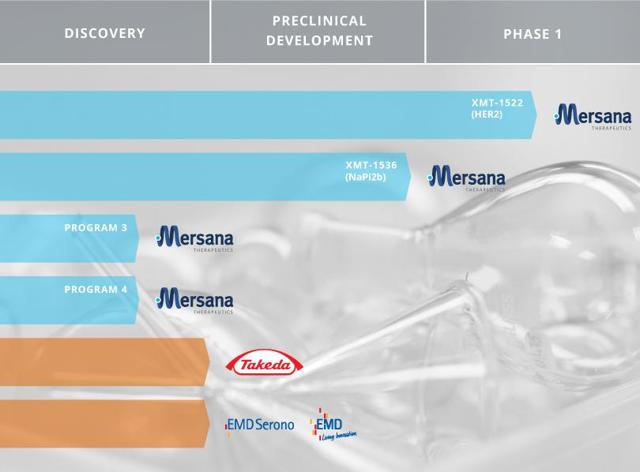
(Source: Company Website)
Mersana has strategic alliances with Asana BioSciences, Merck Serono, and Takeda Pharmaceutical Company Limited. The company was formerly known as Nanopharma Corporation, and it changed its name in 2005 to Mersana Therapeutics. The company was founded in 2001 and is based in Cambridge, Massachusetts.
Use of Proceeds And Highlights From Management's Analysis
Currently, Mersana has no products approved for sale and thus has not generated organic revenue. To date the company has funded its operations through private placements of convertible preferred stock and strategic partnerships. From 2012 through March 31, 2017, Mersana raised $195.2 million in gross proceeds to fund operations. ($95.5 million came from issuing convertible preferred stock, and $99.7 million came from payments from strategic partners.)
Since launching, Mersana has incurred net losses ticked of $16.4 million, $13.7 million, $5.4 million and $8.1 million for the years ended December 31, 2015 and 2016 and the three months ended March 31, 2016 and 2017, respectively.
As of March 31, 2017, the company had an accumulated deficit of $67.2 million. Expenses are expected to grow as Mersana continues with ongoing clinical, preclinical, and research activities.
Use of IPO proceeds will go towards Phase I and pre-clinical activities, as well as ongoing R&D.
Potential Competition: AstraZeneca, Pfizer, Novartis, and Others
Mersana is aware of multiple companies developing antibody drug conjugates including Takeda, Sanofi (SNY), Novartis (NVS), Eli Lilly (LLY), Genentech, AbbVie (ABBV), Seattle Genetics (SGEN), Pfizer (PFE), Immunomedics (IMMU), ImmunoGen (IMGN), Daiichi Sankyo, Bristol-Myers Squibb (BMY), AstraZeneca (AZN), and Astellas.
Executive Management Highlights
President, CEO, and Director Anna Protopapas joined Mersana in 2015. Her previous experience includes senior positions at Takeda Pharmaceutical and Millennium Pharmaceuticals. She serves on the Board of Directors for Bioverativ and Ariad Pharmaceuticals. She received a bachelor's degree in science and engineering from Princeton University, a master's in chemical engineering practice from the Massachusetts Institute of Technology and an M.B.A. from Stanford Graduate School of Business.
Chief Business Officer Eva Jack has served Mersana since 2013. Her previous experience includes positions at Pulmatrix, MedImmune, and Intel Corp. Ms. Jack received a B.A. from the University of Virginia and a master's in health sciences from The Johns Hopkins University.
Conclusion: Consider Modest allocation
We like Mersana's partnerships with major pharma firms.
The pipeline overall is OK and the company notes in its SEC Filings that post-IPO its goal is to file one new IND every 12-24 months.
The company has a strong management team.
We recommend investors consider a modest allocation to MRSN.

Comments
Log in or sign up to join the conversation.