

In one of our last articles, we looked at the German Constitutional Court's ruling that some ECB actions, in regards to Asset purchases regarding the QE, are unconstitutional and thus not valid in Germany, since the ECB decisions are not backed by the EU treaty.
As a result, we developed a bearish Euro scenario, and expected an attack at the current yearly lows around 1.0630 and even a break lower with a minimum test of 1.0500 likely, as long as we trade below 1.1000.
Since then, the Euro-tide has turned over the last week of trading, and we now consider the Euro bullish.
Germany and France propose 500 billion EU recovery fund amid Coronavirus crisis
On May 18, German chancellor Merkel and French president Macron proposed a 500 billion EU recovery fund that would offer grants to European Union regions and sectors hit hardest by the coronavirus pandemic.
In fact, one could see this as a first step towards a transfer union and in addition with the massive monetary stimulus from the ECB which has increased its balance sheet as of April 17 to 5,28 Trillion EUR bullish for the Euro.
This is probably especially true against the US dollar. The Greenback should stay under pressure and while we expect European yields to keep on rising, a sustainable drop in 10-year US Treasury yields below 0.60% would narrow the yield differential between EU and US bonds further, favouring gains in the EUR/USD.
How can we trade the EUR/USD in this environment?
The EUR/USD traded within a range between 1.0750 and 1.1000 since the beginning of April, attacking the region around 1.1000 over the course of last week of trading.
When trading a range breakout, a projected target can usually be found by unfold the range in direction of the breakout.
That said, a potential target of a bullish breakout could be found around 1.1200/50.
Since the EUR/USD failed with its first breakout attempt last week, a more aggressive looks for a re-test of the region around 1.0880/0900, going Long against this region and anticipating a break above 1.1000 from here.
In both case the setup would not be valid anymore once the EUR/USD drops below 1.0730 again:
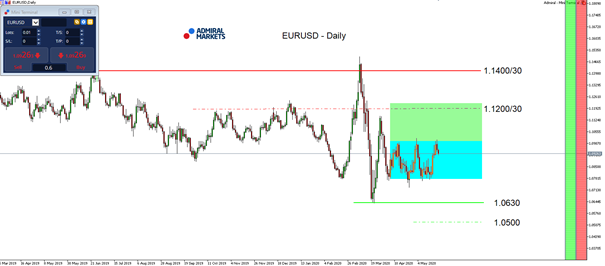
Source: Admiral Markets MT5 with MT5-SE Add-on EUR/USD Daily chart (between March 25, 2019, to May 22, 2020). Accessed: May 22, 2020, at 10:00pm GMT - Please note: Past performance is not a reliable indicator of future results, or future performance.
In 2015, the value of the EUR/USD fell by 10.2%, in 2016, it fell by 3.2%, in 2017, it increased by 13.92%, 2018, it fell by 4.4%, 2019, it fell by 2.2%, meaning that after five years, it was down by 7.3%.

Comments
Log in or sign up to join the conversation.