


Navigating a legal case without a solicitor can feel overwhelming, especially when you are unfamiliar with court procedures and legal terminology. Mckenzie Friend Services UK refers to support that may be available to people representing themselves in court, often called litigants in person. A McKenzie Friend is generally a person who can provide practical assistance and support during legal proceedings, subject to the court’s rules and discretion.
The role is not the same as that of a solicitor or barrister. Understanding the difference can help individuals choose the right type of support for their circumstances.
What Is a McKenzie Friend?
A McKenzie Friend is generally a layperson who assists someone representing themselves in court. The person receiving help remains responsible for presenting and managing their own case unless the court grants specific permission for a different arrangement.
In civil and family proceedings in England and Wales, official judicial guidance explains that a McKenzie Friend may provide moral support, take notes, help with case papers, and quietly offer advice. However, they do not automatically have the right to act as an advocate, conduct litigation, address the court, or examine witnesses.
It is important to understand that rules and procedures can differ depending on the jurisdiction and type of case. For example, Scotland uses its own court rules and terminology for lay assistance.
How Mckenzie Friend Services UK Can Help
People may explore Mckenzie Friend Services UK when they are planning to represent themselves and want practical support throughout the court process.
The exact assistance available can vary, but support may include:
Organising case documents
Taking notes during hearings
Providing emotional or moral support
Helping a litigant understand court procedures
Quietly discussing points that the litigant may wish to raise
Assisting with preparation and organisation of case papers
This type of support can be particularly useful for beginners who find legal processes difficult to understand. However, practical assistance should not be confused with formal legal representation.
The Litigant Remains Responsible
One of the most important points to remember is that a McKenzie Friend does not normally take over the case.
The person representing themselves remains the litigant in person and is generally responsible for:
Speaking to the court
Following court directions
Filing documents correctly
Meeting deadlines
Making decisions about the case
Presenting their own arguments
GOV.UK similarly explains that a person representing themselves may have someone present to take notes and provide advice, but that person cannot normally speak for them, interfere with proceedings, or sign documents on their behalf.
McKenzie Friend vs Solicitor: Understanding the Difference
The following comparison can help beginners understand the distinction.
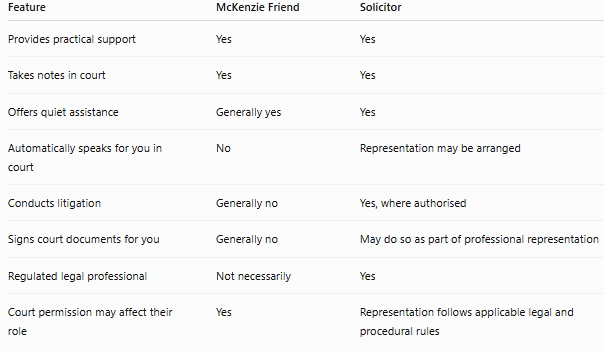
A key distinction is that a McKenzie Friend is not automatically entitled to act as a lawyer or advocate. In some circumstances, a court may consider granting an unqualified person permission to address the court, but this is a matter for the court and should not be assumed.
Benefits of Using a McKenzie Friend
1. Practical Support
Court paperwork can be extensive and difficult to organise. A supportive person may help arrange documents and keep track of important information.
2. Note-Taking During Hearings
It can be difficult to listen, think, and take notes at the same time. A McKenzie Friend may help by recording important points.
3. Emotional Support
Court proceedings can be stressful. Having a calm and supportive person present may help a litigant feel more prepared.
4. Assistance With Understanding Procedure
A person with relevant experience may help a litigant understand the general court process and prepare questions or points for consideration.
5. A Potentially Lower-Cost Support Option
Some people researching self-representation also search for an Affordable Mckenzie Friend UK option when professional legal representation is outside their budget.
However, affordability should not be the only factor. Individuals should carefully understand what assistance is actually being offered, the limits of the service, and whether qualified legal advice may be necessary for their situation.

Common Mistakes to Avoid
Mistake 1: Assuming a McKenzie Friend Is Your Lawyer
This is one of the most common misunderstandings.
A McKenzie Friend and a solicitor or barrister have different roles. Do not assume that a McKenzie Friend can automatically speak for you or conduct your case.
Mistake 2: Failing to Check Court Requirements
Depending on the type of hearing, particularly private family proceedings, the court may need information about the proposed McKenzie Friend.
Government guidance for family court cases involving children explains that the court should be informed if a party wants to use a McKenzie Friend and may require relevant information about that person.
Mistake 3: Missing Deadlines
Having support does not remove the litigant's responsibility to comply with court orders and deadlines.
Create a calendar for:
Hearing dates
Document submission deadlines
Response dates
Required meetings
Other directions from the court
Mistake 4: Expecting Guaranteed Results
No form of support can guarantee the outcome of a legal case. Court decisions depend on the facts, evidence, applicable law, and judicial process.
Mistake 5: Sharing Documents Without Considering Confidentiality
Court papers may contain sensitive personal information. Before sharing documents, understand the purpose of the assistance and any confidentiality responsibilities that apply.
Expert Tips for Choosing Support
When considering Mckenzie Friend Services UK, take time to evaluate the individual or service carefully.
Ask About Relevant Experience
Ask whether the person has experience with the relevant type of case, such as:
Family proceedings
Civil disputes
Child arrangements
Financial matters
Experience does not make someone a regulated lawyer, but understanding their background can help you decide whether their assistance is appropriate.
Understand the Exact Scope
Ask clear questions such as:
Will they attend the hearing?
Can they help organise documents?
What preparation support is included?
What are they not permitted to do?
Are there additional charges?
What happens if the court does not permit their attendance?
Clear expectations can prevent misunderstandings later.
Consider Whether Qualified Legal Advice Is Needed
Some cases involve complex legal issues, significant financial consequences, or serious personal matters. In these situations, it may be sensible to seek advice from a qualified legal professional.
The Courts and Tribunals Judiciary also directs litigants in person toward possible sources of free or low-cost help, including advice centres, law centres, and pro bono organisations.
Best Practices for Working With a McKenzie Friend
To make the arrangement more effective, follow these practices.
Prepare Before Every Hearing
Create a simple hearing file containing:
A case timeline
Important court orders
Relevant evidence
Key questions
Points you want to raise
Agree on Roles in Advance
Both people should understand who will do what.
For example, the litigant may speak to the court while the McKenzie Friend takes notes and quietly highlights important issues.
Stay Focused on the Court Process
Avoid unnecessary arguments or emotional discussions during the hearing. Preparation can help keep communication organised and relevant.
Respect the Limits of the Role
A McKenzie Friend should not attempt to take actions that they are not authorised to perform. Official guidance makes clear that the court retains control over proceedings and may refuse or limit assistance where appropriate.

People Also Ask: Quick Answers
What does a McKenzie Friend do?
A McKenzie Friend may provide practical and moral support, take notes, help with case papers, and quietly offer assistance to a person representing themselves in court.
Can a McKenzie Friend speak in court?
Not automatically. A McKenzie Friend generally does not have an independent right to address the court or examine witnesses. Any exception depends on permission and the applicable legal process.
Does the court have to allow a McKenzie Friend?
The position depends on the circumstances and type of proceedings. Courts retain the power to control who may provide assistance and may refuse permission where appropriate.
Is a McKenzie Friend the same as a solicitor?
No. A solicitor is a regulated legal professional, while a McKenzie Friend is generally a lay assistant providing support to a litigant in person.
Can a McKenzie Friend sign court documents?
Generally, no. Official guidance states that a McKenzie Friend does not normally manage litigation or sign court documents on behalf of the litigant.
Frequently Asked Questions
1. Who can act as a McKenzie Friend?
Depending on the circumstances, a friend, relative, colleague, or another layperson may potentially provide support. The court may consider whether that person's involvement is appropriate.
2. Can I represent myself and still receive legal advice?
Yes. Self-representation does not necessarily prevent you from seeking legal advice separately.
3. Can a McKenzie Friend help with family court matters?
McKenzie Friends are commonly associated with civil and family proceedings, but court procedures and permissions must be considered for the specific case.
4. What should I ask before using a McKenzie Friend?
Ask about their experience, scope of assistance, fees if applicable, confidentiality, availability, and the limits of their role.
5. Can a McKenzie Friend question witnesses?
Generally, no. Questioning witnesses normally requires appropriate authority or permission to act in that capacity.
6. Is a McKenzie Friend suitable for every case?
No. Complex or high-risk legal matters may require qualified legal advice or representation
For people navigating self-representation, Mckenzie Friend Services UK can provide practical, organisational, and moral support. The most important step is understanding the difference between assistance and formal legal representation.
Before relying on any support, check the rules that apply to your court and case, understand the limits of the person's role, keep control of deadlines and documents, and consider qualified legal advice when the issues are complex. With clear expectations and careful preparation, litigants can make more informed decisions about the type of support they need.
eLegal Online
Comments
Log in or sign up to join the conversation.