

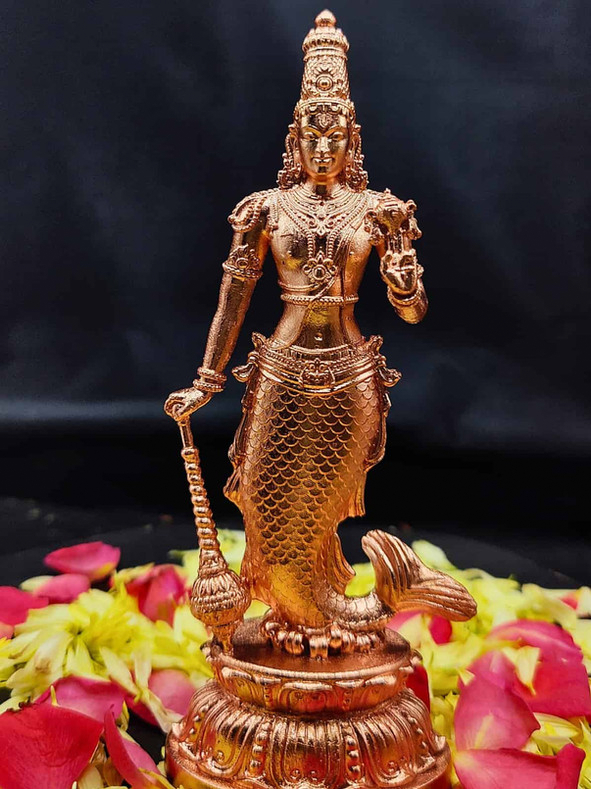
Matsya Avatar, the very first of Lord Vishnu's ten great incarnations, is honoured today through beautifully handcrafted idols from Gold Plating Art Studio's collection that bring this ancient legend into modern devotional spaces. As the earliest of the Dashavatara, Matsya's story marks the beginning of Vishnu's long tradition of descending to earth whenever cosmic order falls into peril, and it remains one of the most enduring symbols of divine protection in Hindu mythology.
Depicted as half-fish and half-divine being, Matsya's tale of rescuing sacred knowledge from a catastrophic flood continues to resonate as a story of preservation, guidance, and hope amid chaos. At Gold Plating Art Studio, this profound narrative is captured in exquisitely crafted idols designed to bring Matsya's protective presence into any home or temple.
Who Is Matsya Avatar?
The First of the Dashavatara
Matsya holds the distinguished place of being the first among the Dashavatara, the ten principal incarnations through which Lord Vishnu descends to earth to restore dharma whenever it is gravely threatened. Coming even before Kurma the tortoise and Varaha the boar, Matsya's appearance set the very template for what an avatar of Vishnu would come to mean: a timely, decisive intervention to save the universe from ruin.
Vishnu in the Form of a Fish
Unlike later avatars who take on more overtly heroic or combative forms, Matsya's incarnation as a fish reflects a gentler, more nurturing kind of divine intervention - one focused on preservation and rescue rather than direct confrontation with a demon. This distinction sets the tone for understanding Matsya's unique place among Vishnu's many forms.
Half-Fish, Half-Divine Form
Matsya is most commonly depicted as a being with the lower body of a fish and the upper body of Vishnu himself, complete with his traditional attributes - the conch (shankha) and the discus (chakra) held in his upper hands. In some renderings, Matsya appears as an enormous golden fish alone, while other depictions show this composite divine-and-aquatic form, emphasizing both his animal disguise and his true, unchanging divine nature.
Preservation Amid Chaos
At its heart, Matsya's imagery speaks to the idea of preservation in the face of overwhelming destruction. Where the deluge represents total dissolution, Matsya represents the calm, guiding presence that ensures life, knowledge, and righteousness survive to be reborn in a new age.
The Legend of Matsya and the Great Deluge
King Satyavrata and the Growing Fish
The story begins with King Satyavrata, a devout and righteous ruler, who one day finds a tiny fish while performing his ritual ablutions in a river. Taking pity on the small creature, he places it in his water pot, only to find that it rapidly outgrows every container he offers it — a pot, then a pond, then a lake - until finally it must be released into the vast ocean itself.
The Warning of the Deluge
Recognizing that no ordinary fish could grow at such a miraculous pace, Satyavrata realizes he is in the presence of the divine. Matsya then reveals his true identity and warns the king of an imminent, world-ending deluge that will soon submerge the entire earth. He instructs Satyavrata to gather the Saptarishi, the seven great sages, along with the sacred Vedas and the seeds of every living being, and to build a great boat that will carry them safely through the coming flood.
The Battle with Hayagriva
As the floodwaters rise and consume the world, Matsya guides Satyavrata's boat by tying it to his own massive horn, steering it safely through the raging deluge. During this same cosmic upheaval, the demon Hayagriva seizes the opportunity to steal the sacred Vedas from Brahma. In the climax of the legend, Matsya confronts and slays Hayagriva, recovering the Vedas and restoring them to Brahma, ensuring that humanity's most sacred knowledge survives the destruction of the age.
Matsya Temples and Sacred Sites
Among the temples dedicated to this ancient avatar, the Veda Narayana Swamy Temple in Nagalapuram, Andhra Pradesh, stands as one of the most significant. Built during the Vijayanagara era, this temple is renowned for its intricate stone carvings and stands as a lasting tribute to Matsya's role as the preserver of sacred wisdom. Devotees visiting the temple often reflect on the same themes of protection and renewal that define Matsya's legend.
Spiritual Significance of Matsya
Preservation of sacred knowledge: Matsya's rescue of the Vedas underscores the belief that divine wisdom must be protected at all costs, even amid total destruction.
Guidance through crisis: His steady guidance of Satyavrata's boat through the flood symbolizes divine support during humanity's darkest moments.
A template for renewal: Matsya's story teaches that even complete dissolution can give way to a fresh, restored beginning.
Trust in the divine plan: Satyavrata's willingness to follow Matsya's instructions without full understanding reflects the value of faith during uncertain times.
Why Is Matsya Different from Other Avatars of Vishnu?
Each of Vishnu's ten avatars addresses a distinct kind of cosmic threat, and Matsya's role stands apart in several ways:
Matsya vs. Kurma: While Kurma the tortoise physically supports the churning of the cosmic ocean, Matsya's intervention is centred on rescue and preservation rather than bearing a burden.
Matsya vs. Varaha: Varaha the boar defeats the demon Hiranyaksha through direct combat, whereas Matsya's confrontation with Hayagriva comes only after guiding humanity safely through the flood.
A gentler first intervention: As the very first avatar, Matsya's fish form is far less overtly powerful in appearance than later avatars like Narasimha or Varaha, reflecting an early, formative stage in Vishnu's descent into the world.
Preserver rather than destroyer: Where many avatars are remembered chiefly for defeating a demon, Matsya is remembered first and foremost as a preserver - of life, of knowledge, and of dharma itself.
Conclusion
As the opening chapter of Vishnu's Dashavatara, Matsya's story remains one of the most quietly powerful legends in Hindu tradition — a tale of humble beginnings, divine revelation, and the safeguarding of humanity's most sacred knowledge against total annihilation. His enduring image, half of this world and half beyond it, continues to remind devotees that preservation, patience and faith can carry us through even the greatest floods life presents.
Comments
Log in or sign up to join the conversation.