

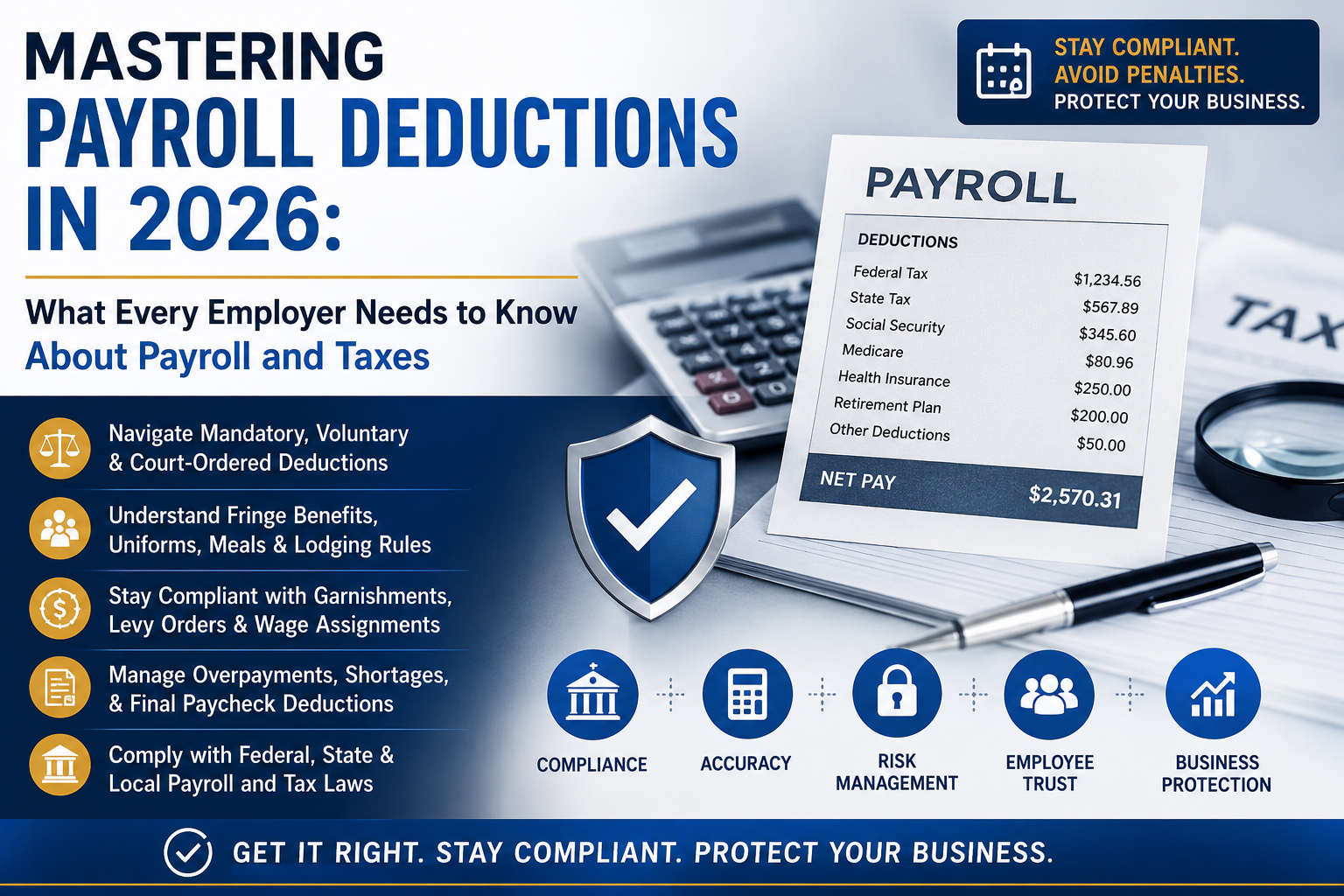
Calculating gross wages correctly is only half the battle in payroll. The harder, riskier part comes next: figuring out exactly what can, must, and must never be deducted from an employee's paycheck. Get payroll and taxes wrong at this stage, and an employer isn't just risking an unhappy employee — they're risking penalties from the IRS, a visit from the federal Department of Labor, or an audit from a state labor agency. As payroll expert Vicki M. Lambert, CPP, points out in her upcoming webinar "Mastering Payroll Deductions in 2026," this is one of the most complex and high-stakes areas of payroll administration, and the rules are shifting again this year.
Why Deductions Are So Tricky
Everyone understands that payroll withholds federal and state taxes. What's far less understood is how much control an employee actually has over those deductions versus how much is purely mandatory. Some deductions are required by law, some are a courtesy the employer extends, and others are entirely within the employee's discretion. Misclassifying any of these — treating a mandatory deduction as optional, or vice versa — can trigger compliance failures that ripple through every paycheck an employer issues.
Complicating matters further, federal and state rules don't always agree. A deduction that's perfectly legal under federal law might be prohibited in a particular state. This patchwork means payroll teams operating across multiple states need to track two (or more) sets of rules simultaneously, and the cost of getting it wrong multiplies with each additional jurisdiction.
Mandatory vs. Voluntary: Knowing the Difference
Payroll and taxes deductions generally fall into a few buckets:
Mandatory tax withholdings — federal and state income tax, Social Security, Medicare
Court-ordered or government-mandated deductions — child support, tax levies, and creditor garnishments
Voluntary deductions — health insurance, group term life insurance, retirement contributions
Gray-area deductions — wage assignments for items like payday loans, which carry specific rules about when they must be honored
Each category carries its own compliance requirements. For example, garnishments have limits on how many an employer can honor at once and how frequently, while tax levies must be processed according to specific federal and state procedures. Confusing a court-ordered garnishment with a voluntary wage assignment — or vice versa — can expose an employer to liability.
Fringe Benefits, Uniforms, Meals, and Lodging
Beyond taxes and garnishments, payroll teams must navigate deductions tied to fringe benefits. Voluntary health insurance deductions are usually straightforward, but a medical support order changes the processing requirements entirely. Similarly, employers who require uniforms, provide meals, or offer lodging as part of compensation must understand exactly what can be deducted — and whether those costs can be counted toward minimum wage obligations. Get this wrong, and an employer may inadvertently violate minimum wage law even while believing they've followed the rules.
The Especially Risky Areas: Overpayments, Shortages, and Final Paychecks
Some of the thorniest payroll and taxes questions involve money the employer believes it's owed back. If an employee is overpaid, can the employer simply deduct the difference from a future check — or does the employee need to agree in writing first? Does the answer change once the employee has terminated employment?
The same questions arise around:
Cash shortages and breakage — Can an employee be charged for a register shortfall or damaged equipment, and is this legal under state law even if it seems reasonable?
Advanced vacation pay — If an employee took vacation in advance and then quit, can the employer recoup those hours from the final paycheck?
Employee loans and purchases — What repayment terms are enforceable while someone is employed, and what changes once they leave?
These scenarios are exactly where federal and state law most often diverge, and where anti-wage theft laws in various states have added new layers of restriction. A final paycheck, in particular, is subject to different rules than a regular one — timing requirements, allowable deductions, and penalties for noncompliance can all shift the moment an employee separates.
Why This Matters More in 2026
States continue to tighten wage theft protections, and enforcement agencies — both state departments of labor and the federal DOL — have shown no sign of easing audit activity. For payroll professionals, HR managers, accounting teams, and business owners alike, staying current isn't optional. A single improper deduction, even one made in good faith, can result in penalties, interest, and reputational damage.
The Bottom Line
Payroll and taxes compliance doesn't end once gross wages are calculated correctly — it's just getting started. Understanding which deductions are mandatory, which are voluntary, and which depend on circumstances like termination or court orders is essential for avoiding costly mistakes. For payroll executives, HR professionals, and business owners who want a deeper, rule-by-rule breakdown of these scenarios — including garnishments, fringe benefits, overpayments, and final paycheck deductions — Vicki M. Lambert's webinar, Mastering Payroll Deductions in 2026: Federal, State & Voluntary Rules Explained, offers a comprehensive walkthrough of exactly where the risks lie and how to stay compliant.
FAQs
1. What's the difference between mandatory and voluntary payroll deductions?
Mandatory deductions — like federal/state income tax, Social Security, and Medicare — are required by law and the employer has no choice but to withhold them. Voluntary deductions, such as health insurance or retirement contributions, depend on the employee's consent. There's also a middle category, like court-ordered garnishments, which the employer must honor but doesn't choose.
2. Can an employer deduct an overpayment directly from an employee's next paycheck?
Not always. Federal law and state law often disagree here — some states require written employee consent before recovering an overpayment, while others allow employers more flexibility. The answer can also change once the employee has been terminated, making this one of the riskier areas of payroll compliance.
3. Are deductions for uniforms, meals, or lodging legal?
It depends on the state and the circumstances. Some costs can be deducted or counted toward minimum wage obligations, while others cannot — especially if doing so would drop an employee's effective pay below minimum wage. Federal and state rules frequently differ on this point.
4. Why do final paychecks have different deduction rules than regular paychecks?
Many states impose stricter timing and deduction rules once an employee separates from the company. Items like advanced vacation pay, outstanding loans, or employee purchases may be harder (or impossible) to recoup from a final check compared to a regular one, and anti-wage theft laws in several states add further restrictions.
Comments
Log in or sign up to join the conversation.