


Analysts keep hiking their stock price targets for chip-maker Marvell Technology (MRVL). As a result, two attractive plays are shorting out-of-the-money MRVL put options and put credit spreads.
MRVL closed up 1.45% on Friday, Sept. 18, at $244.25. It has risen from a recent trough price of $163.40 almost two months ago (July 29), but it's still well below a 6-month peak of $316.43 on June 4.
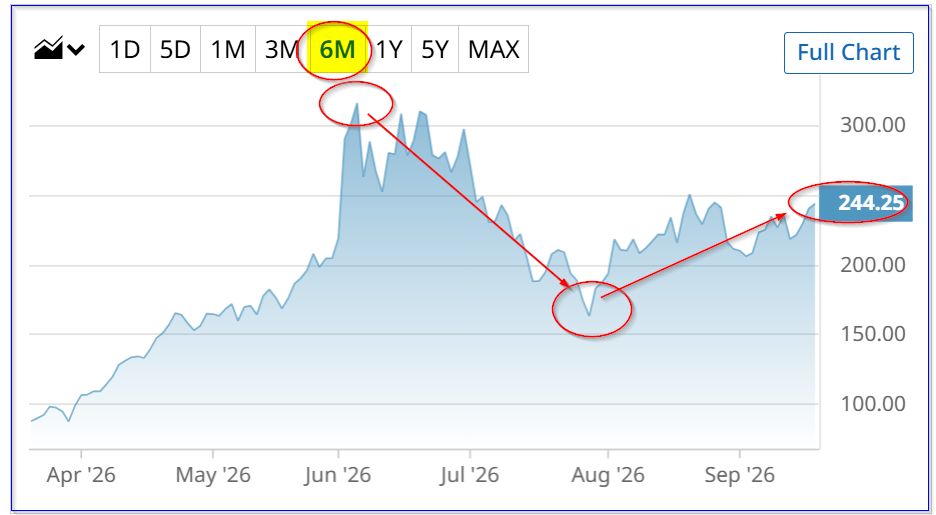
MRVL stock - last 6 months - Barchart - Sept. 18, 2026
I wrote about how cheap it was last month in a Sept. 1 Barchart article, “Marvell Technology Posts Lower FCF Margins, But Revenue Could Surge Next Year - Is MRVL Stock Too Cheap?”
At the time, MRVL was at $211.66, but I showed that, based on its strong free cash flow (FCF) and FCF margins, it could be worth $285.32. That is still 16.8% higher than its Friday close.
Moreover, analysts surveyed by Yahoo! Finance have hiked their price targets (PTs) to $289.04, up from $278.89 last month. Barchart's mean survey PT is now $291.25, higher than $290.94 last month.
However, AnaChart shows that the average of 28 analysts is $241.23, slightly below its current price.
The bottom line is that MRVL stock could still have some upside, albeit not as much as before.
That also makes it ideal for investors who want to buy in at a lower price and get paid while waiting. They do this by selling short out-of-the-money (OTM) cash-secured puts.
Shorting OTM Cash-Secured MRVL Puts
Last month I wrote about shorting the Oct. 2, 2026, expiry put option at the $190.00 strike price. At the time, this was 10% below the trading price. Moreover, the delta ratio was -0.2290, implying a low chance the account would be assigned to buy 100 shares at that strike price.
Short-sellers collected a $5.15 premium, so the expected short-put yield was 2.71% (i.e., $515/$19,000 collateral). Today, that put premium has dropped to just 45 cents. So, the short-seller has made most of the income and can now roll this trade over.
For example, the Oct. 30, 2026, expiry period, 39 days away, the $215 strike price put contract has a midpoint premium of $8.38. This strike has a similar delta ratio (-0.2389), and it's 12% below Friday's close (i.e., out-of-the-money).
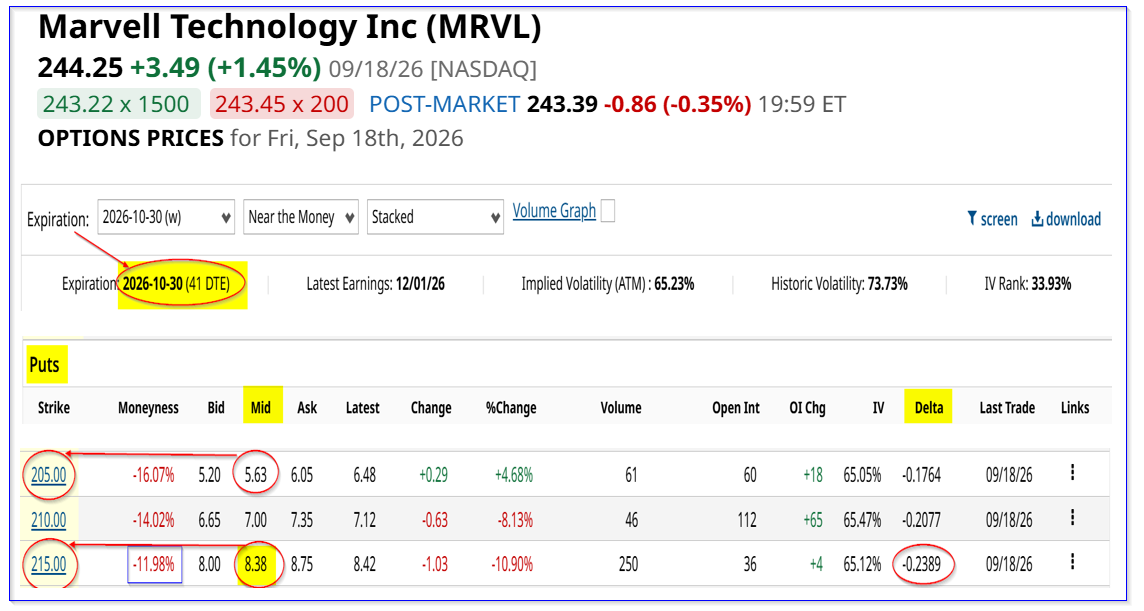
MRVL puts expiring Oct. 30 - Barchart - As of Sept. 18, 2026
This means an investor who posts $21,500 with the brokerage firm immediately collects $838. That's an expected short-put yield of 3.90% (i.e., $838/$21,500 = 0.038976).
Even after the rollover (i.e., buying back the prior trade for $45), the net premium collected would be $793 (i.e., a short-put yield of 3.688%).
Note that if an investor can repeat this play for 6 months, the expected return (ER) is 22.1% (3.688% x 6). That's about equal to the potential upside in owning MRVL stock shares over the next year.
Moreover, the investor will have a lower potential buy-in point: $215-$8.38 = $206.62. That's 15.4% below Friday's close at $244.25.
However, not everybody has $21.5K to post as collateral. An easier way to do this with less collateral, albeit with more risk, is to enter a put credit spread trade.
MRVL Put Credit Spread Play
This play means buying a lower-strike-price put with the short-put income. For example, buying a $205.00 put in the Barchart table above shows that it would cost $563.
As a result, the net credit collected is $838-$563, or $275.00.
On the one hand, this ensures the short-put investor that any drop in MRVL stock below $205 will be covered. So the exposure is just $1,000 (i.e., $215-$205 x 100).
On the other hand, an investor with less capital (i.e., can't afford the $21.5K collateral) can do this play. That's because the brokerage firm will only require $1,000 in collateral.
As a result, the put credit spread play has a very attractive expected return:
$275 / $1,000 collateral -1 = 27.5% ER
And, on a net basis, since the most that the investor can lose is $1,000 - $275, or $725:
$275 / $725 -1 = 37.93% net ER
But don't forget that the investor could lose $725. So, that is much riskier than just a straight short-put play. Nevertheless, if MRVL falls close to $215, the investor can roll over the trade to the next month.
The upside is quite high here. For example, by doing 3 put credit spreads (i.e., requiring $3,000 in collateral), the investor collects $825 (i.e., $275 net credit x 3). That is close to the $838 short-put play, which required $21.5K in collateral. (Of course, the investor stands to lose $3,000, whereas the short-put investor just has to buy 100 shares if MRVL drops to $205).
The bottom line is shorting MRVL puts and doing put credit spreads allows an investor to make attractive returns.



Comments
Log in or sign up to join the conversation.