

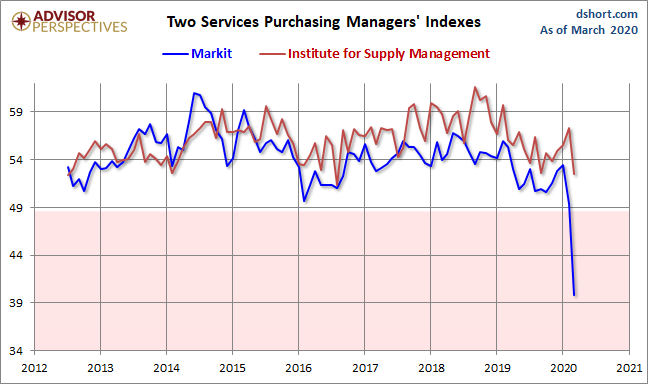
The March US Services Purchasing Managers' Index conducted by Markit came in at 39.8 percent, down 9.6 from the final February estimate of 49.4. The Investing.com consensus was for 49.4 percent.
Here is the opening from the latest press release:
Commenting on the latest survey results, Chris Williamson, Chief Business Economist at IHS Markit, said:
“Business activity slumped to the greatest extent for more than a decade in March as efforts to contain the spread of the COVID-19 pandemic intensified. The survey indicates that the economy contracted an annualised rate approaching 5% in March, but with more measures to fight the virus outbreak being taken this decline will likely be eclipsed by what we see in the second quarter. More nonessential businesses are being forced to close, some are going bust, and lockdowns are leading to vastly reduced consumer spending.
“Employment and prices charged for goods and services are already being slashed at rates not seen since 2009 as companies seek to aggressively cut costs and discount charges in the face of collapsing revenues. Given that the survey does not include the self-employed, the jobless numbers are likely to rise at a much faster rate than even the slide in the PMI indicates. The policy response to the economic damage from the virus has already been unprecedented, but the collapse in business expectations for the year ahead tells us that companies are expecting far worse to come. IHS Markit is now forecasting an around 5.5% contraction of US GDP in 2020.” [Press Release]
Here is a snapshot of the series since mid-2012.
(Click on image to enlarge)

Here is an overlay with the equivalent PMI survey conducted by the Institute for Supply Management, which they refer to as "Non-Manufacturing" (see our full article on this series here). Over the past year, the ISM metric has been significantly the more volatile of the two.
(Click on image to enlarge)
The next chart uses a three-month moving average of the two rather volatile series to facilitate our understanding of the current trend. Since early in 2016, the ISM metric has shown stronger growth than the Markit counterpart.
(Click on image to enlarge)
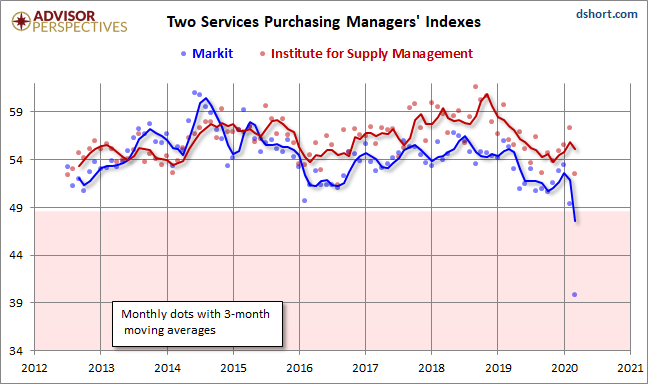
Both series weakened since 2015 and saw an uptick in the latter half of 2016. The interim three-month moving average of the Markit Services index peaked in August of 2014. The ISM index peaked in September of 2015. The two were fairly closely aligned at the beginning of 2016, but they diverged early with the Markit index signaling noticeably weaker growth.

Comments
Log in or sign up to join the conversation.