

The markets have remained volatile in March. The major U.S. equity benchmarks dropped about 10% from their peaks, with the exception of the Energy sector. The CBOE Volatility Index (VIX®), the so-called “fear gauge,” has been hovering above 30, which is the 90th percentile of its historical value. Its level on March 10, 2022, was more than two standard deviations above its one-year average. Although it remains unclear how long these geopolitical tensions will last and how much it will affect the global economy, the U.S. equity market has managed to stay cool so far, compared with the VIX levels seen two years ago, which were triggered by pandemic-driven sell-offs.

More importantly, historical data show that the equity markets may be more robust than we expect and tend to bounce back quickly after elevated volatility. We look at all the trading days on which VIX hit above 30 and calculate the S&P 500
®
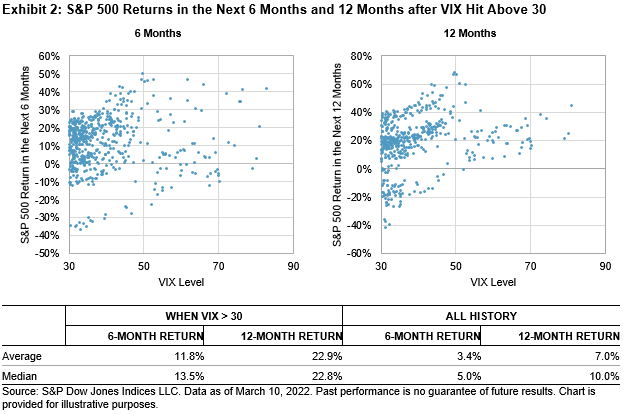
returns in the subsequent 6 months and 12 months. The scatter charts in Exhibit 2 show that the vast majority of these 557 days were followed by a positive return in the next 6 months (82%) and 12 months (88%).
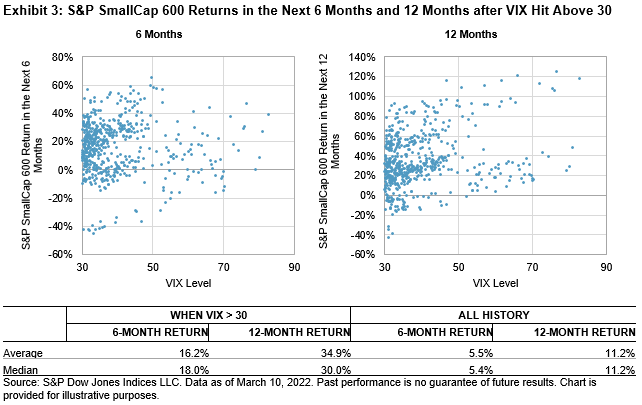
We further compare the 6- and 12-month returns after these highly volatile days with rolling returns on all historical days. On average, the 12-month return after VIX hit above 30 was two times higher than the 12-month rolling returns on any business day since Dec. 31, 1999. Similar results held in the small-cap space (see Exhibit 3).
In the coming weeks, the swings in U.S. equities could continue and test investors’ sentiment. Big problems remain and big opportunities emerge. Fasten your seat belts and stay cool.



Comments
Log in or sign up to join the conversation.