

Taking it all in stride – markets are waiting for the ECB and the Trump/Juncker trade discussion – with some hope for deals and so they are willing to move over the geopolitical fears that remain. The US President suggested the EU should drop all tariffs and trade barriers ahead of the talk while EU Malmstrom said they were read to levy $20bn tariffs on US goods, but hopes to find a solution.
The Italian President is trying to shield FinMin Tria – adding to political hopes there, while UK May is taking over the Brexit team and negotiations – increasing the probability for a soft Brexit. The US President also was open to a quick NAFTA deal with Mexico and even talks with Iran. Deal-making abounds, but you need to take this all in stride as the data overnight highlights the mix with German IFO lower but not as bad as feared, with UK CBI retail trends lower but not as bad as feared.
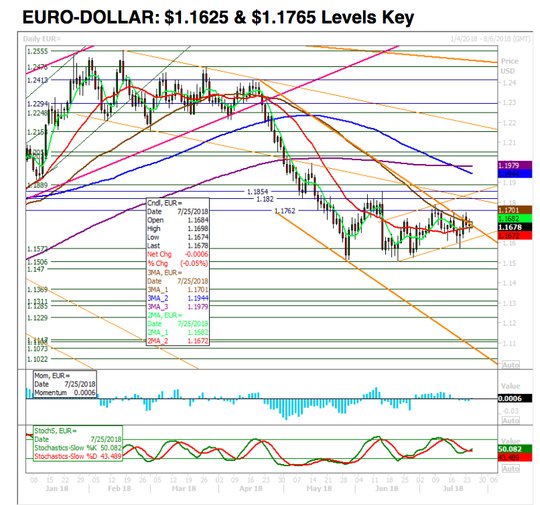
With PPI up in France and Spain but not fully fed into consumers while the opposite appears at play in the US after the Markit flash PMI. There is still an underlying fear about inflation knocking markets off-track but the deflation from Asia remains and the ongoing talks about China stimulus and BOJ tweaks matter. The days ahead seem to matter more than the present and that is clearly the problem as momentum stalls and ranges narrow with lower volumes – proving in summer that walking fast only makes for more sweat and less returns. Focus on risk today revolves around the EUR thanks to the EU talks and ECB tomorrow – leaving anything over 1.1770 or below 1.1620 interesting, otherwise keep walking (slowly.)
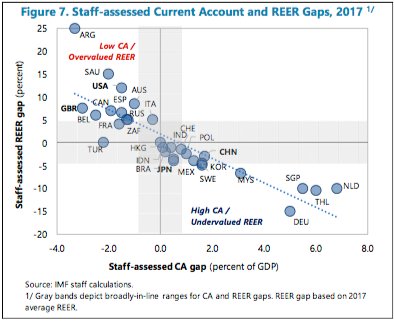
Question for the Day: Is the real problem Germany’s Current Account Surplus? The focus on the day is likely the US/EU trade discussion and the role of the USD/EUR should not be cast aside in this with many starting the year thinking the EUR should be 1.30 but for the rate differential. The IMF 2018 report on global imbalances came out last week and is worth highlighting today. Overall global current account surpluses and deficits remained broadly unchanged, at about 3¼ percent of world GDP in 2017, with growing concentration in advanced economies. About 40-50 percent of last year’s global current account balances were deemed excessive (that is, not explained by countries’ fundamentals and desirable policies). Higher-than-desirable balances prevailed in the euro area (driven by Germany and the Netherlands), other advanced economies (Korea, Singapore, Sweden), and China, with their contributions to excess global imbalances depending both on the size of their economies and their own imbalances. Lower-than-desirable balances remained concentrated in the United States, the United Kingdom, some euro area debtor countries, and a few vulnerable emerging market economies (Argentina, Turkey).
What Happened?
- New Zealand June trade balance –NZ$113mn after +NZ$208mn – worse than +NZ$175mn expected - biggest 12M deficit in 9 years at NZ$4bn. Both exports and imports rose to record highs for a June month. Exports rose 4.6% y/y to NZ$4.9 billion and imports rose 13% y/y to NZ$5.0 billion. Exports were led higher by a rise in meat - mainly lamb, fruit – mainly kiwifruit, petroleum and products, which offset a 25% fall in milk powder as volumes dropped. Imports rose mainly due to a 64% rise in petroleum and products, and a jump in fishing vessels. China remained New Zealand's top destination for exports, up 6.2% to NZ$1.1 billion.
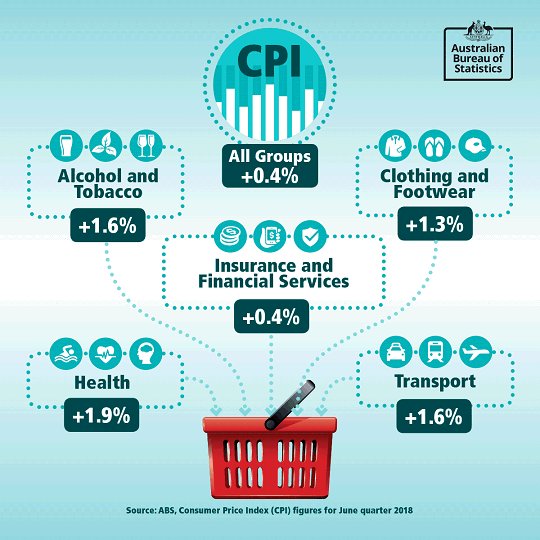
- Australian 2Q CPI 0.4% q/q, 2.1% y/y after 0.4% q/q, 1.9% y/y – less than 0.5% q/q, 2.2% y/y expected. The RBA trimmed mean CPI held 0.5% q/q, 1.9% y/y – as expected – leaves expectations for any hike from RBA low and late for 2019. The tradable inflation was 0.5% q/q, +0.3% y/y while non-tradable was up 0.3% q/q, 3% y/y. The underlying inflation was up 0.5% q/q, 1.9% y/y as expected – still below the 2%-3% target band.
- French June PPI up 0.1% m/m 3.4% y/y after 0.7% m/mm, - less than 0.3% m/m expected. Import prices +0.4% m/m, 4.6% y/y with oil products -1.5% m/m, +45.2% y/y. Manufacturing PPI -0.2% m/m, 3.3% y/y. Food/Tobacco prices -0.2% m/m, -0.3% y/y.
- Spanish June PPI up 1.0% m/m, +4.1% y/y after 3% y/y – more than 3.3% y/y expected. Energy goods rose 2.7% m/m, 12.1% y/y while intermediate goods rose 0.4% m/m, 3.3% y/y with capital goods 0% m/m, 0.8% y/y and consumer goods 0% m/m, -0.5% y/y.
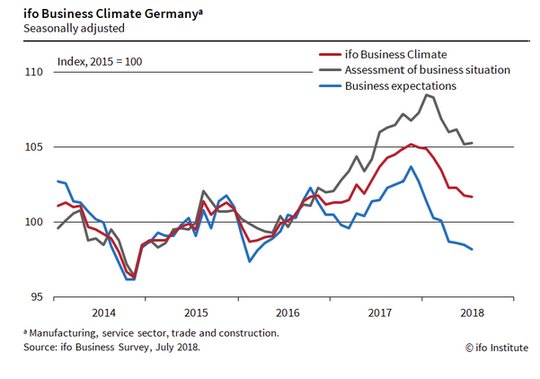
- German July IFO business climate 101.7 from 101.8 – better than 101.5 expected. The current conditions rose to 105.3 from revised 105.2 – also better than 104.8 expected. The future expectations fell to 98.2 from 98.5 – near forecasts. The IFO Business Climate deteriorated marginally this month. The index fell to 101.7 points in July from 101.8 points in June. Companies were slightly more satisfied with their current business situation, but scaled back their business expectations slightly. The German economy continues to expand, but at a slower pace. In manufacturing, the index fell for the sixth consecutive month due to far poorer assessments of the current business situation. The indicator nevertheless remains significantly above its long-term average. Manufacturers’ business expectations, by contrast, remained slightly optimistic. Demand picked up, but at a slower pace than last month. Capacity utilization was unchanged at 87.7 percent.
- ECB June M3 4.4% from 4% - more than 4% expected. The private loans were steady at 2.9% - less than the 3% expected – while loans to non-financials rose to 4.1% form 3.7%.
- UK July CBI retail trade 20% from 32% - better than 15% expected. Sales for August expected 0% from 18%. The volume of orders -8 from +20 while August expected orders -3 from +11.
Market Recap:
Equities: The US S&P500 futures are off 0.11% after gaining 0.48% yesterday. The Stoxx Europe 600 is off 0.3% after trading up 0.1% at the open – with earnings and US trade talks driving – while the MSCI Asia Pacific index rose 0.2% despite profit taking in China.
- Japan Nikkei up 0.46% to 22,614.25
- Korea Kospi off 0.31% to 2,273.03
- Hong Kong Hang Seng up 0.90% to 28,920.90
- China Shanghai Composite off 0.04% to 2,904.37
- Australia ASX off 0.21% to 6,341.70
- India NSE50 off 0.02% to 11,132.00
- UK FTSE so far off 0.7% to 7,656
- German DAX so far off 0.25% to 12,656
- French CAC40 so far flat at 6,432
- Italian FTSE so far-off 0.45% to 21,778
Fixed Income: Bonds were bid overnight with focus on ECB/Trade and US GDP next – leaving low volumes, tighter ranges. Failed German 5Y sale ignored, but US sale will be watched closely today. Core bonds slightly bid – UK Gilt 10Y yields off 0.2bps to 1.272%, German Bunds off 0.5bps to 0.385%, French OATs off 1.2bps to 0.685%. The periphery recovers a touch with Italy off 3.5bps to 2.64%, Spain off 2.5bps to 1.34% and Portugal off 4.5bps to 1.717%, while Greece off 3.5bps to 3.785%.
- Germany sold E3.201bn of 5Y 0% Oct 2023 Bobl at -0.18% with 0.91 cover – after Bundesbank holdings 1.1.The target was an E4bn sale.
- US Bonds are bid with bull flattening after mixed risk overnight – 2Y flat at 2.645%, 5Y off 0.5bps to 2.815% - with focus on supply – 10Y off 0.6bps to 2.943%, 10Y off 0.8bps to 3.068%.
- Japan JGBs rally after BOJ buying – 10Y off 2bps to 0.065%, 20Y off 3.5bps to 0.56%.BOJ keeps its buying of 5-10Y, 10-25Y and 25+ unchanged – but investors wanted to keep their bonds – with offers to sell 1.84 down from 4.19 in the 25Y+ bucket – the lowest since Feb 2016. 2Y sale tomorrow next focus.
- Australian bonds rally on benign CPI, renewed China doubts – 3Y off 4bps to 2.11%, 10Y off 4bps to 2.68%.
- China PBOC skips open market operations, net drains CNY60bn on the day. Money market rates mixed again – 7-day up 3bps to 2.656%, O/N off 0.5bps to 2.562%. 10Y bond yields off 2bps to 2.545%.
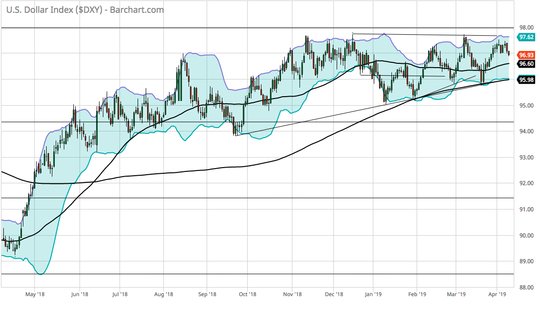
Foreign Exchange: The US dollar index off 0.1% to 94.50 – still watching 93.71 and 95.52 with 94.95 the pivot. In Asia EM FX, USD lower – TWD up 0.3% to 30.63 – biggest gains since July 9. KRW up 0.8% to 1126 – linked to Kospi rally. INR up 0.25% to 68.781.In EMEA, USD offered as well: RUB up 0.5% to 62.944, ZAR up 0.2% to 13.246 and TRY 4.8670 up 0.3% - holding steady after big CB disappointment and 3% hit yesterday.
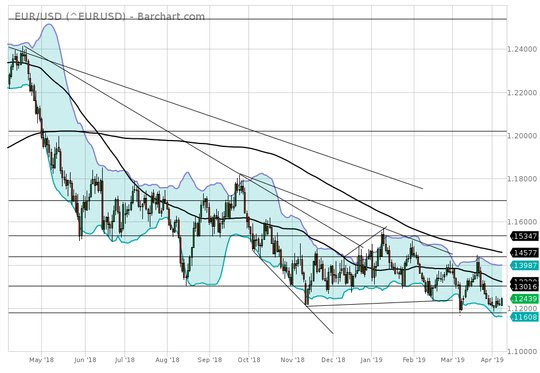
- EUR: 1.1695 up 0.1%. Range 1.1676-1.1705 with focus on ECB and US/EU trade talks stuck with 1.1650-1.1740 interesting.
- JPY: 111.05 off 0.1%. Range 111.04-111.38 with EUR/JPY 129.85 flat. Talk about BOJ continues but the focus is on US rates/equity risk mood. 110.50 or 112 key.
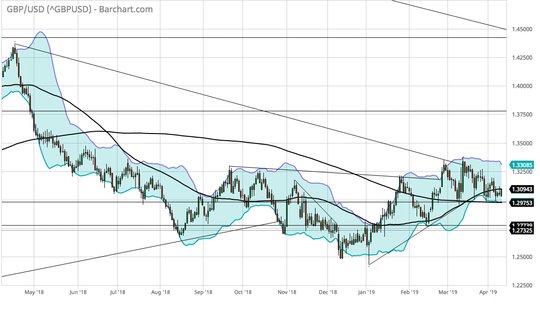
- GBP: 1.3160 up 0.1%. Range 1.3138-1.3174 with EUR/GBP .8885 flat. Dull with UK May winning the summer but expected to lose the Autumn.
- AUD: .7415 off 0.1%. Range .7392-.7449 with NZD .6810 up 0.1%. All about CPI and then China with .7350-.7480 holding still. NZD ignores trade watching crosses.
- CAD: 1.3125 off 0.25%. Range 1.3120-1.3166 with NAFTA hopes back up and mixed oil with a focus on rates.
- CHF: .9920 off 0.15%. Range .9908-.9947 with EUR/CHF 1.1600 off 0.1% - watching EU/US trade and ECB like rest of G4.
- CNY: 6.8040 fixed 0.22% weaker from 6.7891. The focus is on the 6.8446 level yesterday’s USD high. Trades calmer 6.7586-6.8087 range now 6.7655 up 0.4%. CNH 6.7750 up 0.4% as well.
Commodities: Oil mixed, Gold up, Copper off 0.35% to $2.8290.
- Oil: $68.41 off 0.15%. Range $68.33-$68.93. WTI watching $69.31 Monday highs then $70 pivot against $67.20 and $66.40 100-day base. Brent $73.78 up 0.45%, watching $74.61 and $75.26 July 16 highs next with $72.78 Monday low as support.
- Gold: $1231 up 0.5%. Range $1224-$1232. Still stuck in broad range with $1211.40 July 19 lows against $1238 Jul 3 lows, still tracking USD/risk mood – with Silver up 0.7% to $15.574, Platinum up 0.95% to $841.15, Palladium up 1.8% to $931.60.
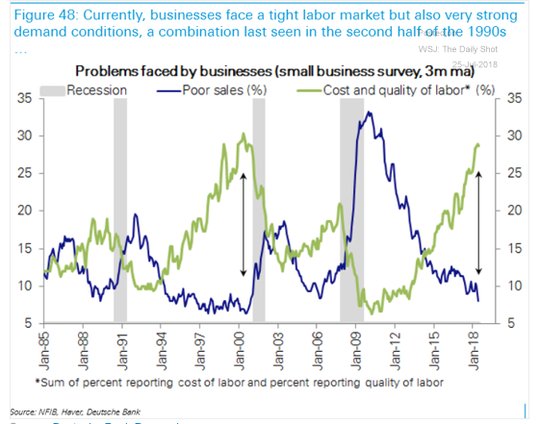
Conclusions: Is inflation being passed-through to consumers? The 2Q earnings are in full swing and beating expectations with profit margins strong even with higher energy, more FX noise. The lesson is that there is a pass-through of costs going on. The Richmond Fed Manufacturing index records this data and its release yesterday highlights the point.The IHS US flash PMI report had a similar outcome. The key problem for the US in this pass-through is that wages aren’t yet going up fast enough to support this increase forever.
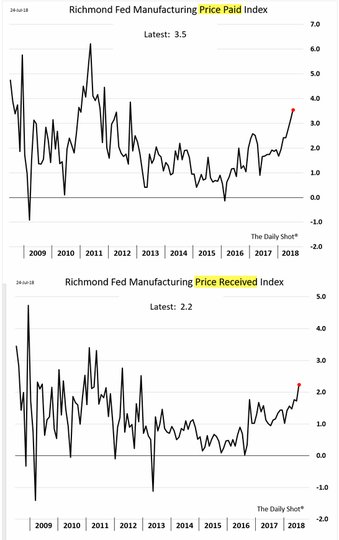
Point is that inflation pressures are being passed on to consumers and that means the FOMC will have higher CPI to watch in the months ahead. The implication being that even though Trump wants the Fed to slow its hikes, the tariffs and the stimulus from tax reform are driving up prices to force a central bank reaction. The only brake against the present evidence is in future expectations which are gloomy thanks to trade and costs – this is the animal spirits that matter and maybe important in Autumn but unlikely to matter now.
Economic Calendar:
- 1000 am US June new home sales 6.7%p -2.8%e / 0.689mn p 0.670mn e
- 1030 am US weekly EIA crude oil inventories +5.836mb p -3.461mb e
- 0100 pm US 5Y $35bn note sale
Comments
Log in or sign up to join the conversation.