

The world isn’t flat but it’s easy to look at pictures and think its true. The lesson being that where you observe things matters to how you interpret them. If you look at macro – nothing happened today – if you look at stocks there was a modest take-profit shift driving more risk-off than the recent risk-on as we trade at 2900 S&P500 – with big number rules in play. Flat isn’t quite the right word to describe the mood but its clearly the US focus with an obsession about the shape of the yield curve and what it forecasts for US growth and policy dominating another slow news day. Here are a few non-economic headlines that mattered today:
- The Canadian Globe and Mail said Trudeau was ready to make dairy concessions to get a NAFTA deal. CAD remains on a tear stronger with 1.25 targets and positions long USD vulnerable.
- Australian Westpac Bank hikes mortgage rates – first big lender to act. They move rates up 0.14% with variable rate mortgages now 5.38%. The move by Westpac follows interest rate hikes from more than a dozen smaller banks in recent months. Australian government bonds rallied on the story and sent A$ lower.
- Turkish central bank doubles banks overnight borrowing limits – TRY trades off again down 3% with 6.20 now key USD support and 6.50 pivotal. The market support for TRY rests on WSJ story of Germany considering offering Turkey financial aid, while the action of the CBRT smacks of desperation.
- UK and EU officials see mid-Novemberas new deal deadlinefor Brexit. A November deadline would imply the EU calling an emergency EU summit during that month, though an EU official said there was no firm plan to do so yet. Leaders are due to discuss Brexit at a summit in Salzburg in the middle of September and then again at the October meeting in Brussels. Net effect has been GBP is doing better as talks seem to be in earnest.
What is notable for equities is the return of CNY correlations to stocks. The 6.80-6.90 range in USD/CNY holds and that means that other stories matter as above. CNY weakness was related to trade fears and growth doubts in China, which haven’t changed, but the Beijing attitude to FX and the squeeze in month-end rates maybe has. Overnight economic stories were weaker with Japan Consumer Confidence at 1-year lows, French Consumer Spending weaker than expected. There isn’t much to trade on until the US opens with the USD weakness and “goldilocks” arguments needing something else to boost confidence. Focus remains on the big shift in thinking about the non-threat of Turmp tariffs – a bluster for more bilateral deals. The US-Mexico trade deal as a global tailwind puts MXN into the spotlight again for all EM risk plays. CAD is in a catch-up mode and the MXN/CAD spread clearly is worth watching today.
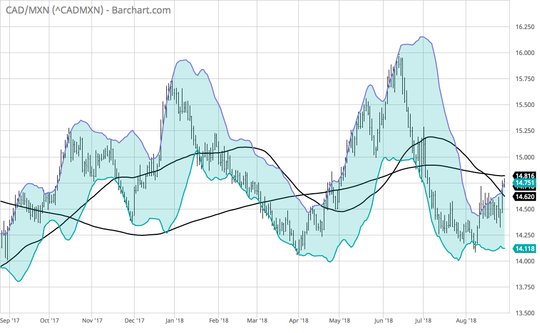
A rip higher over 15 may be in play
Question for the Day: Is the market underpricing the Fed? There are two ways to measure the thinking about the FOMC future rate hikes – first is the futures markets and their predictions of the path against the FOMC dot plots. Second is the path of the USD where many see the shape of the curve as state of the art modeling for directions on EUR/USD and other key currencies.
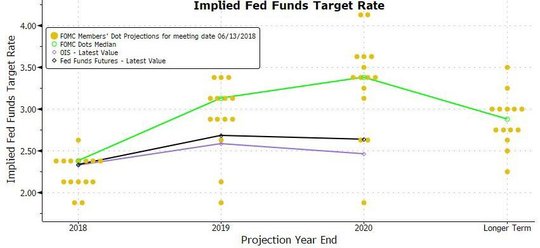
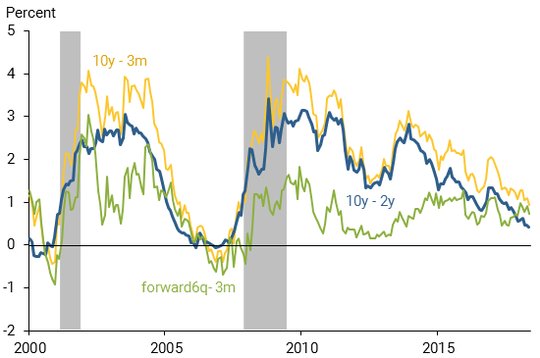
The news coverage about the flattening US yield curve and its implications for a US recession remain in play today. US Treasury Mnuchin yesterday noted it’s a correlation not a cause of economic events. Confusing causality with correlations isn’t new and its common for markets. Umbrellas don’t cause showers, but they maybe a good indicator of rain. Throw in the pesky problem of the term-premium and the role of other central bankers QE and zero rates making US bonds attractive and you have a healthy debate. The San Francisco Fed Economic Letter on the information of the yield curve is required reading on this topic. This is part of their conclusion: The yield curve has been a reliable predictor of recessions, and the best summary measure is the spread between the ten-year and three-month yields. Although this particular spread has narrowed recently like most other measures, it is still a comfortable distance from a yield curve inversion. In this Letter, we do not find an empirical basis for adjustments based on the term premium, especially in light of uncertainties about the possible effects of quantitative easing.
What Happened?
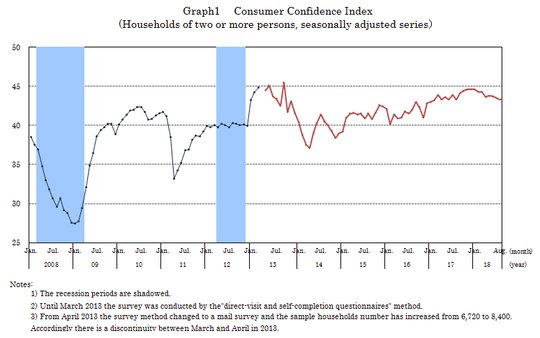
- Japan August Consumer Confidence 43.3 from 43.5 – weaker than 43.7 expected– 12-month lows. The government downgrades its view view. The sub-index for income growth fell to 41.8 in August from 42.2 in the previous month. Similarly, the component index for employment decreased from 48.0 to 47.7. The gauge measuring willingness to buy durable goods worsened to 42.0 from 42.2, while the index for overall livelihood rose to 41.7 from 41.6. Price expectations rose with 12M forward – those who expect “go down” drops 0.3% and “go up” rises 0.1%.
- BOJ Suzuki: Warns on runaway easing costs. He highlights the effect of easing on the functioning of bond market and financial institutions. In a speech to business leaders in Naha, southwestern Japan, Suzuki said, "As for the conduct of monetary policy, we have to keep a close eye on medium- to long-term effects and side-effects. We must pay a full attention to the risk that it would be difficult to cope with the situation well or too late to act if the accumulated side-effects materialize sometime in the future."
- German September GfK Consumer Confidence seen at 10.5 from 10.6 – weaker than 10.6 expected. While economic expectations improved, income expectations and the propensity to buy declined a bit. GfK forecasts a slight decrease in consumer climate for September accordingly.
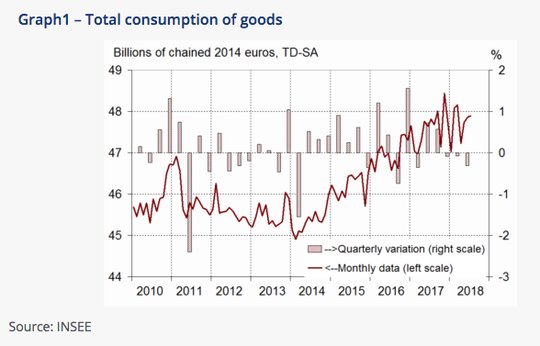
- French July Consumer Goods Spending up 0.1% m/m, 0.2% y/y after 0.3% m/m – weaker than 0.5% m/m expected. June revised higher from 0.1% m/m. Autos were up 0.1% after -0.5% m/m, while durable goods were -0.3% after 0.6% m/m and household goods were -0.8% after +2.3% m/m.
- French 2Q GDP unrevised at 0.2% q/q, 1.7% y/y – as expected. Household consumption unchanged at -0.1% q/q, business capex revised higher to 1.3% from 1.1% q/q, foreign trade cuts 0.3pp from GDP with exports revised to up 0.2% from 0.6% and imports revised to 1% from 1.7% q/q, while inventories add 0.2pp. Domestic demand ex-stocks adds 0.2pp to GDP.
Market Recap:
Equities: The S&P500 futures are up 0.03% after a 0.3% gain yesterday. The Stoxx Europe 600 is up 0.1% reversing from early -0.1%, while the MSCI Asia Pacific was up 0.15% with China and India lagging.
- Japan Nikkei up 0.15% to 22,848.22
- Korea Kospi up 0.26% to 2,309.03
- Hong Kong Hang Seng up 0.23% to 28,416.44
- China Shanghai Composite off 0.31% to 2,769.30
- Australia ASX up 0.68% to 6,457
- India NSE50 off 0.40% to 11,691.90
- UK FTSE so far off 0.4% to 7,587
- German DAX so far up 0.1% to 12,538
- French CAC40 so far up 0.15% to 5,493
- Italian FTSE so far flat at 20,625
Fixed Income: Another day with focus in Europe on BTPs with 2Y flipping from 1.265% back to 1.205% in morning session. Risk flip in equities and auctions driving with German 10-year Bund yields up 1.5bps to 0.39%, French OATS up 1bps to 0.725%, UK Gilts up 1.5bps to 1.465% while periphery mixed with Spain off 0.5bps to 1.445%, Italy off 2bps to 3.16%, Portugal up 1bps to 1.87% and Greece up 3.5bps to 4.145%.
- Italy sold E6bn of new 6M Feb 28, 2019 bills at 0.428% with 1.87 cover.
- Germany sold E3bn of 5Y Oct 2023 Bobl at -0.18% with 1.67 cover– previously -0.18% with 0.91 cover.
- US Bonds see bull curve flattening, moderated in Europe into supply and US data – 2Y up 0.5bps to 2.67%, 5Y off 0.2bps to 2.77%, 10Y off 0.2bps to 2.879% and 30Y off 0.2bps to 3.029%.
- Japan JGBs holding tight ranges again, curve slightly steeper– BOJ left buying in 10-25Y Rinban unchanged – cover ratios were 10-25Y 3.47 from 3.72, 25Y plus 3.69 from 2.60. Focus shifts to 2Y sale tomorrow - 2Y flat at -0.126%, 5Y flat at -0.085%, 10Y up 0.1bps at 0.089%, 30Y up 0.1bps to 0.831%.
- Australian bonds bought on Westpac mortgage move– 3Y off 3bps to 1.995%, 10Y off 1.1ps to 2.545%. AOFM sold A$1bn of 11Y 2.75% Nov 2029 bonds TB154 at 2.6052% with 2.695 cover – previously 2.7136% with 2.878 cover.
- China PBOC skips open market operations, leaves liquidity neutral on the day. The money market rates fell with O/N off 2bps to 2.377% and 7-day flat at 2.633%. 10Y bond yields were flat at 3.61%.
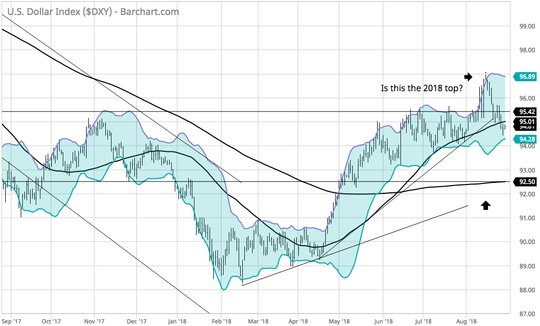
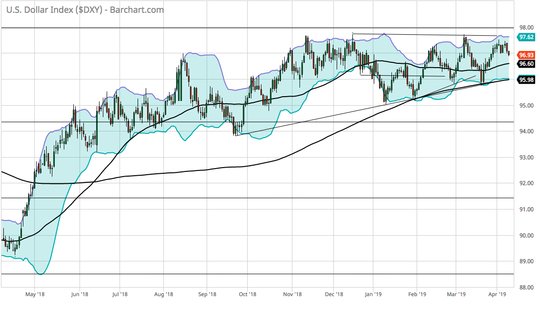
Foreign Exchange: The US dollar index is up 0.2% to 94.84 with focus on 94.40 and 94.95 range with 95.10-95.52 further hurdles to any rally. In EM, USD is mostly bid– EMEA: TRY off 3% to 6.45, ZAR off 1.1% to 14.38, RUB off 0.3% to 68.07; ASIA:INR off 0.7% to 70.59, KRW flat at 1110.25 with 1117 key for $ upside. TWD flat at 30.705.
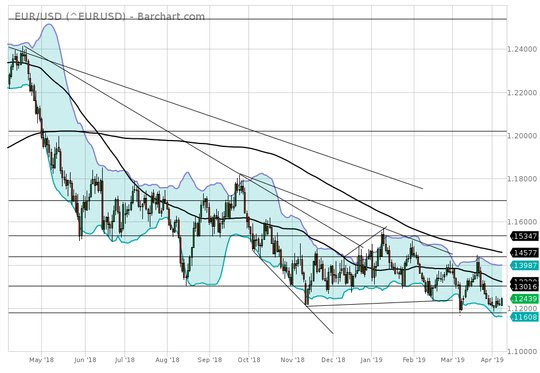
- EUR: 1.1660 off 0.3%. Range 1.1652-1.1698 with 1.1720 capping rally opens test for 1.16 support – rates, Turkey back in focus.
- JPY: 111.20 flat. Range 111.12-111.32 with EUR/JPY off 0.25% to 129.70 with 130.50 resistance. Equities holding vs. rates and trade stories.
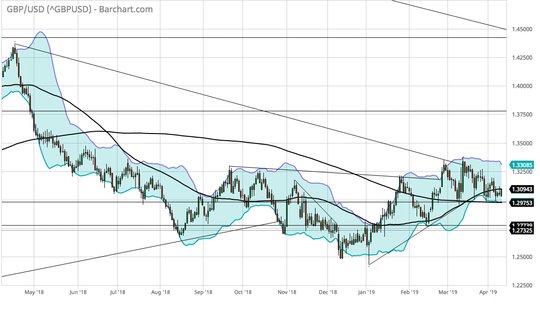
- GBP: 1.2890 up 0.1%. Range 1.2846-1.2902 with EUR/GBP off 0.4% to .9045 with .91 resistance holding – focus is on Brexit and politics 1.2750-1.3050 consolidation.
- AUD: .7300 off 0.55%. Range .7298-.7349 with Westpac mortgage hike driving. NZD off 0.15% to .6700 with focus on .6640 base against .6770.
- CAD: 1.2940 up 0.1%. Range 1.2903-1.2944 with NAFTA focus key and 1.2880 pivotal against 1.30 again.
- CHF: .9770 flat. Range .9757-.9776 with EUR/CHF 1.1390 off 0.25% - focus is back on Turkey and Italy as key with .9750 pivot for .97 and .9550.
- CNY: 6.8072 fixed 0.03% weaker from 6.8052, trades weaker into London at 6.82 from 6.8070 official close, now 6.8280 off 0.35% with 6.8026-6.8293 range.
Commodities: Oil up, Gold down, Copper off 0.8% to $2.7455.
- Oil: $68.73 up 0.3%. Range $68.37-$68.80. WTI watching $69.19 July 30 highs against $66.50 base. Modest uptick in API inventory of crude kept market soft in Asia. WSJ story on Iranian oil shipments declining counters along with talk of Mexico’s Pemex dropping IEA and forging closer OPEC ties. Brent up 0.1% to $76.05.
- Gold: $$1205 off 0.2%. Range $1201-$1205. Gold rally fizzles as USD returns bid with $1201.60 and $12000 key support against $1217 resistance. Silver stuck with $15 now key resistance and $14.483 Aug 23 as base.
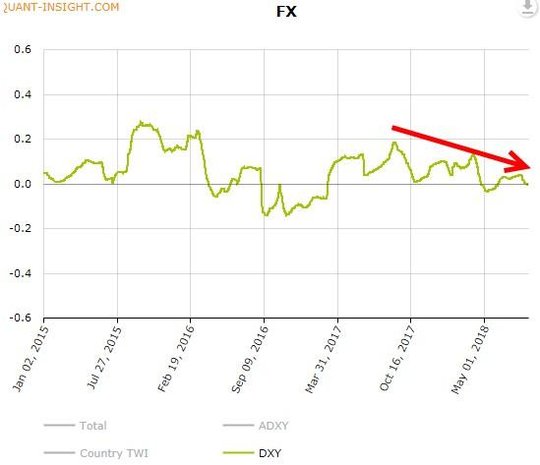
Conclusions: Does the USD matter to stocks anymore? The relationship of CNY to EM and global shares seems to be back in play from August 13 when the CNY bottomed out just ahead of 7.00 again. This turn-about maybe more important than the dollar index watching that many have been using for stocks. The role of the USD to the S&P500 is clearing changing and its important to recognize that point Quant-insight hightlights.
Economic Calendar:
- 0830 am US 2Q GDP revised 4.1%p 4%e / core Personal Cons Expenditures 2%p 2%e
- 0830 am Canada 2Q Current Account Deficit C$19.5bn p C$18.0bn e
- 1000 am US July pending home sales (m/m) 0.9%P 0.4%e (y/y) -2.5%p -6%e
- 1030 am US weekly EIA oil inventories -5.83mb p -1.4mb e
- 0100 pm US sells 7Y notes
Comments
Log in or sign up to join the conversation.